Understanding the Role of Private Equity and Why Hands-On Ownership Still Matters
Over the past decade, private equity has become increasingly visible across service-based industries, from healthcare and construction to home services and residential property care. Landscape design and maintenance firms are no exception. For homeowners who follow industry trends or have worked with multiple providers, this shift has raised understandable questions about ownership, service models, and what those changes mean at the property level.
This article is not an argument against private equity. Instead, it is an honest look at how different ownership structures influence business decisions, client experience, and long-term care. As a locally owned landscape design firm, we believe transparency matters. Understanding these differences helps homeowners make informed choices and better understand why a Blade of Grass has chosen to remain privately owned.
Key Takeaways
- Private equity has become more common in landscape services, offering scale and efficiency while introducing different tradeoffs at the property level.
- Ownership structure influences design flexibility, responsiveness, and how site-specific decisions are made.
- Hands-on, local ownership keeps leadership close to the work, supporting thoughtful design and long-term care.
- A locally owned model benefits both clients and employees through continuity, accountability, and stability.
The Rise of Private Equity in Landscape and Home Services
Private equity investment in home services has accelerated as firms seek industries with recurring revenue, fragmented ownership, and long-term demand. Landscaping, lawn care, and outdoor maintenance naturally fit that profile. Properties require ongoing care, services are essential rather than discretionary, and many successful firms were historically owner-operated and regionally focused.
According to Bain & Company’s Global Private Equity Report, services and infrastructure-adjacent businesses have remained a consistent target for investment due to predictable cash flow and scalability. Industry reports show that landscaping services rollups continue to attract major private equity players, with PitchBook data documenting acquisition activity in residential and commercial landscaping services.
For clients, these trends often become visible when familiar local firms change names, expand rapidly, or adjust how services are delivered.
What Private Equity Ownership Can Offer
Private equity ownership is not inherently negative. In many cases, it brings meaningful advantages, particularly for firms operating at scale or managing large portfolios. Increased access to capital can support investments in equipment, technology, training, and systems that improve operational efficiency. Standardized processes can create consistency across multiple locations, and geographic expansion can make bundled services more accessible.
For certain clients and project types, these strengths are valuable. PE-backed firms often perform well where uniformity, volume, and efficiency are the primary objectives. Acknowledging these benefits is important. The differences between ownership models are less about right versus wrong and more about alignment with client expectations.
Where Tradeoffs Can Appear at the Property Level
Ownership structure plays a meaningful role in how decisions are made, particularly in service-driven businesses. As organizations grow, there is often a natural shift toward efficiency, consistency, and standardized ways of operating.
At the property level, this can influence how flexible design decisions are, how much discretion teams have to adjust in real time, and how quickly input from the field turns into action. As leadership becomes further removed from day-to-day work, continuity and responsiveness can change.
This does not mean quality disappears, but the focus can evolve. Residential landscapes are not interchangeable. Each property presents its own mix of soil conditions, drainage patterns, microclimates, architectural context, and long-term use. Addressing those variables effectively depends on judgment and attention to detail, not process alone.
Why Local Ownership Still Plays an Important Role
For a Blade of Grass, remaining locally owned is not about resisting change. It is about preserving the ability to make informed decisions close to the work itself.
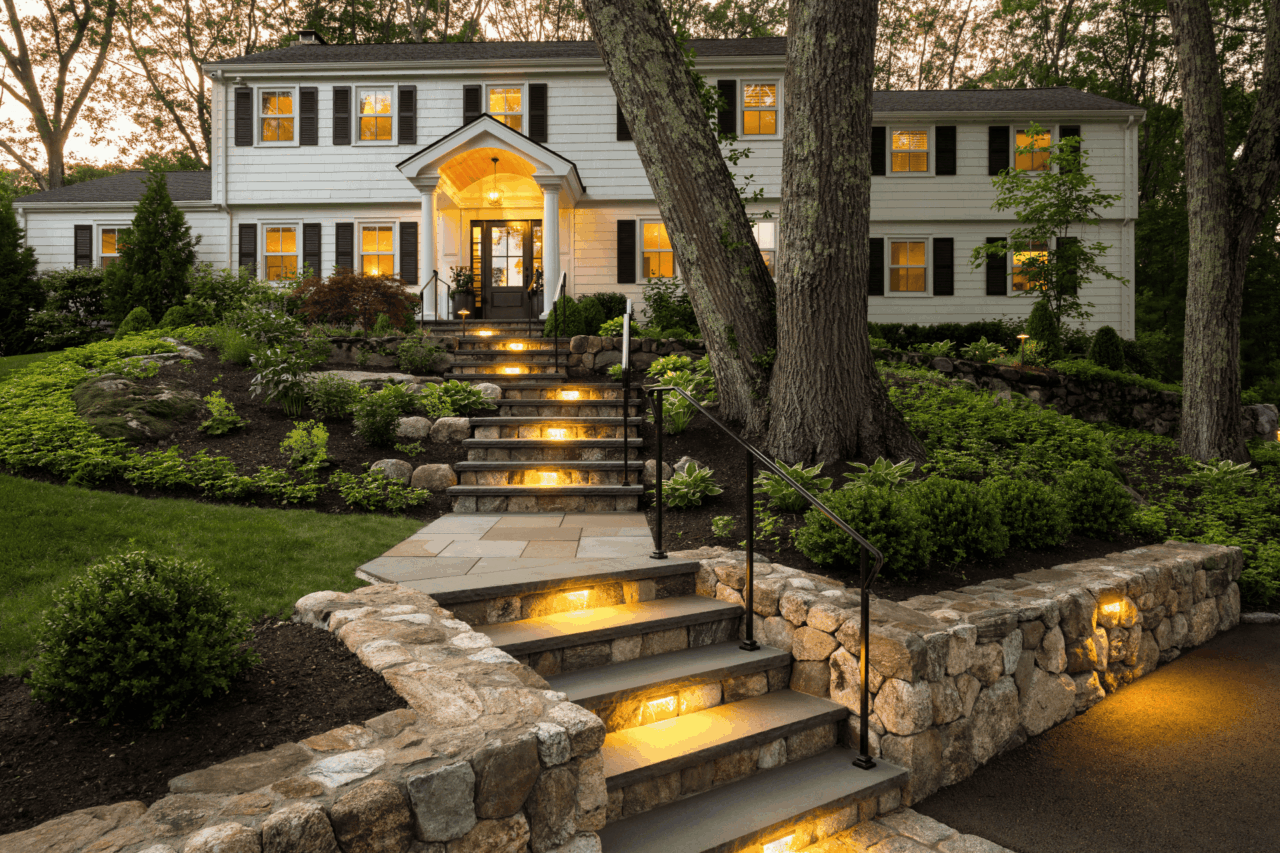
Hands-on ownership allows leadership to remain directly involved in design review, quality control, and long-term planning. Decisions can be made quickly without multiple layers of approval, and design intent can be protected throughout installation and ongoing care. Local familiarity with New England soils, climate patterns, regulations, and architectural context further supports better outcomes at the property level.
Local ownership does not mean limited ambition. It reflects a commitment to intentional growth, thoughtful project selection, and maintaining standards that serve both the landscape and the client.
Design Quality Versus Operational Efficiency
Efficiency matters in any well-run business, but in landscape design, efficiency should support quality rather than replace it. Many design decisions occur in real time, once soil conditions are exposed, drainage patterns are confirmed, or light and views are fully understood.
These moments require experience, discretion, and authority on site. Highly standardized systems can struggle to accommodate the nuance that residential landscapes demand. The American Society of Landscape Architects reinforces this point, noting that successful residential landscapes rely on site-specific planning rather than templates
Relationships, Continuity, and Long-Term Care
Landscapes evolve over time. Trees mature, planting strategies shift, and how homeowners use their outdoor space changes with seasons and life stages. Long-term success often depends on continuity rather than isolated projects.
Local ownership supports enduring client relationships, consistent teams familiar with the property, and a design philosophy that carries through maintenance and seasonal care. When the same people remain involved year after year, landscapes benefit from accumulated knowledge and context that cannot be replicated through handoffs or systemization alone.
The Bigger Picture: The Future of Private Equity
Private equity will continue to play a role across many industries, including landscape services. That trajectory is unlikely to reverse, but it is also unlikely to accelerate indefinitely.
Economic cycles, interest rates, labor availability, and increased scrutiny around consolidation are already influencing how and where investment occurs. While private equity involvement will likely remain an upward trend overall, many analysts expect it to level off and affect some industries more than others.
Service sectors that depend heavily on craftsmanship, local expertise, and long-term relationships may experience consolidation differently than highly transactional industries. For homeowners, this creates clearer distinctions between providers and business models, making it easier to choose an approach that aligns with their expectations.
Why Private Ownership Is Also Better for Our Team
Remaining privately owned is not only a client-facing decision. It is also a decision about the kind of workplace we want to build.
Local ownership supports greater stability during economic cycles, clearer career paths grounded in skill and experience, and the flexibility to make decisions based on real conditions in the field. When leadership is present and accessible, teams feel empowered rather than managed from a distance.
We believe this environment produces better outcomes for both employees and clients. Stable teams build stronger relationships, take greater pride in their work, and bring continuity to the properties they care for.
Choosing What Aligns With Your Property and Priorities
There is no single ownership model that fits every client or every project. PE-backed firms, locally owned companies, and hybrid structures all have a place in today’s landscape industry.
What matters most is understanding how decisions are made, who is accountable for outcomes, and how quality is defined and protected. For a Blade of Grass, remaining locally owned is a deliberate choice that allows us to stay design-driven, client-focused, and closely connected to the landscapes we create and maintain.
In Summary
Private equity has reshaped the landscape industry, bringing both opportunity and complexity. By remaining privately owned, we are choosing a path that prioritizes hands-on leadership, long-term relationships, and site-specific design.
For clients who value thoughtful planning, continuity, and accountability, local ownership remains a meaningful differentiator.