Hostas are so familiar in New England gardens that it is easy to think of them as one plant.
They are not.
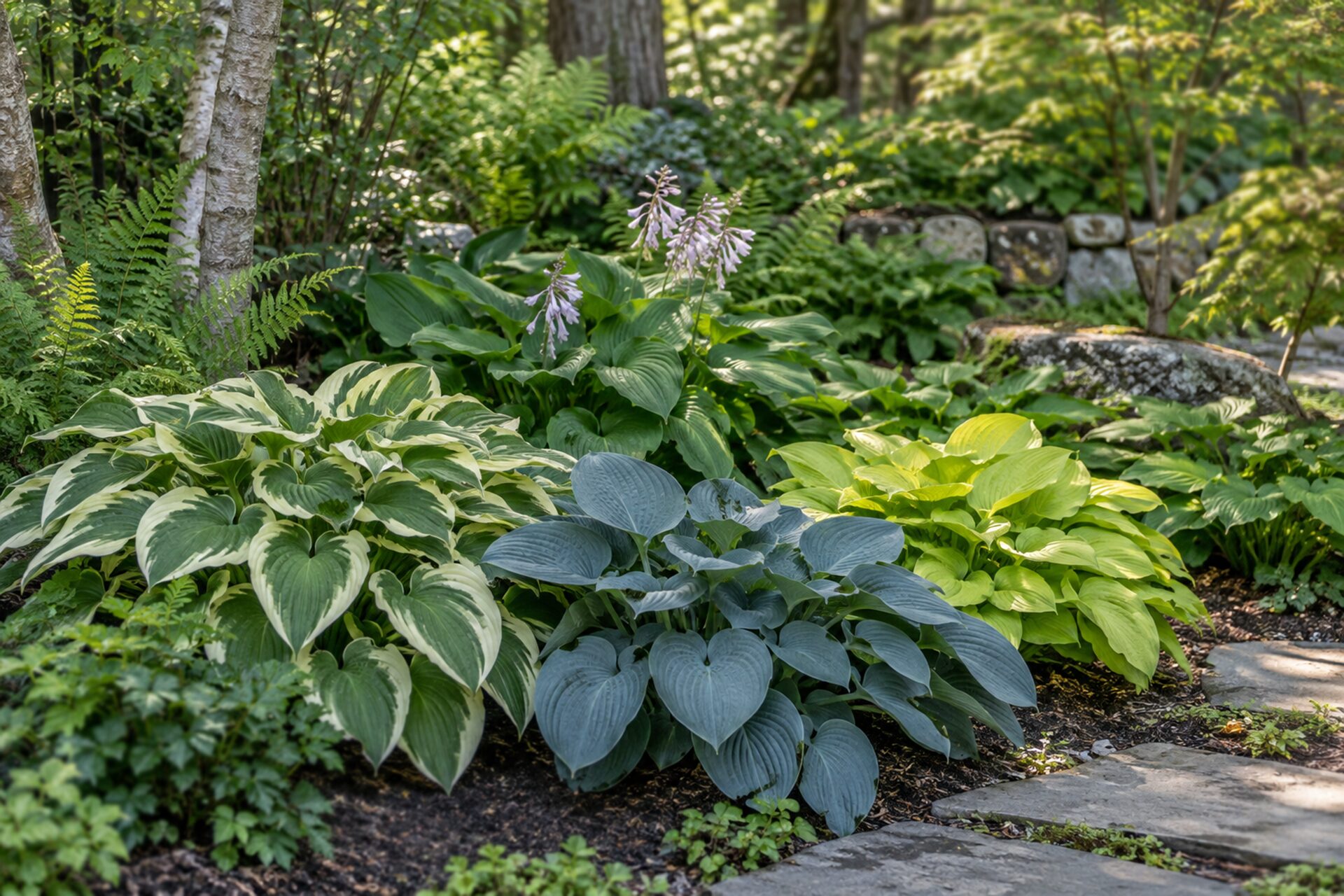
A hosta can be a compact mound tucked along the edge of a shaded path, a broad blue-green mass beneath mature trees, or a substantial foliage specimen several feet across. Leaves may be smooth or deeply corrugated, nearly round or narrow and pointed, solid green, blue, chartreuse, gold, or variegated.
That range is part of what makes hostas so useful in landscape design.
In a shaded garden, where flowers may be less abundant or shorter-lived than they are in full sun, foliage has to do more of the work. Hostas can provide mass, repetition, contrast, and growing-season structure while pairing naturally with finer-textured plants such as ferns and sedges.
But familiar does not mean foolproof.
A hosta planted beneath a mature tree may technically be growing in shade while also competing with established roots for every available drop of moisture. A large cultivar squeezed beside a walkway can eventually occupy much more space than expected. And on a property with heavy deer pressure, hostas may simply be an unrealistic choice.
So the useful question is not whether hostas grow in Massachusetts. They do.
The better question is which hosta belongs in the space, and what do we want it to contribute to the larger planting?
Hostas at a Glance
- Botanical name: Hosta spp. and hybrids
- Plant type: Herbaceous perennial
- Mature size: Extremely cultivar-dependent, from compact plants under a foot wide to specimens several feet across
- Light: Generally part shade to shade; tolerance varies by cultivar
- Soil / moisture: Prefers fertile, moisture-retentive but well-drained soil
- Bloom season: Primarily summer
- Flowers: White, lavender, or purple depending on the cultivar; some are fragrant
- Primary ornamental value: Foliage
- Native status: Not native to North America; the genus originates in East Asia
- Deer resistance: Poor; hostas are frequently browsed
- Best landscape uses: Shade borders, mass plantings, woodland-style gardens, path edges, perennial layers, and foliage specimens
Why We Use Hostas in Massachusetts Shade Gardens
Hostas are sometimes treated as plants you use when nothing else will grow in shade. We think that undersells them.
Their real value is foliage.
A flowering perennial may have two or three particularly good weeks. Hosta foliage can influence the composition for most of the growing season. Broad leaves create visual weight. Blue-green foliage can cool down a planting. Chartreuse or gold can brighten a darker area. Variegated leaves introduce contrast without depending on flowers.
Size matters just as much.
Some hostas stay compact enough to repeat along an edge. Others create substantial mounds that can visually balance shrubs, stone walls, steps, or other larger elements. Upright forms can introduce a very different shape from the familiar rounded hosta mound.
That variety gives designers a remarkably flexible foliage palette.
The challenge is using that variety deliberately. A collection of six unrelated hostas may contain beautiful individual plants while still producing a scattered-looking garden. We usually get more from hostas when their size, color, and form are selected in response to what the rest of the planting needs.
What Do Hostas Look Like Through the Seasons?
Hostas have a long growing-season presence, but they are not four-season plants.
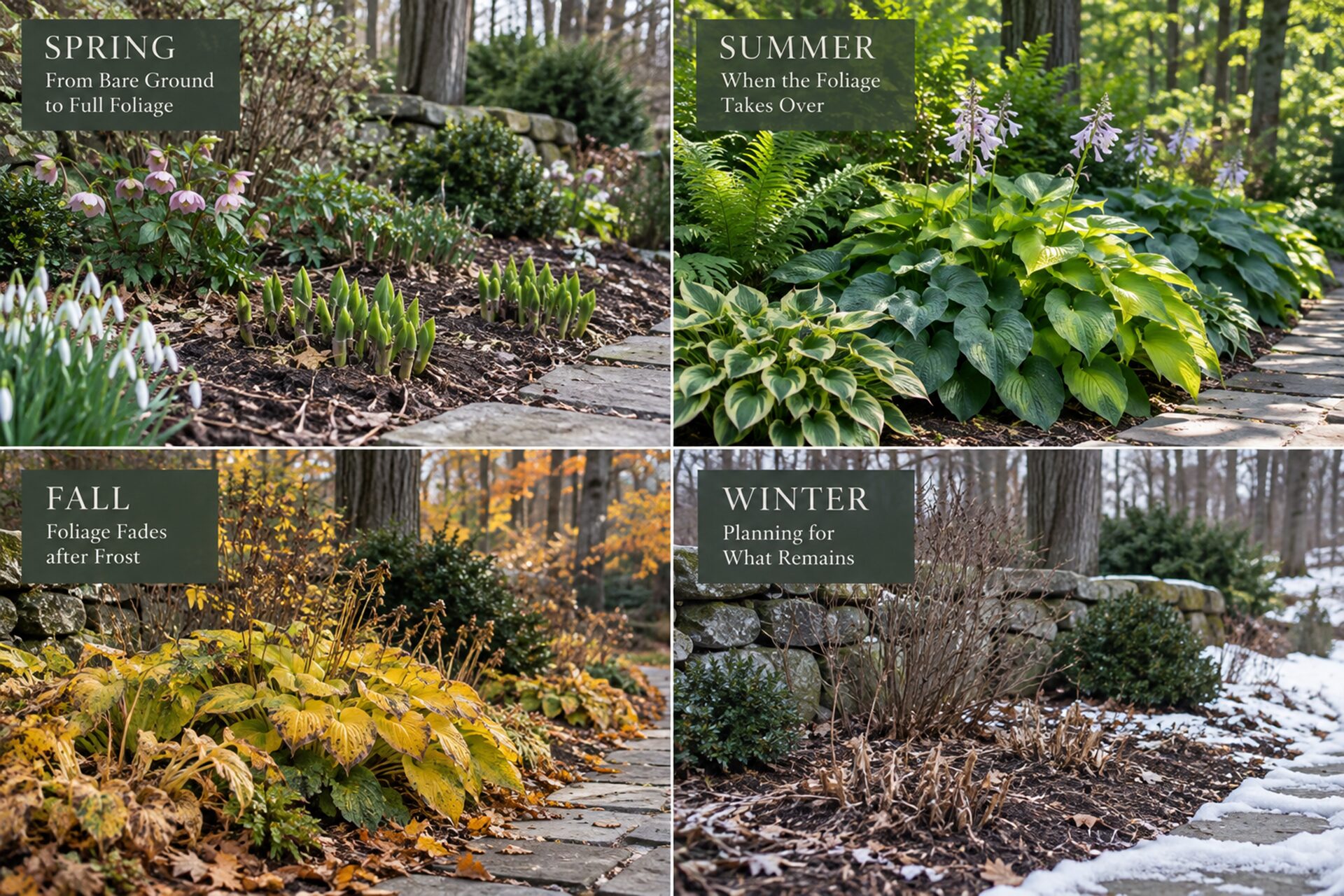
Spring: From Bare Ground to Full Foliage
Hostas emerge from the ground in spring as tight shoots that quickly begin unfurling into recognizable leaves.
That transformation can be useful in a layered garden. Early bulbs and spring-flowering plants may occupy the visual foreground while hostas are still small. As the season progresses, expanding hosta foliage begins filling the space.
It is also a reminder that an apparently empty bed in March may not actually have much room available by June.
Summer: When the Foliage Takes Over
Summer is when hostas do most of their design work.
Mature leaves overlap into broad mounds, foliage colors become more apparent, and flower stalks rise above the leaves. Depending on the cultivar, those flowers may be white, lavender, or purple. Some are fragrant.
We generally think of the flowers as an additional layer rather than the main event. A hosta should still earn its place in the planting when it is not blooming.
Fall and Winter: Knowing What Disappears
Hosta foliage eventually declines after frost and the plant goes dormant.
That matters when we talk about using hostas for structure. They can create very strong growing-season structure, but they cannot hold a garden together through a Massachusetts winter.
The larger planting still needs woody plants, evergreens, stone, branching structure, ornamental grasses, or other elements that remain once the hostas disappear.
A successful shade garden plans for both versions of the landscape.
Where Do Hostas Grow Best in Massachusetts?
Shade is only one part of the equation.
UMass Extension’s guidance on perennials for shade distinguishes between part shade, dappled shade, and deeper shade, while also pointing out that shaded locations may be complicated by tree roots and wet or dry soil.
Those additional conditions often determine whether a hosta merely survives or actually looks good.
Light: Not All Shade Is the Same
Most hostas perform well with filtered light, morning sun, or part shade, but different cultivars respond differently to exposure.
Blue foliage gets much of its color from a waxy surface coating, and that color is often strongest with greater protection from direct sun. Gold and chartreuse forms may develop more pronounced color with some additional light.
But there is a large difference between a few hours of morning sun and a west-facing bed absorbing heat late in the afternoon.
We look at the actual microclimate rather than assuming every location labeled “shade” is interchangeable.
Soil and Moisture
Hostas generally prefer fertile soil with consistent moisture and good drainage.
The important word is consistent.
Dry shade beneath established trees can be deceptively difficult. The canopy blocks some rainfall, while mature roots compete aggressively for whatever moisture reaches the soil. A location may look cool and sheltered while becoming remarkably dry during July and August.
That does not mean hostas cannot work beneath mature trees, but it does mean we consider irrigation, existing roots, soil conditions, and the particular plants already growing there.
For particularly difficult sites, our guide to native ground covers for shade looks more closely at dry shade, root competition, slopes, and other challenging conditions.
At the opposite extreme, hostas do not want chronically saturated soil. They need moisture, but their crowns and roots still require drainage.
Available Space
This may be one of the most overlooked hosta requirements.
The American Hosta Society’s clump-size guidance notes that mature hosta width is generally around two to two-and-a-half times the mature height, although form varies by cultivar. It also notes that hostas may grow somewhat larger in northern climates.
That makes mature width particularly relevant in Massachusetts.
A hosta that looks modest when planted may eventually cover a significant amount of ground. Along walks, steps, patios, and narrow beds, we plan for those leaves before they arrive.
Choosing Hostas by Size, Form, and Foliage
Writing “hosta” on a planting plan is not especially specific.
A miniature hosta and a five-foot-wide hosta cannot perform the same job, even though both belong to the same genus.
That is why we look first at the role the plant needs to play, then choose the cultivar.
The same principle applies to many other landscape plants. As we discuss in Plant Spacing: Designing Your Future Landscape, mature dimensions are a starting point for understanding how a plant will eventually relate to neighboring plants, walks, walls, architecture, and open space.
These six hostas illustrate just how different those roles can be:
| Cultivar | Typical Mature Size | General Character and Use |
|---|---|---|
| Blue Mouse Ears | About 6–12″ tall × 9–12″ wide | Miniature blue-green mound; useful for smaller spaces, edges, and detailed planting compositions |
| Halcyon | About 18″ tall × 3′ wide | Blue-green foliage with a controlled medium-scale form; useful for massing and foliage contrast |
| June | About 15″ tall × 20″ wide | Blue-green margins with a chartreuse-to-gold center; useful where brighter foliage can lift a shaded planting |
| Krossa Regal | About 3′ tall × 3–6′ wide | Large blue-green hosta with an upright, vase-shaped habit; useful for architectural form rather than a typical mound |
| Sum and Substance | About 2–3′ tall × 3–5′ wide | Very large chartreuse-to-gold foliage; useful as a substantial seasonal specimen where there is room |
| Frances Williams | About 18–24″ tall × 4–5′ wide | Large blue-green leaves with yellow-green margins; a classic specimen with a notable Massachusetts connection |
The measurements are almost more important than the colors.
A three-foot-wide blue hosta and a five-foot-wide gold hosta may both look small at installation. Give them several years and they can occupy completely different amounts of space.
We would rather choose the right mature scale at the beginning than spend the life of the garden trying to force a large hosta to behave like a small one.
A Massachusetts Connection: Frances Williams
Hostas also have an interesting connection to Massachusetts horticultural history.
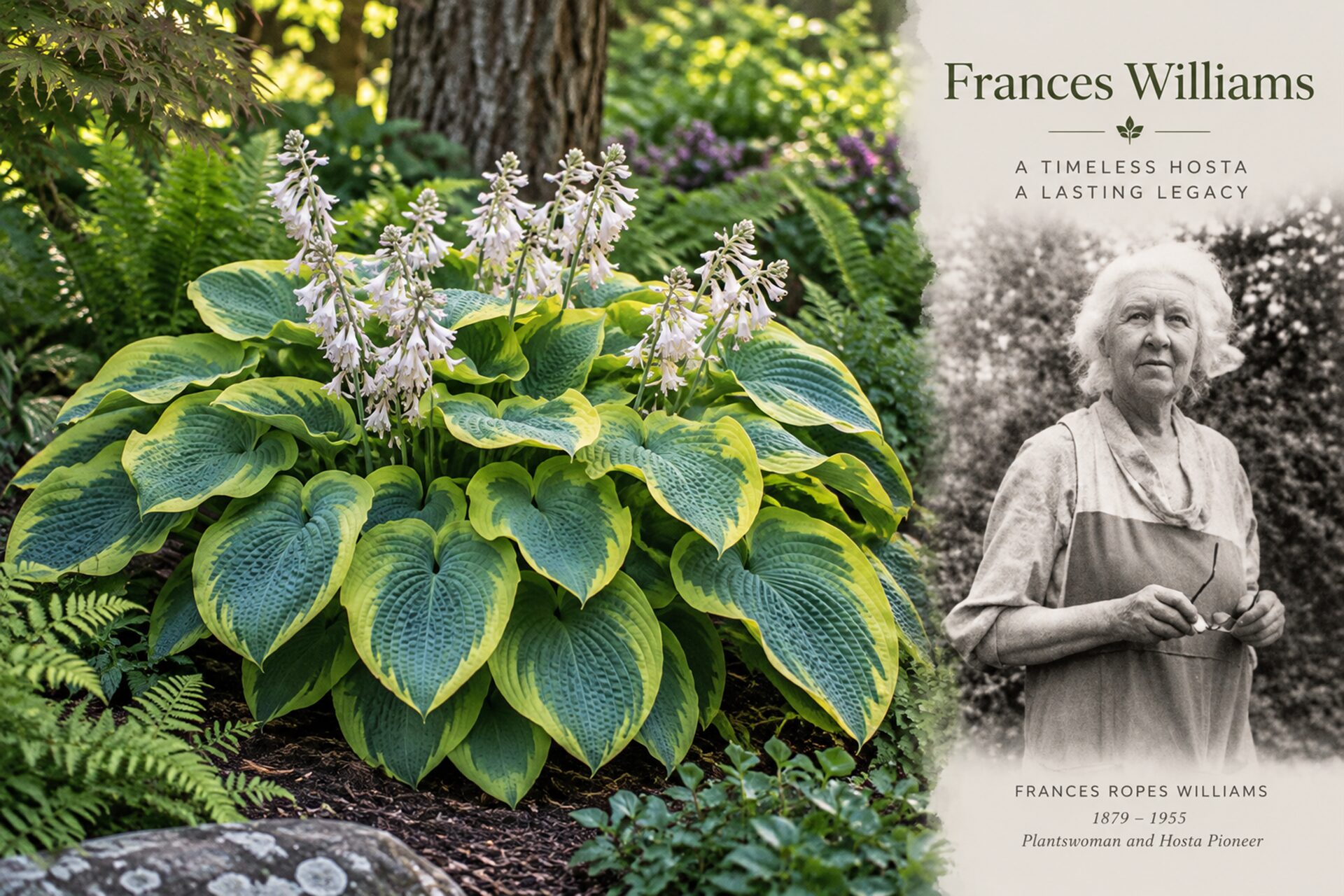
Frances Ropes Williams grew up in Salem and later lived in Winchester. According to the New England Hosta Society, she became one of the important early American hosta hybridizers and was deeply involved in the plant during the middle of the twentieth century.
Her daughter, Constance Williams, later became a founder and the first president of the New England Hosta Society when it was established in 1982.
The familiar cultivar ‘Frances Williams’ carries her name.
It is an impressive plant, with large blue-green leaves edged in yellow-green, but its history does not make it the correct hosta for every garden. It still needs enough room, appropriate light, and the right surrounding composition.
That is part of what makes plant selection interesting. A plant can be historically important, locally relevant, and beautiful, while still needing to earn its place on a particular property.
Where Hostas Work Best in a Landscape
Hostas are most effective when they have a clear role rather than simply filling leftover shaded spaces.
Massing and Repetition
One hosta surrounded by mulch reads very differently from a repeated group.
Massing several plants of the same cultivar can create a broad sweep of foliage that organizes a planting and gives the eye somewhere to rest. Repetition can also carry a consistent color or leaf form through a larger garden without making it feel busy.
The goal does not have to be a solid carpet. Even a few repeated groups can create continuity.
Shaded Borders Beneath Trees and Shrubs
Hostas can work beautifully beneath the higher structure of trees and shrubs when the soil contains adequate moisture.
Their broad foliage helps fill the perennial layer and creates a visual connection between woody plants and the ground plane.
We are more cautious where the tree canopy creates severe dry shade. Shade tolerance does not eliminate competition for water.
Paths, Steps, and Garden Edges
Compact and medium hostas can soften hard edges without requiring the formality of a clipped hedge.
They are particularly effective beside stone, where broad foliage contrasts with the harder texture of walls, walks, or steps.
Again, spacing matters. A hosta planted too close to a walkway eventually stops softening the edge and starts occupying it.
Large Foliage Specimens
The largest hostas deserve to be treated almost like seasonal shrubs.
Cultivars such as ‘Krossa Regal’ and ‘Sum and Substance’ can carry enough visual weight to become focal points within a shaded planting. Their scale works particularly well when they are balanced by larger shrubs, mature trees, stonework, or generous planting beds.
They need room to do that.
Where We Wouldn’t Use Hostas
We like hostas. That does not mean every shaded bed needs them.
We would think twice about using hostas:
- on properties with severe deer pressure and no realistic management strategy
- in extremely dry shade with intense competition from mature tree roots
- in soil that stays saturated for long periods
- where hot afternoon sun is likely to scorch the selected cultivar
- in narrow beds that cannot accommodate the plant’s mature width
- where large foliage would repeatedly fall into a path or seating area
- where the planting already contains too many similar broad, mounded forms
- where year-round structure is the primary objective
That last point is easy to overlook.
Hostas can make a shaded garden feel wonderfully full in July and completely different in January. If most of the planting behaves the same way, the entire composition may disappear when winter arrives. Sometimes the right answer is another hosta. Sometimes it is a fern, sedge, native groundcover, woody shrub, or evergreen.
Shade tolerance is not the same thing as suitability.
What Should You Plant With Hostas?
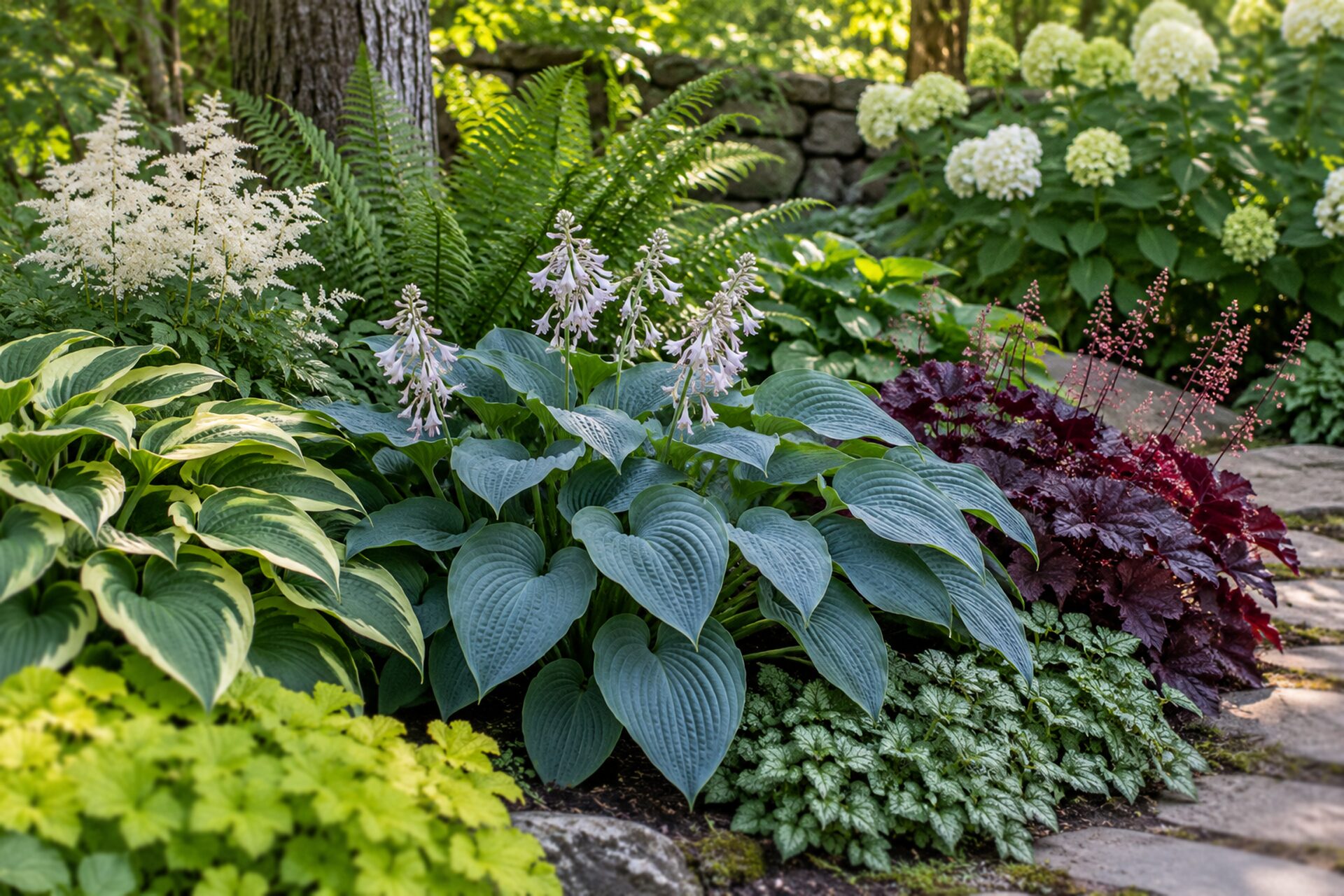
We think about hosta companions in terms of contrast.
Broad leaves already provide a lot of visual mass, so the plants around them should usually contribute something different.
Ferns and Other Fine-Textured Plants
This is one of the most natural combinations.
Hosta leaves feel broad and substantial. Fern fronds feel light and intricate. Put them together and each plant makes the other more noticeable.
Our guide to the best ferns for Boston and New England shade gardens looks at hardy options ranging from maidenhair and painted fern to larger cinnamon and ostrich ferns.
The best pairing depends on moisture and available space, but the design principle remains the same: contrast creates interest without requiring more flowers.
Sedges and Grass-Like Foliage
Sedges and other narrow-leaved shade plants can provide a similar contrast at a lower scale.
Their finer leaves introduce movement and a vertical or arching line against the broad hosta foliage.
Woody Plants and Evergreen Structure
Shrubs and small trees give hostas something permanent to sit beneath or beside.
This becomes especially important once winter arrives. Hostas can provide the lower seasonal layer while woody and evergreen plants continue defining the garden after frost.
Plants That Carry Other Seasons
A shaded garden should not peak all at once.
Early woodland plants, spring-flowering perennials, bulbs, flowering shrubs, and later-season plants can extend interest around hostas without asking the hostas themselves to provide everything.
The goal is not to find plants that simply tolerate the same light. It is to create a planting in which different plants take turns doing the work.
How Much Maintenance Do Hostas Need?
Hostas are generally manageable when their basic needs are met.
They benefit from consistent moisture during dry periods, enough room to reach their mature dimensions, seasonal removal of declining foliage, and routine observation for browsing or pest damage.
A hosta in the right location may remain an easy part of the garden for years.
The same hosta planted in hot sun, severe dry shade, or a heavily browsed area can require constant attention and still never look particularly good.
As with so many plants, maintenance often begins with design.
What About Slugs?
Slugs are one of the most familiar hosta problems.
The University of Minnesota Extension identifies hosta among the ornamental plants commonly damaged by slugs, which chew irregular holes through foliage.
That damage is usually aesthetic rather than fatal, but aesthetics matter when foliage is the primary reason we selected the plant.
Site conditions can influence pressure, and some thick-leaved cultivars tend to show less damage than thinner-leaved forms. We would rather consider those factors when choosing plants than assume every hosta will perform identically.
Do Deer Eat Hostas?
Yes.
This is one of the most important limitations to understand before planting hostas on a Massachusetts property.
Deer find hosta foliage highly appealing, and repeated browsing can leave a planting stripped quickly. The level of pressure varies dramatically from one neighborhood and property to another, so we do not treat deer as a theoretical concern.
On properties with significant browsing, we may use hostas selectively as part of a management strategy or choose other shade perennials altogether.
Our guide to deer-resistant plants and landscaping strategies looks at the broader issue, including plant selection, barriers, and other ways to reduce damage.
No plant palette should be designed without considering the wildlife that is actually using the property.
Are Hostas Native to Massachusetts?
No.
Hostas originate in East Asia and are not native to Massachusetts or North America.
That does not automatically exclude them from a landscape.
We value native plants for the ecological functions they can provide, but we also look at the composition as a whole. A shade garden may combine native trees, shrubs, ferns, sedges, groundcovers, and flowering perennials with selected ornamental plants that contribute a particular foliage color, form, or scale.
The important question is not whether every individual plant checks the same box.
It is whether the overall planting fits the site, supports the goals of the landscape, and offers enough diversity and seasonal change to function well over time.
So, Are Hostas a Good Choice for Massachusetts Shade Gardens?
Very often, yes.
Few perennial groups give us this much control over foliage color, texture, form, and scale in shade. A compact blue hosta can solve a very different design problem from a broad chartreuse specimen, and a repeated mass can have an entirely different effect from a single accent plant.
But the strongest hosta plantings are not necessarily the ones with the most varieties.
They are the ones where mature size makes sense, the foliage contrasts with what surrounds it, the soil can provide enough moisture, deer pressure has been considered, and other plants carry the garden through the seasons when the hostas are not present.
Hostas are particularly good at reminding us that foliage is not background.
In the right setting, it can organize the entire garden.
Frequently Asked Questions About Hostas
Q: Do hostas spread, or do they stay in one clump?
A: Most hostas are clump-forming perennials that gradually increase in diameter as new growth develops around the crown. They do not typically race through a garden like an aggressive running groundcover, although growth rate and habit vary by cultivar. A mature clump can still become surprisingly wide, which is why spacing for the specific variety matters.
Q: When is the best time to divide and replant hostas?
A: Spring, just as new shoots begin emerging, is one of the easiest times to divide hostas because the foliage has not fully expanded. Established plants can also be divided later in the growing season. Hostas do not necessarily need frequent division simply because they are old, but division can be useful when a clump becomes too large, develops a dead center, or when additional plants are wanted. Replant divisions promptly and keep them consistently watered while they reestablish.
Q: Can hostas be planted with spring bulbs?
A: Yes, and the timing can work particularly well. Many spring bulbs flower before hostas reach their full size. As bulb foliage begins to decline, expanding hosta leaves can help make that transition less visually prominent. The bulbs still need enough light and time for their foliage to mature naturally before it is removed.
Q: Are hosta flowers worth keeping?
A: They can be. Hosta flowers rise above the foliage in summer and may attract bees and hummingbirds, while some varieties produce noticeably fragrant flowers. Whether the flower stalks suit the garden is largely an aesthetic decision. Once flowering is finished, spent stalks can be removed if a cleaner foliage-focused appearance is preferred.
Q: Are hostas toxic to dogs and cats?
A: Yes. Hostas are considered toxic to dogs and cats if eaten, so homeowners with pets that regularly chew garden plants should take that into account when deciding where and whether to use them.
Choosing Plants as Part of the Larger Landscape
The best shade gardens are not collections of individual shade-tolerant plants. They are compositions.
A hosta might be exactly right beside a shaded walk, repeated beneath a group of shrubs, or used as a broad foliage contrast beside ferns. Twenty feet away, where the soil is drier or deer regularly pass through, something completely different may make more sense.
That is why we consider more than whether a plant is hardy in Massachusetts. We look at light, moisture, mature size, tree roots, neighboring plants, architecture, circulation, seasonal change, deer pressure, and the maintenance the planting will require as it matures.
At a Blade of Grass, our landscape designers bring those relationships together into planting plans designed for the way Greater Boston properties actually grow and change.
If you are planning a new shade garden, reconsidering an established planting, or trying to make different parts of your landscape feel more connected, contact us to start a conversation about your property.
Sources and Further Reading