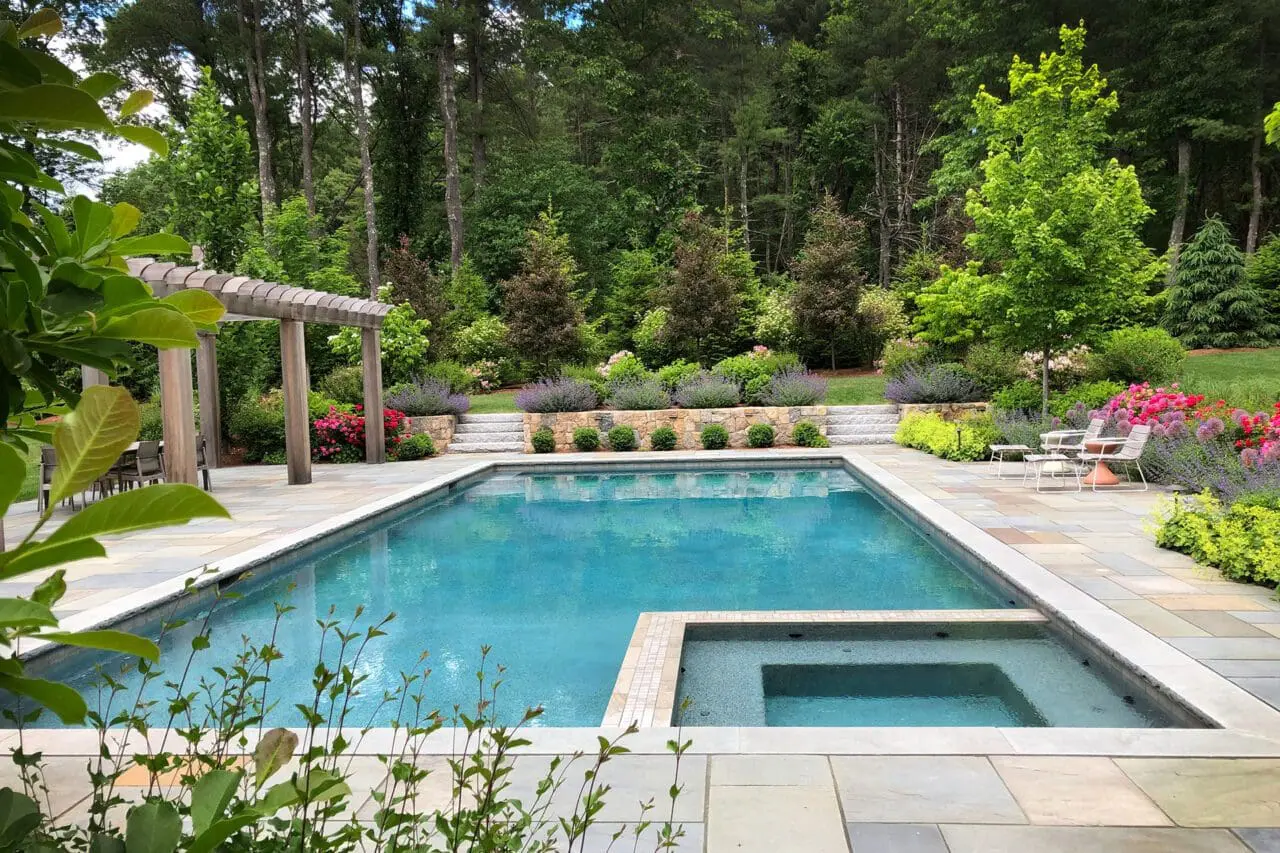
A homeowner looking at a newly planted landscape will sometimes ask a perfectly reasonable question: why are the plants so far apart?
There may be fresh mulch between the shrubs. The hydrangeas haven’t begun to fill their space. A group of ornamental grasses may still look more like individual plants than the broad sweep shown on the landscape plan. In that moment, it can be tempting to add a few more.
Sometimes that’s exactly what we should do. Other times, filling those spaces would create a problem that won’t become obvious for another three or four years. That kind of delayed problem is something we see often on otherwise well-maintained properties, as we discuss in our guide to common landscape problems on New England properties.
Plant spacing is one of those landscape design decisions that sounds as though it should have a simple answer. Look up the mature width, measure the appropriate distance, and start planting. In practice, it’s much more contextual than that.
How far apart plants should be depends on what they are, how they grow, what surrounds them, how we want them to relate to one another, and what we’re asking the planting to accomplish.
A hydrangea intended to stand as a distinct shrub may be spaced differently from the same hydrangea used in a broad mass. Evergreens planted to create privacy have different requirements from shrubs used to frame an entry. Perennials in a naturalistic border may be expected to mingle. A clipped hedge is deliberately asking plants to grow together.
The measurements matter, but they only get us part of the way there.
Key Takeaways
- Space plants for mature size and growth habit.
- Specimens need room; masses and hedges can grow together.
- Account for walks, patios, buildings, and views.
- Overplanting creates crowding and extra maintenance.
- Too much space can make planting feel disconnected.
- Layering creates fullness without overcrowding.
- Design for how the landscape will mature, not just installation day.
Plant Spacing Is Really About Designing With Time
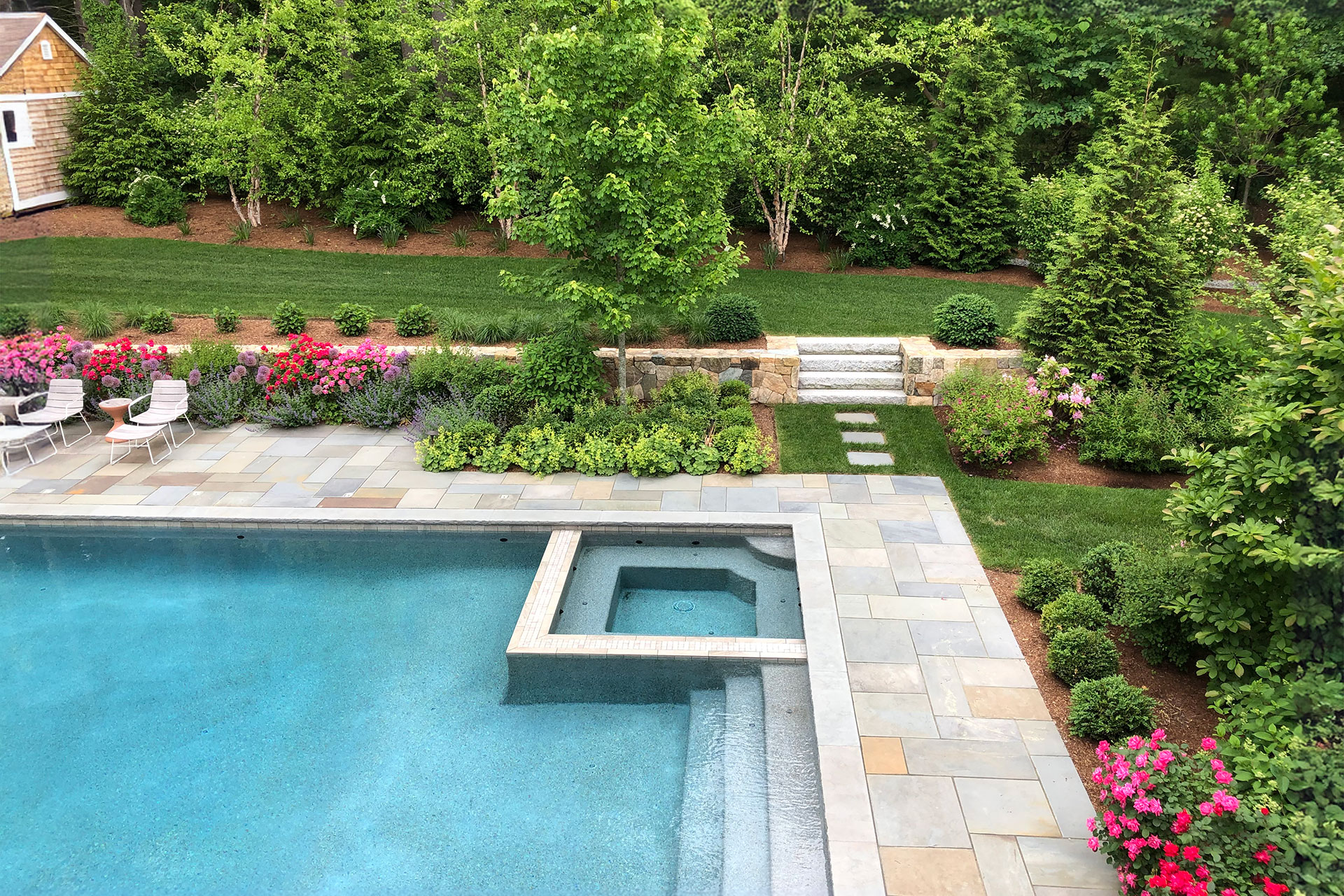
When we’re laying out plants on a Massachusetts property, we’re not designing only for installation day. We’re trying to imagine the landscape several years from now, when the shrubs have broadened, the perennials have settled in, and the relationship between the planting and the house is much more established.
That’s one of the important differences between buying plants individually and developing a planting design.
A three-gallon shrub may not look particularly impressive sitting in the middle of a large bed. What matters more is the five-foot-wide shrub it may eventually become.
NC State Extension summarizes the basic principle well:
“Knowing the mature plant size is critical for spacing plantings to accommodate both mature height and width.”
Mature size gives us a reference point, but it still doesn’t tell us exactly where every plant belongs.
We also need to understand the plant’s form. Does the shrub grow upright or broadly? Does it sucker outward? Does it stay dense near the ground or open up beneath its canopy? Does a perennial remain in a tidy clump or slowly move through neighboring plants? Does an ornamental grass arch well beyond the diameter of its crown?
Then we look at everything around it.
A shrub growing beside a stone walk has a different spatial constraint from one growing into the edge of a woodland. A plant beneath a window has a height limit that doesn’t exist at the corner of the house. A planting around a patio needs to soften the hardscape without eventually occupying the seating area.
Plant spacing isn’t simply the distance between two plants. It’s the amount of room we’re giving each plant to become part of the larger composition.
Mature Size Is a Starting Point, Not a Formula
You’ve probably seen mature dimensions on plant labels: 4 to 5 feet tall by 4 to 5 feet wide. That’s useful information, but it isn’t a guarantee.
Plants respond to the conditions they’re given. A shrub growing in good soil with consistent moisture and plenty of light may become larger than expected. The same cultivar growing beneath mature oaks in dry soil may remain smaller or develop a looser habit.
Greater Boston properties make this especially relevant. We work with landscapes in Wellesley, Weston, Concord, Newton, Brookline, Sudbury and throughout eastern Massachusetts where growing conditions can change significantly within the same property. One side of a house may receive strong afternoon sun while another sits beneath mature tree canopy. Soil near a recently constructed patio may behave very differently from soil along an established woodland edge.
That’s why we look at mature plant dimensions as a design reference rather than a precise instruction. If three shrubs are expected to become approximately five feet wide, five feet on center might be reasonable in one situation. In another, we might move them closer. In another, farther apart.
Choosing a rhododendron by its mature size and form illustrates why a plant name alone tells us too little about the space it will need.
The important question is what we want those plants to become together.
“We’re rarely asking, ‘What’s the correct number of feet between these plants?’ We’re asking what we want the planting to look like in five years and how much room each plant needs to get there.”
— Megan Davey, Landscape Designer, a Blade of Grass
Spacing Changes With Design Intent
This is where plant spacing becomes less about horticultural measurements and more about landscape design. The same plant can be spaced differently depending on the role it’s playing.

A Specimen Plant Needs Room to Be Seen
Sometimes we want a plant to read as an individual.
A beautifully formed Japanese maple, flowering shrub or distinctive evergreen may need visual space around it so its branching, shape and texture can be appreciated. Place neighboring plants too close and that architecture starts to disappear.
Instead of seeing one strong specimen surrounded by supporting planting, you begin to see one continuous mass.
In that situation, the open space around the plant isn’t wasted. It’s helping the plant do its job in the composition.
Mass Plantings Are Supposed to Connect
Now consider three, five or seven shrubs of the same variety used together.
Here, the objective may be quite different. We’re often less interested in seeing every individual plant and more interested in the collective shape they create.
This connects directly to the design thinking behind our guide to the Rule of 3 in landscaping.
Grouping plants can create rhythm, repetition and visual strength, but choosing three plants isn’t enough on its own. Their spacing determines whether the group eventually reads as three disconnected circles or as one coherent planting.
That may mean allowing the plants to meet or overlap somewhat as they mature. The spacing still needs to account for plant health and future maintenance, but the visual intention matters.
Hedges Deliberately Change the Rules
A hedge is one of the clearest examples of why there can’t be one universal plant-spacing formula.
If we wanted each evergreen shrub to retain its complete natural form, we would give it substantial room. But that’s not what we’re asking a hedge to do. We’re deliberately encouraging neighboring plants to grow together and create a continuous screen.
Virginia Tech Extension notes that shrub spacing depends partly on mature size and partly on the desired size under the intended pruning regime. For hedges, it also depends on how quickly the planting is expected to close together.
That doesn’t mean closer is always better.
Planting a privacy hedge excessively tight can create competition and unnecessary maintenance later. The goal is to understand the mature habit of the particular plant and create enough density to accomplish the screening objective without making the planting fight itself.
This is also why layered screening is often more successful than a single tightly packed row of evergreens. Our guide to creating privacy with trees and hedges looks more closely at how different plant layers can work together to create privacy.
Perennials Can Be Allowed to Mingle
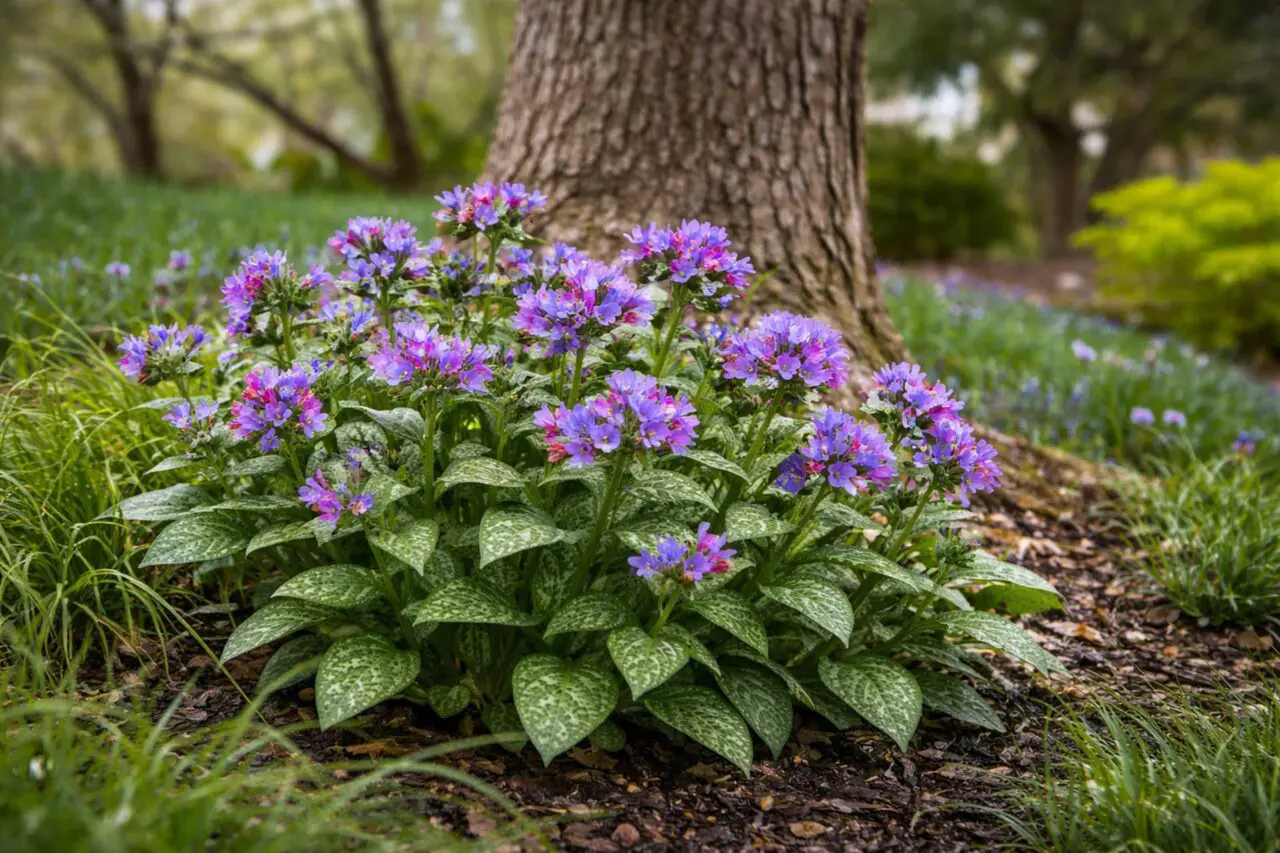
Perennial spacing introduces another variable. Many perennial gardens look better once plants begin interacting with one another. We may want catmint to soften the edge of a walk. Geraniums may knit together beneath larger shrubs. Ornamental grasses can lean into neighboring flowering plants. Groundcovers may eventually close over exposed soil. Some degree of overlap is often part of the design.
The goal isn’t to preserve a permanent mulch circle around every perennial. We’re thinking about how leaves, stems, flowers, seed heads and neighboring plants will occupy the space together through the season.
That can create a garden that feels much more natural than a bed made up of evenly spaced individual specimens.
Spacing Is Also About What Isn’t Planted
One of the more overlooked parts of plant spacing is negative space.
A successful garden doesn’t necessarily need vegetation occupying every available square foot. Open space can separate two important plant groups, allow stonework to remain visible, provide breathing room around a specimen tree or help frame a view. That idea is closely related to circulation.
As we discuss in What Is Circulation in Landscape Design?, the way people experience a landscape depends on more than the width of a walkway. Sightlines, planting, destinations and spatial relationships all influence movement. Plant spacing affects those relationships.
Shrubs positioned too close to a walk can make a generous path feel narrow. Planting that closes around a garden entrance can make the route feel private and intriguing, which may be useful in one part of a property and confusing near the front door.
A carefully positioned opening between shrubs can reveal a terrace, sculpture or distant part of the garden.
This is one reason we don’t solve planting plans by filling every blank area with another plant. Sometimes the open space is contributing just as much as the plants around it.
What Happens When Plants Are Too Close Together?
The immediate problem with overplanting is that it often looks quite good. A newly installed bed appears lush. Shrubs touch one another. Mulch nearly disappears. The landscape feels mature almost immediately. The problems usually come later.
Wisconsin Extension cautions against trying to create the effect of a mature group planting too quickly, noting that a planting may need three to five years before it achieves its intended effect.
Trying to compress those years into installation day can eventually create several problems:
- repeated shearing simply to keep shrubs inside their allotted space
- branches growing across walks, windows, steps or patios
- plants competing for sunlight, water and growing space
- reduced air movement through dense foliage
- taller plants overwhelming slower-growing neighbors
- loss of the natural forms that made the plants attractive in the first place
- maintenance crews continually correcting a problem created by the original layout
Plant health is part of the issue. Virginia Tech notes that overcrowding can increase competition for light, water and space while reducing air circulation.
For us, one of the biggest warning signs is repeated pruning.
If a five-foot shrub has been given three feet of usable space, there’s going to be a disagreement between the plant and the landscape every growing season. You can keep cutting it back, but the better solution is often to choose a plant whose mature size actually fits the location.
That comes up frequently with panicle hydrangeas. There are cultivars that remain relatively compact and others that can become substantial shrubs. As our panicle hydrangea guide for Massachusetts landscapes explains, choosing the right cultivar is usually better than putting a large-growing hydrangea beside a walkway and relying on pruning to contain it forever.
“One of the easiest ways to create unnecessary maintenance is to put the right plant in the wrong amount of space. If we know a shrub wants to be six feet wide, we’d rather plan for that growth than spend the next ten years trying to keep it four feet wide.”
— Katie Johnson, Landscape Designer, a Blade of Grass
Plants Can Also Be Too Far Apart
Overcrowding gets most of the attention, but planting too sparsely can create its own problems. Imagine five perennials distributed evenly across a large planting bed. Every plant may have plenty of room to grow, yet even at maturity the composition may never really connect.
Instead of seeing a broad sweep of color and texture, the eye continues to register five unrelated plants surrounded by mulch. The spacing may be horticulturally acceptable but visually unsuccessful.
Sparse planting can also leave more exposed soil where weeds can establish, particularly in perennial and groundcover plantings. This is why mature width can’t make the design decision on its own.
We still have to ask what the planting should eventually feel like. Should the plants touch? Should they overlap slightly? Should there be visible ground between them? Should one plant weave beneath another? Should the grouping read as several individuals or as one larger shape?
Once those questions are answered, the measurements become much more useful.
Layering Changes the Equation Again
Some of the most interesting planting designs don’t occupy space in a single horizontal plane. They stack it vertically.
Imagine a mature shade tree above a group of medium shrubs, with ferns, sedges and low groundcovers beneath them. If we looked only at the diameter of each plant and tried to prevent every canopy from overlapping, we’d need an enormous amount of space.
But plants occupy different layers. The tree canopy may begin fifteen feet above the ground. A shrub occupies the middle layer. Ferns and groundcovers fill the space below. Their footprints overlap, but they aren’t all competing for exactly the same physical space.
This is one reason layered New England gardens can feel full without necessarily feeling crowded.
It also creates much richer planting compositions. Instead of a row of shrubs surrounded by mulch, you get transitions between canopy, understory, shrub layer, perennials and ground plane.
In that kind of design, spacing becomes three-dimensional.
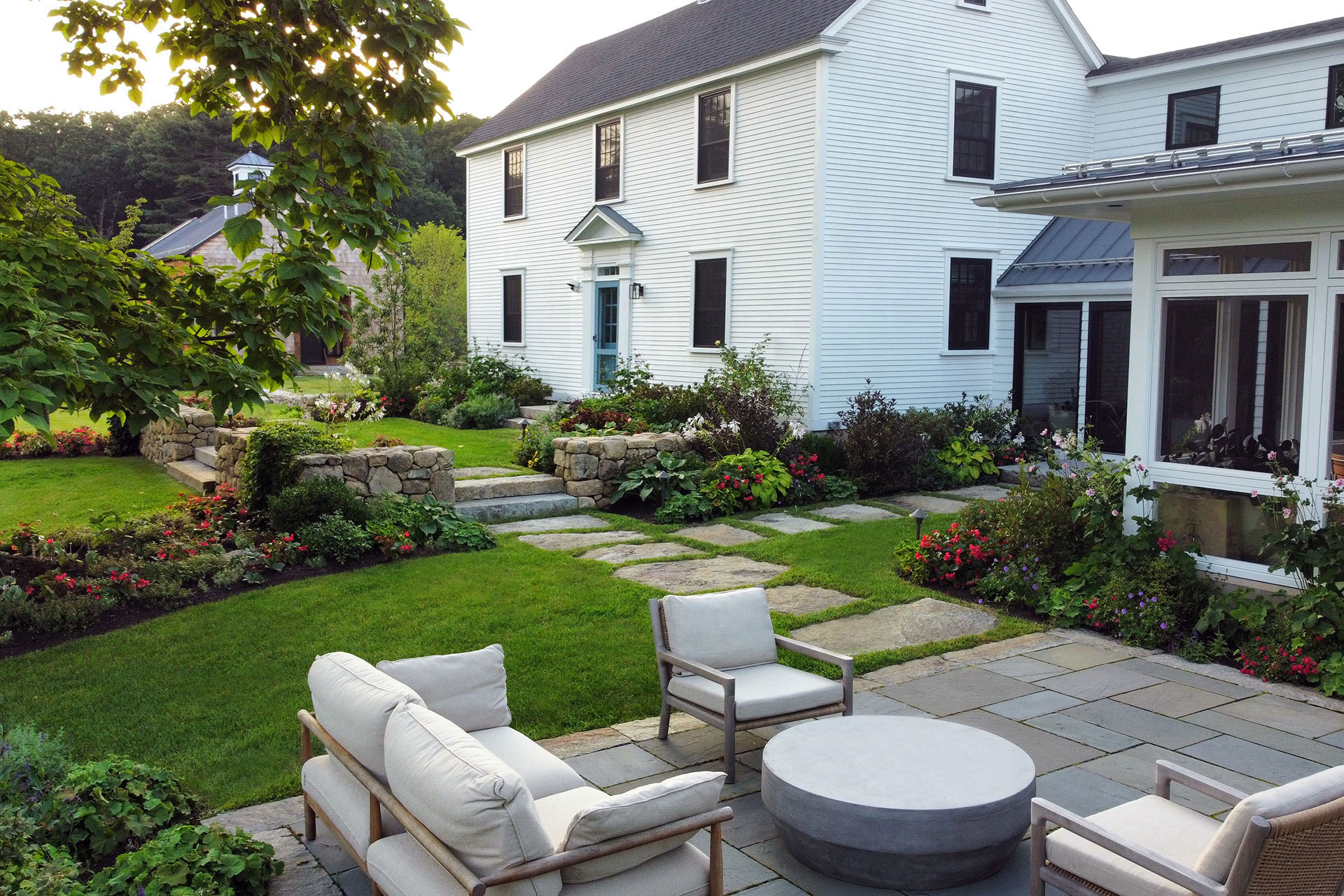
Buildings, Walkways and Patios Need Their Own Space Too
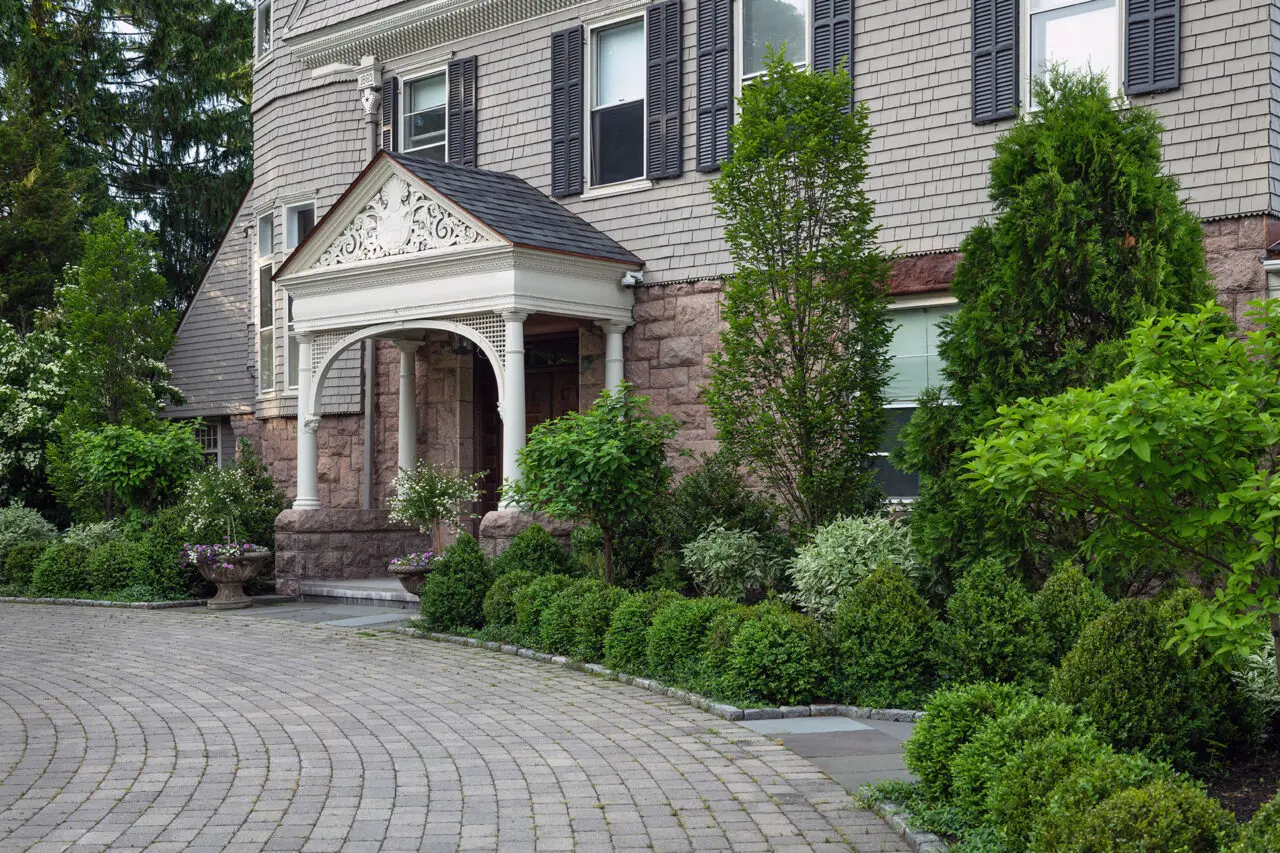
Plant spacing isn’t limited to the distance between plants. We also need to think about architecture and hardscape. This comes up constantly in foundation landscaping.
A shrub that eventually becomes six feet wide shouldn’t necessarily have its center planted three feet from the house simply because that’s half its mature diameter. We need room for the plant, air movement, building maintenance and sometimes access to windows, utilities or drainage.
NC State Extension recommends accounting for both half the mature plant width and additional clearance from structures rather than allowing mature shrubs to grow directly against the building.
The same logic applies beside walks and terraces. Plants can soften stone beautifully. We often want foliage to relax a hard edge rather than maintaining a perfectly rigid gap. But there’s a difference between ornamental grass arching slightly toward a walkway and a shrub eventually reducing a four-foot path to two feet.
The appropriate distance depends on the plant’s habit, the importance of the route and the experience we’re trying to create.
Our guide to foundation landscaping for Boston homes explores that same relationship between mature plant scale and architecture.
New England Landscapes Make Context Especially Important
Plant-spacing recommendations can look wonderfully precise on paper. Established properties around Greater Boston rarely are. We often work around mature oak roots, compacted soil near previous construction, changing shade, old stone walls, ledge, slopes, drainage patterns and substantial differences in soil moisture across fairly short distances.
Winter changes the picture again.
Deciduous plants lose their foliage. Snow can push branches outward. Evergreens that provide useful structure in January may occupy much more visual space than the perennials around them.
Designing planting for Massachusetts means thinking about the composition throughout the year, not simply at peak growth in June.
It also means watching how the landscape actually develops. A planting plan establishes an intention, but plants grow at different rates. One may outperform expectations while another remains smaller. A tree canopy may expand and change the available light. A shrub may eventually need selective pruning so a neighboring plant can continue to develop properly.
That’s where thoughtful property maintenance becomes part of the design rather than something separate from it.
Sometimes We Intentionally Break the Spacing Rules
Landscape designers break spacing conventions all the time, but usually for a reason.
We might place plants closer because we want a hedge to knit together. We may allow perennials to overlap because we want a more naturalistic effect. We might leave unusually generous room around a specimen tree because its form deserves attention.
We may cluster plants tightly on one side of a path while leaving the opposite side open, or stagger several large shrubs rather than placing them at mathematically consistent intervals.
None of those decisions means plant spacing doesn’t matter. It means the spacing is serving the design.
That’s very similar to the Rule of 3. The value of that principle isn’t that every landscape should contain groups of exactly three plants. It’s that grouping, repetition and odd-numbered compositions give us a useful way to think about visual organization.
Plant spacing works the same way. Guidelines give us a starting point, but the property, the plant and the intended effect all influence the final decision.
The Better Question Isn’t “How Many Feet Apart?”
When we’re planning a planting design, we certainly look at dimensions. But before deciding exactly how far apart two plants should be, we’re more likely to ask a series of broader questions.
What will these plants look like when they’re mature? Do we want them to remain separate or grow together? What role does each plant have in the composition? How will someone move past them? What happens to the view when they get larger? Will they eventually interfere with the house, patio or walkway? How much pruning will be required to maintain the intended form?
And just as importantly, what will this part of the property look like in winter? Those questions usually lead to much better spacing decisions than a universal chart ever could.
A well-spaced landscape doesn’t always look completely finished the day it’s planted. Sometimes there should be some room. As the plants grow, the individual pieces begin relating to one another and the design becomes clearer with each season. That space wasn’t forgotten. It was planned.
Frequently Asked Questions
Q: How far apart should landscape plants be spaced?
A: There isn’t one correct spacing for all landscape plants. Mature size is an important starting point, but spacing should also account for growth habit, site conditions, nearby structures and the intended design effect. Two identical shrubs may be spaced differently depending on whether they’re being used as individual specimens, a mass planting or part of a hedge.
Q: Should plants touch when they reach maturity?
A: Sometimes. In a hedge, groundcover planting or perennial drift, some overlap may be intentional and desirable. A specimen shrub or small ornamental tree, on the other hand, may need more open space so its natural form remains visible. The goal isn’t necessarily to prevent plants from touching. It’s to decide how they should relate to one another as the planting matures.
Q: Is it better to plant shrubs farther apart and let them grow in?
A: Often, yes, but not always. Allowing appropriate room for mature growth can reduce future crowding and excessive pruning. At the same time, spacing shrubs too far apart can leave a planting looking disconnected even after it matures. The right distance depends on the plant and the composition rather than simply maximizing space between plants.
Q: Why does a newly installed landscape sometimes look sparse?
A: Most landscape plants are installed well before reaching their mature size. A shrub that looks small in a new bed may eventually become several feet wider. Leaving some visible space at installation can give plants room to develop without creating crowding later. A well-designed planting should become fuller over time rather than looking completely mature on the first day.
Q: What happens if landscape plants are planted too close together?
A: Overcrowded plants can compete for light, water and growing space and may require frequent pruning to keep them away from walks, windows or neighboring plants. Dense growth can also reduce air circulation. From a design standpoint, crowding can blur plant forms and turn a layered composition into an indistinct mass. Choosing plants whose mature size fits the available space is usually more successful than relying on constant pruning to control them.
Planning a Landscape That Has Room to Mature
Good landscape design involves imagining something that doesn’t fully exist yet.
We’re selecting relatively young plants and deciding where they should live based on how they’ll grow, interact and change over many years. Plant spacing is part horticulture, part composition and part understanding how people will experience the property.
The right distance might be three feet in one garden and five feet in another. It might deliberately allow plants to touch, or deliberately keep them apart.
The useful question is rarely, “What is the correct spacing?” It’s usually, “What are we trying to accomplish here, and what will these plants need in order to do it well?”
If you’re planning a new landscape or looking at an established property where plants have become crowded, disconnected or difficult to maintain, the Blade team can help evaluate the larger planting composition. We design and care for residential landscapes throughout Greater Boston, MetroWest and Cape Cod with an emphasis on how properties will grow and function over time.
Contact a Blade of Grass to talk with our team about landscape design, planting and long-term property care.
Learn More About Plant Spacing
- Landscape Design | NC State Extension – Covers mature plant size, density, scale, and why overcrowding for an “instant landscape” can create problems later.
- Shrubs: Functions, Planting, and Maintenance | Virginia Tech Extension – Guidance on shrub spacing, mature size, pruning, and placement around walks, windows, and other landscape features.
- Planning and Designing Your Home Landscape | University of Wisconsin Extension – Explains spacing for mature growth and why group plantings may take three to five years to reach their intended effect.
- Landscape Designs With Native Plants | University of Maryland Extension – Shows how plant size, spacing, light, moisture, and plant type work together in residential planting plans.