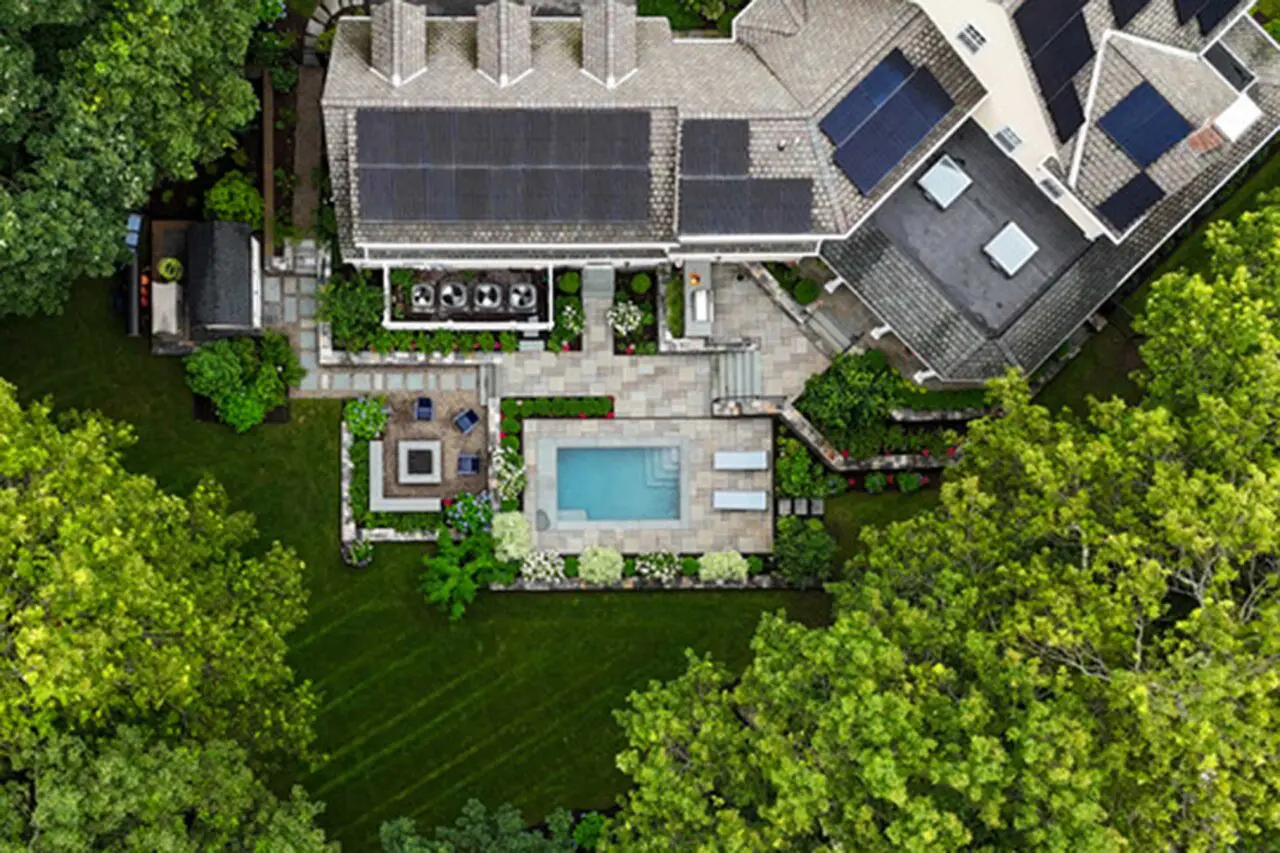
Spend enough time looking at established gardens around Greater Boston and you start seeing certain plants again and again. Panicle hydrangea is one of them.
There’s a reason for that.
We use panicle hydrangeas because they’re dependable, adaptable, long-flowering shrubs that can do quite a bit of work in a landscape. They can soften the corner of a house, bring summer color to a mixed border, add fullness around a terrace, or repeat through a larger planting to give it rhythm. And unlike some hydrangeas that can be frustrating after a difficult New England winter, panicle hydrangeas bloom on new growth produced that same year.
But dependable doesn’t mean foolproof.
One of the most common problems we see isn’t a panicle hydrangea that won’t grow. It’s one that’s growing perfectly well in a space that was never large enough for it.
There are now panicle hydrangeas ranging from genuinely compact shrubs to plants that can become substantial parts of the landscape. Choosing the right one has much more to do with the space you have and the role you want the plant to play than picking the flower you like best.
So, is a panicle hydrangea a good choice for a Massachusetts landscape?
Very often, yes. But we’d still want to know where you plan to put it.
Panicle Hydrangea at a Glance
- Botanical name: Hydrangea paniculata
- Plant type: Deciduous flowering shrub; some forms can be trained as small trees
- Mature size: Highly cultivar-dependent; compact varieties may stay around 3 feet while traditional forms can reach 10 feet or more
- Light: Full sun to part shade
- Soil / moisture: Prefers moist, well-drained soil; established plants tolerate moderately dry conditions
- Bloom season: Mid-to-late summer into fall
- Native status: Not native to North America; native to eastern Asia
- Deer resistance: Not reliably deer resistant
- Best landscape uses: Mixed borders, foundation plantings, informal hedges, mass plantings, garden transitions, patio and terrace edges
Why We Keep Coming Back to Panicle Hydrangeas
There are shrubs with more unusual flowers, more interesting foliage, or greater ecological value. Panicle hydrangea earns its place for another reason: it’s remarkably useful.
On a residential property, a shrub usually has a job beyond flowering. It may need to create enough mass to balance the architecture of the house, bridge the visual gap between an evergreen and a perennial border, or soften the edge of a stone wall or patio.
Panicle hydrangeas can handle many of those jobs while producing a long season of flowers.
That versatility is why we included Hydrangea paniculata among our flowering shrubs for structure in New England landscapes.
They’re also more forgiving than many homeowners expect a hydrangea to be. Panicle hydrangeas generally tolerate more sun than bigleaf hydrangeas, and because they bloom on new wood, a cold winter doesn’t necessarily mean losing the following summer’s flowers.
The University of Connecticut notes that the species is hardy to Zone 3 and that traditional Hydrangea paniculata can eventually reach 10 to 20 feet in height and spread. Modern cultivars give us much more control over size, but the point is worth remembering: the hydrangea you buy isn’t necessarily the hydrangea you’ll have five or ten years from now.
What Does Panicle Hydrangea Look Like Through the Seasons?
One reason we like panicle hydrangeas is that their contribution doesn’t end when the flowers first open.
Spring: A Quieter Start
Panicle hydrangeas aren’t usually the plants carrying a garden in April and May. They leaf out and put on new growth while bulbs, flowering trees and spring perennials get most of the attention.
That’s not a weakness. Good landscape design doesn’t require every plant to perform at the same time.
Summer: The Main Event
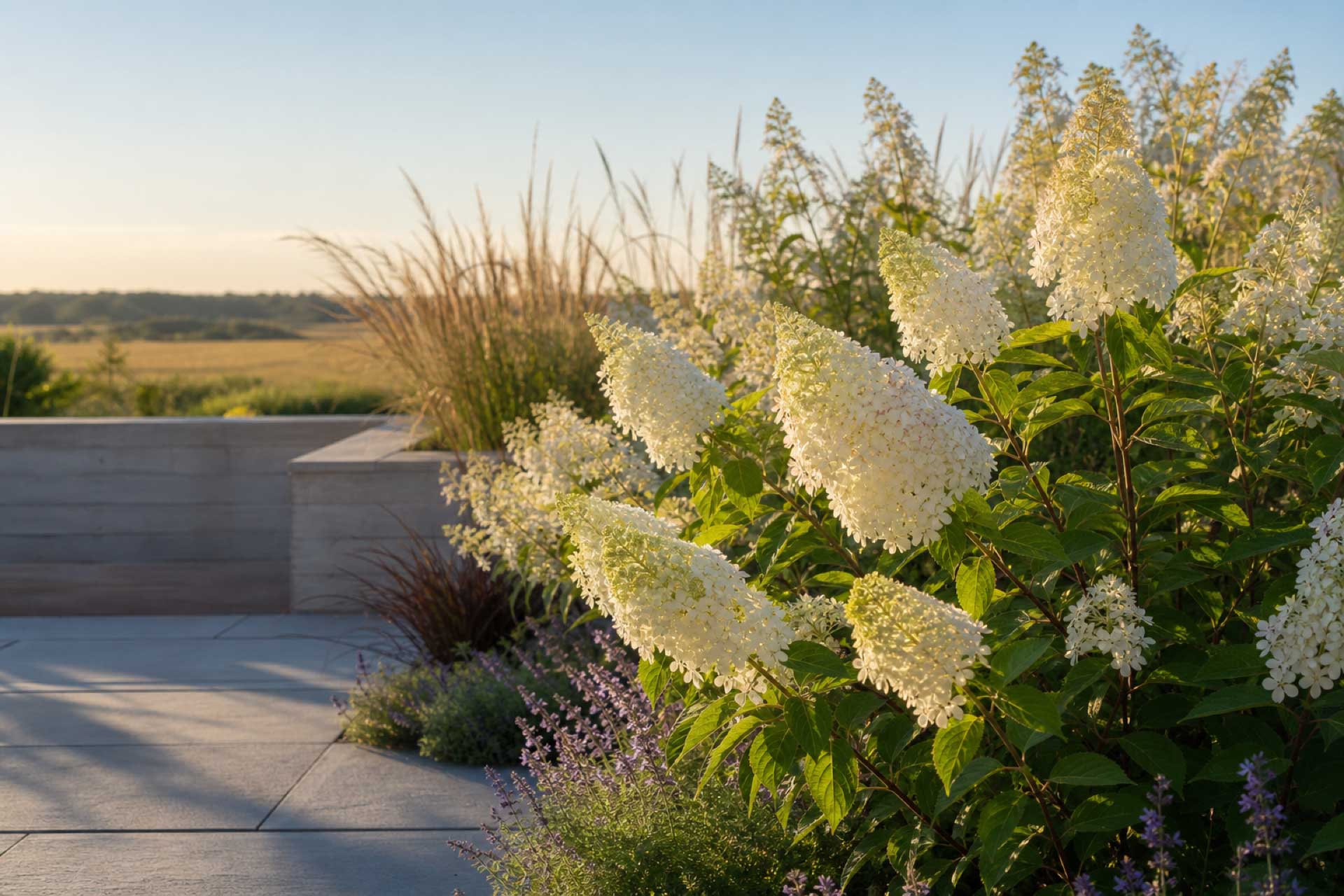
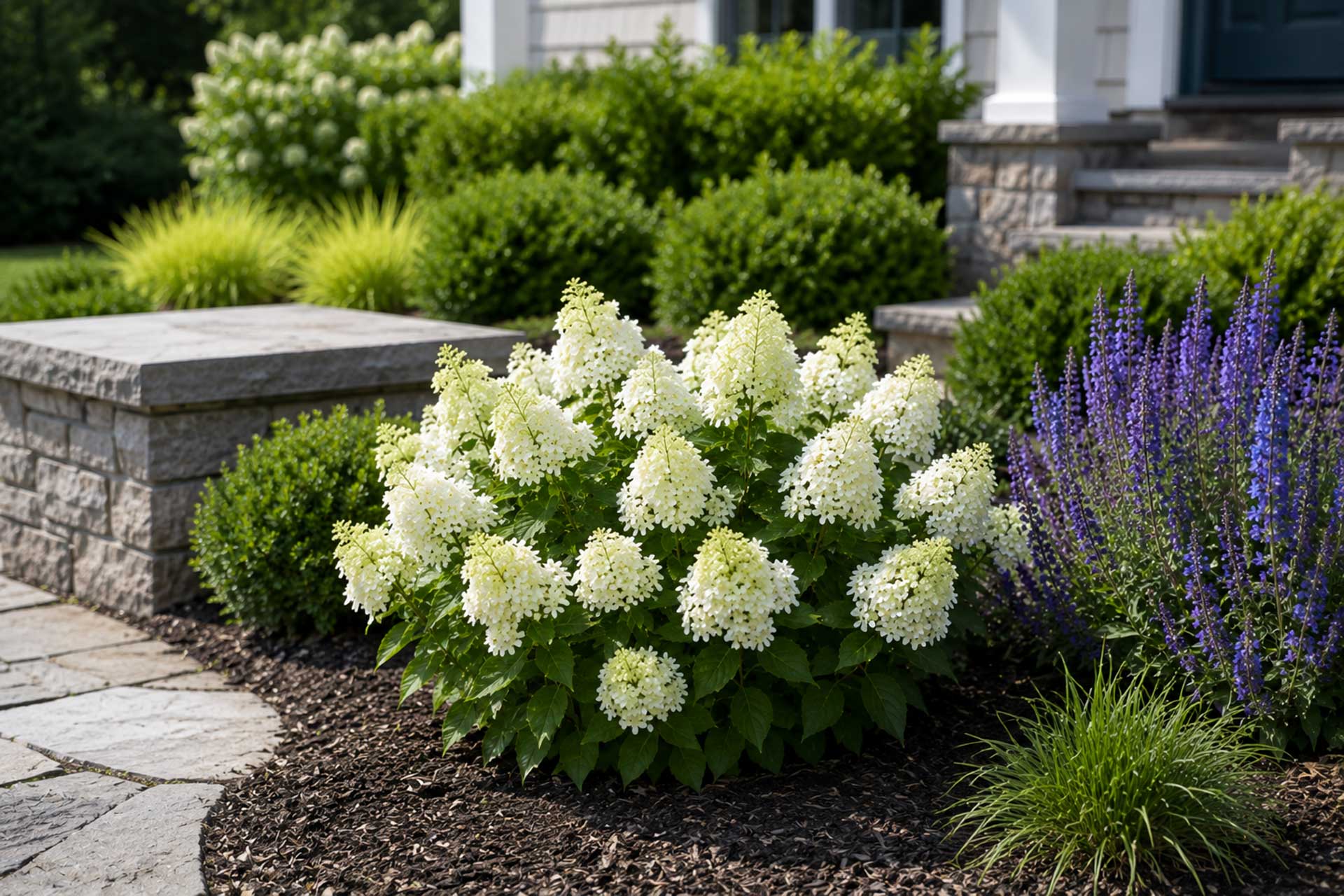
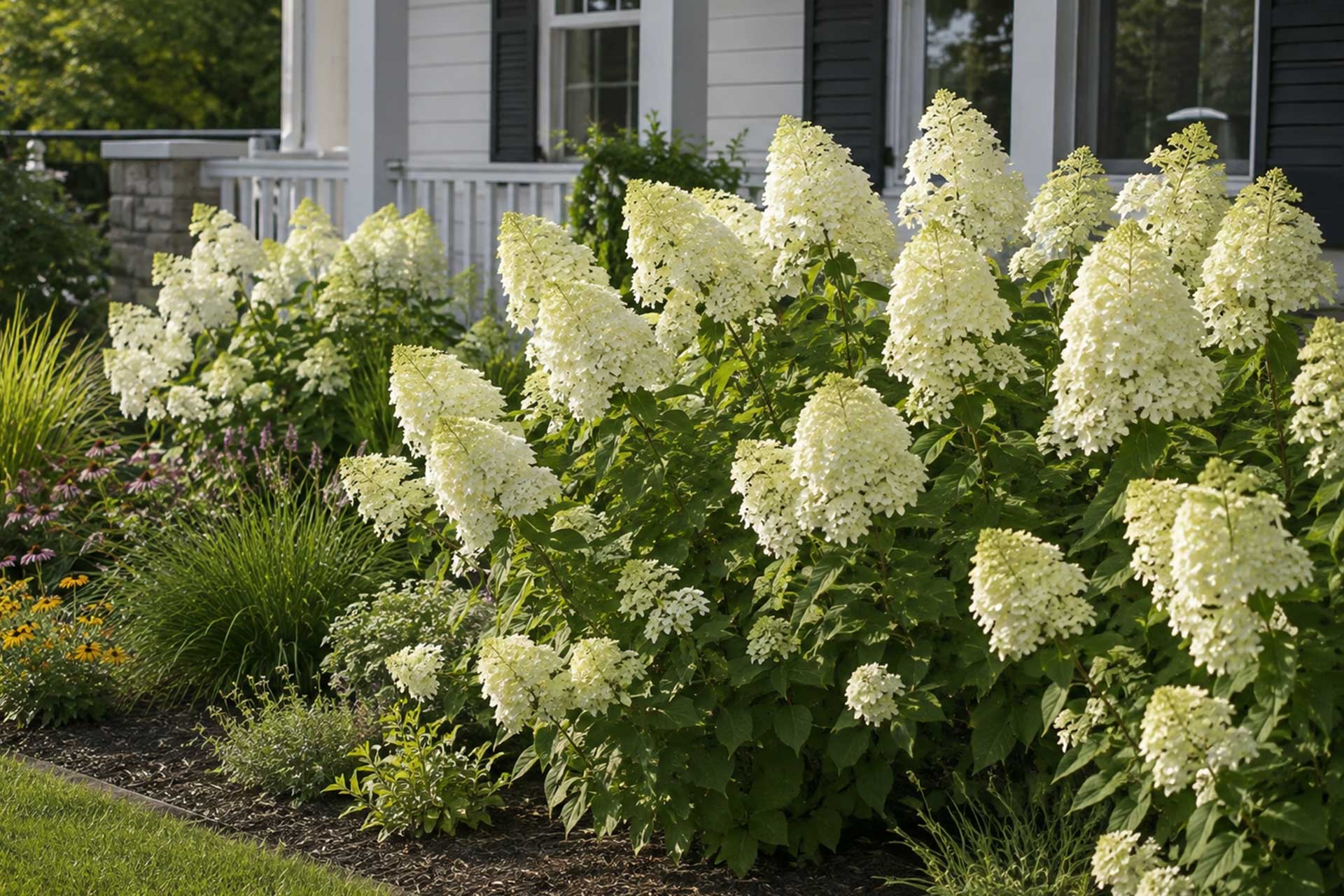
By midsummer, panicle hydrangeas begin producing their characteristic cone-shaped flower clusters.
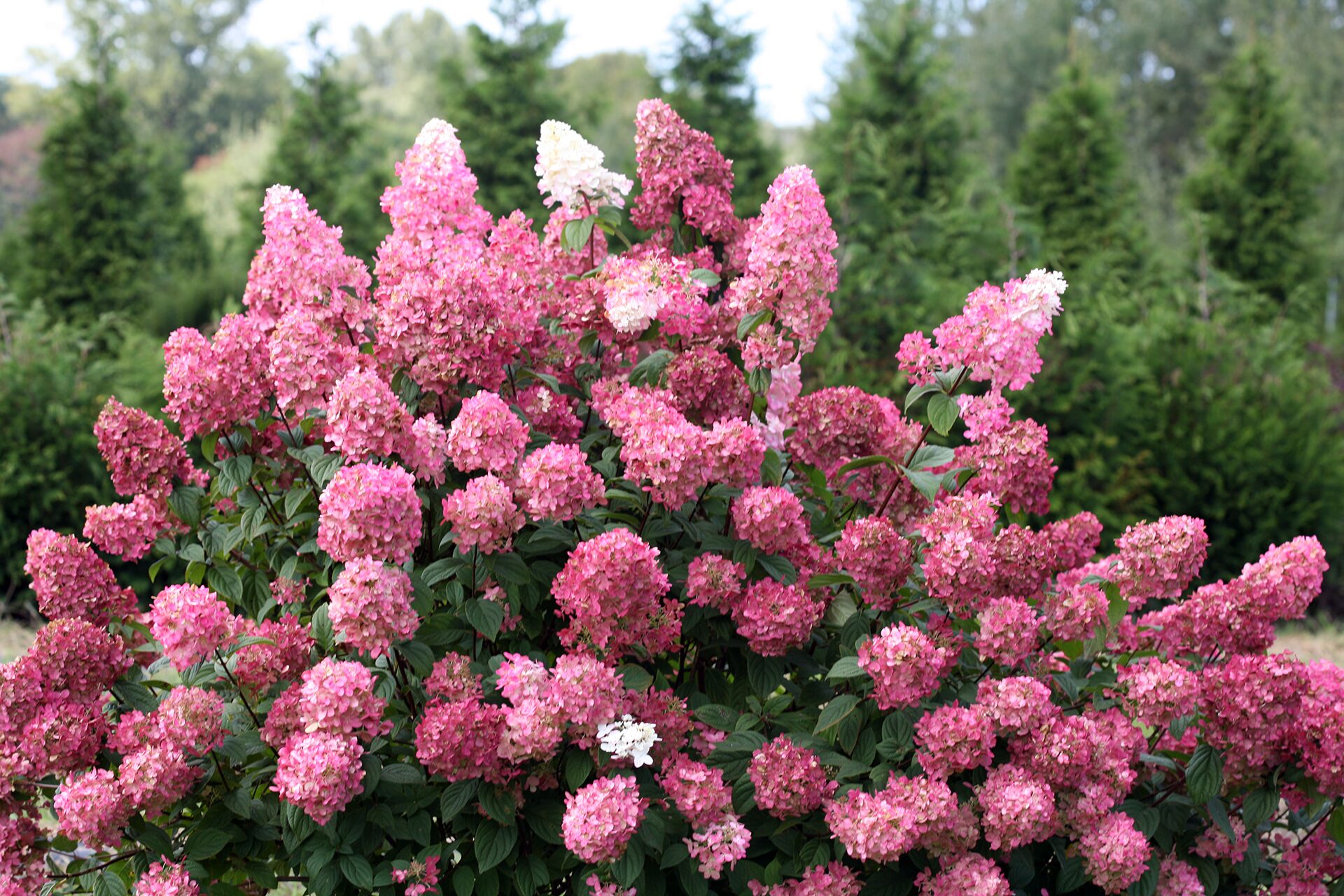
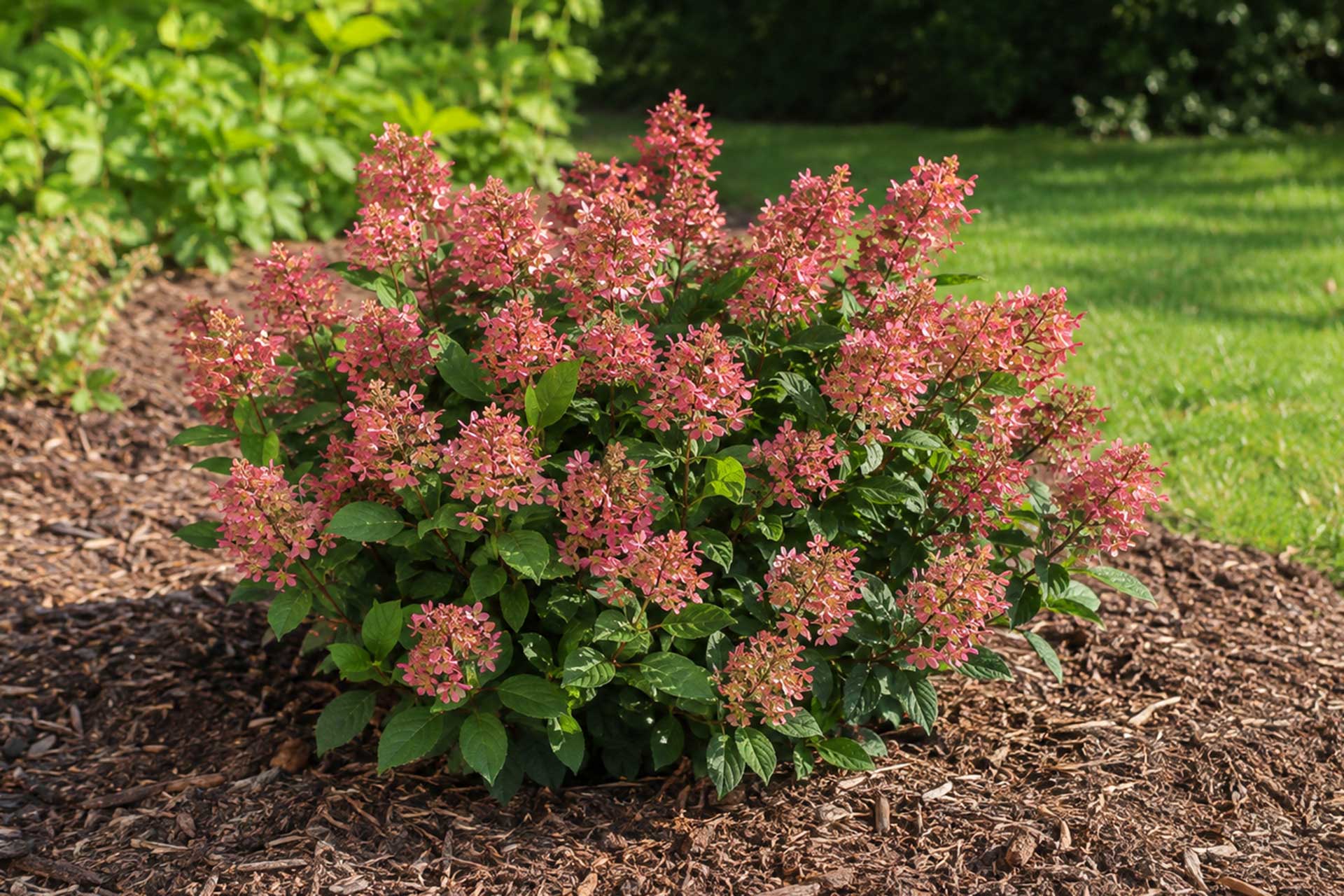
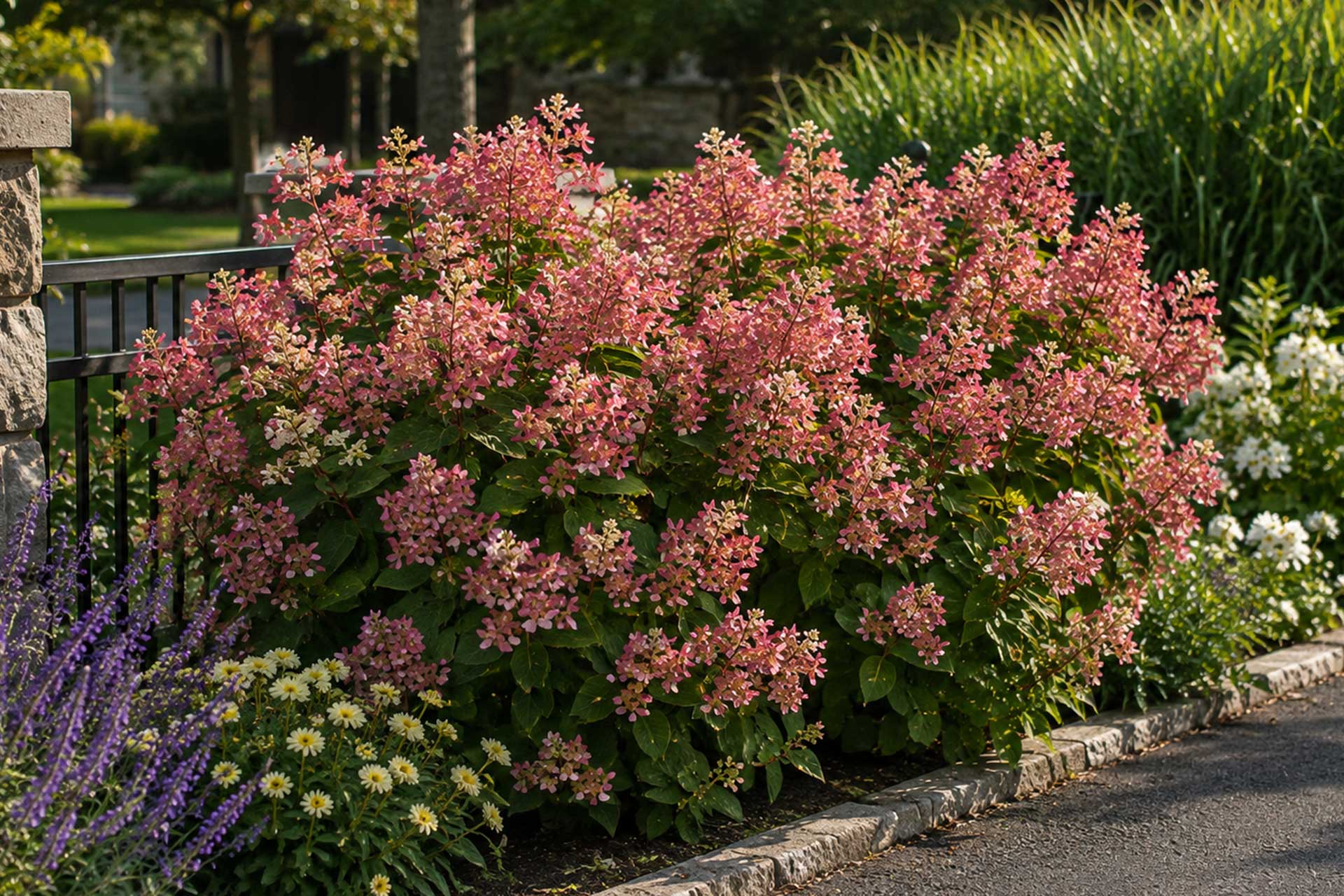
Depending on the cultivar, flowers may emerge creamy white, bright white or greenish, with many varieties developing pink, rose or burgundy tones as they mature.
This is also when repetition can be particularly effective. One hydrangea can be a specimen. A thoughtfully spaced group can become part of the architecture of the garden.
Fall and Winter: Let Them Age a Little
We often like panicle hydrangeas even more as their flowers begin aging into muted pinks, dusty rose, tan and parchment tones.
The effect works particularly well with ornamental grasses, late perennials, stone and the warmer colors of a New England fall landscape. We’ve written about this idea in our guide to plants that bring fall interest to Boston-area gardens.
After the leaves drop, some homeowners leave the dried flower heads for winter texture while others prefer a cleaner look. Either approach can work.
Where Do Panicle Hydrangeas Grow Best in Massachusetts?
Panicle hydrangea is adaptable, but we still look closely at sunlight, drainage and available space.
Sun
Panicle hydrangeas can grow in full sun to part shade and generally handle considerably more sun than many other hydrangeas.
Still, “full sun” on a plant label doesn’t tell the whole story.
A bed receiving good morning and midday sun is different from one beside a west-facing stone terrace radiating heat on an August afternoon. We look at the actual microclimate, not simply the number of hours of sunlight.
Soil and Moisture
Moist, fertile, well-drained soil is ideal.
The “well-drained” part matters. Panicle hydrangea can handle regular moisture, but we wouldn’t use it as a solution for a low area that stays saturated after storms.
At the other extreme, established panicle hydrangeas can be more forgiving of temporary dry periods than their lush flowers suggest. That’s one reason we include them in our guide to drought-tolerant plants for Boston landscapes.
Newly planted hydrangeas still need consistent water while their roots establish.
Choosing the Right Panicle Hydrangea
This is where we’d spend some time if we were standing with a homeowner looking at an empty planting bed.
“Panicle hydrangea” isn’t specific enough anymore. Cultivars vary considerably in mature size, flowering time and habit.
A few common examples show the range:
| Cultivar | Typical Mature Size | Where It Can Work |
|---|---|---|
| Bobo® | About 3′ × 3′ | Smaller beds and compact planting compositions |
| Little Lime® | About 3–5′ × 3–5′ | Residential borders where a full-size Limelight would be too large |
| Little Quick Fire® | About 3–5′ × 3–5′ | Smaller gardens where earlier bloom is useful |
| Limelight® | Larger shrub | Larger borders, mass plantings and areas where substantial presence is needed |
| Quick Fire® | Larger shrub | Larger plantings where earlier flowering helps extend the season |
Plant breeders have given designers much more control over size, which is good news. But it also makes reading the plant label more important than ever.
We wouldn’t put a full-sized panicle hydrangea three feet from a walkway and plan to solve the problem with pruning. We’d choose a cultivar whose natural dimensions fit the space.
Where Panicle Hydrangeas Work Best in a Landscape
The question isn’t simply whether a hydrangea will survive somewhere. We want to know whether it improves the composition.
Foundation Plantings
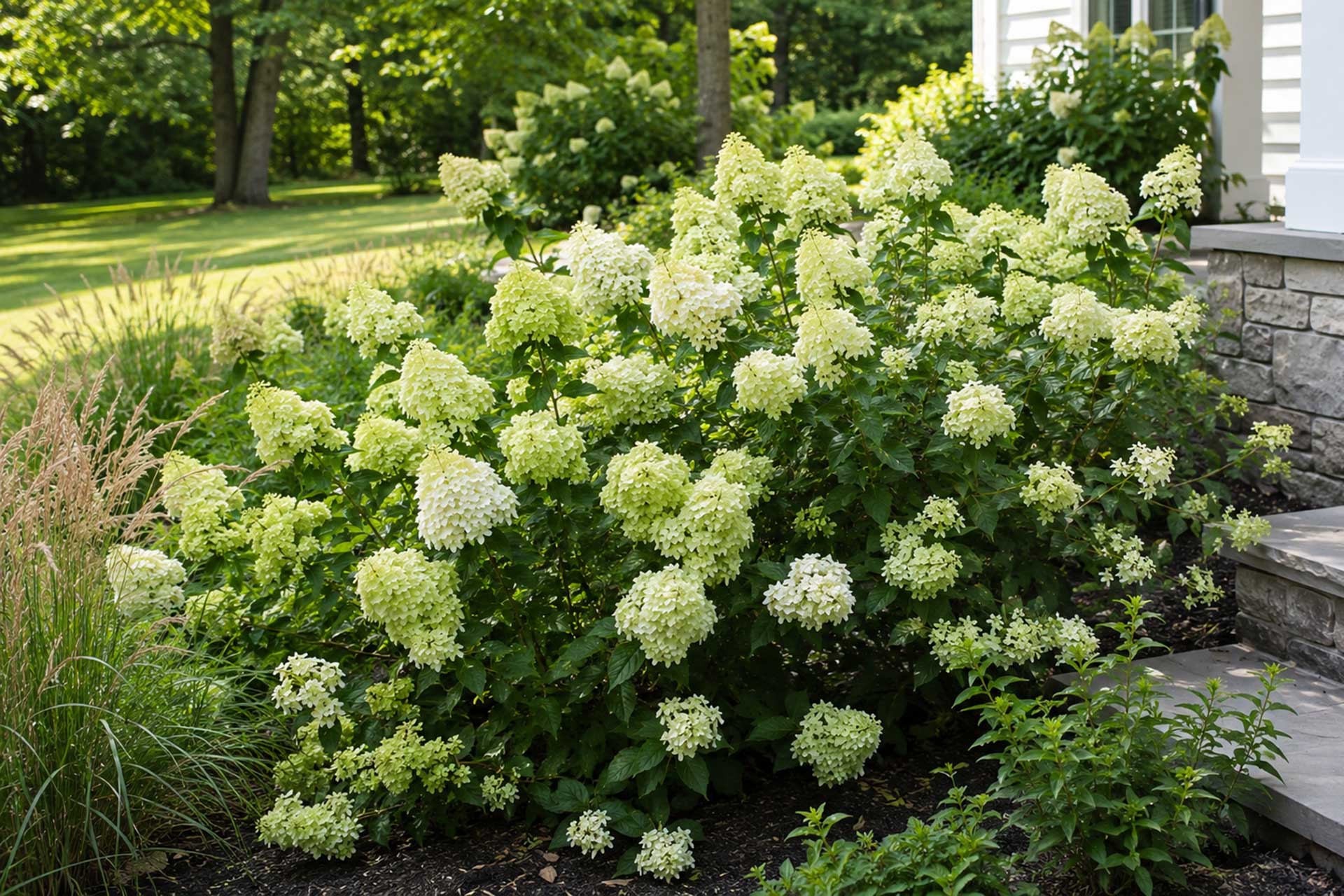
Panicle hydrangeas can provide enough volume to relate to the architecture of a house while softening walls, windows and hardscape.
But scale matters. A large cultivar under a low window or beside a narrow front walk is asking for trouble.
As we discuss in our guide to foundation landscaping for Boston homes, good foundation planting depends on scale, spacing and year-round composition.
Mixed Borders and Outdoor Living Areas
This may be one of our favorite uses.
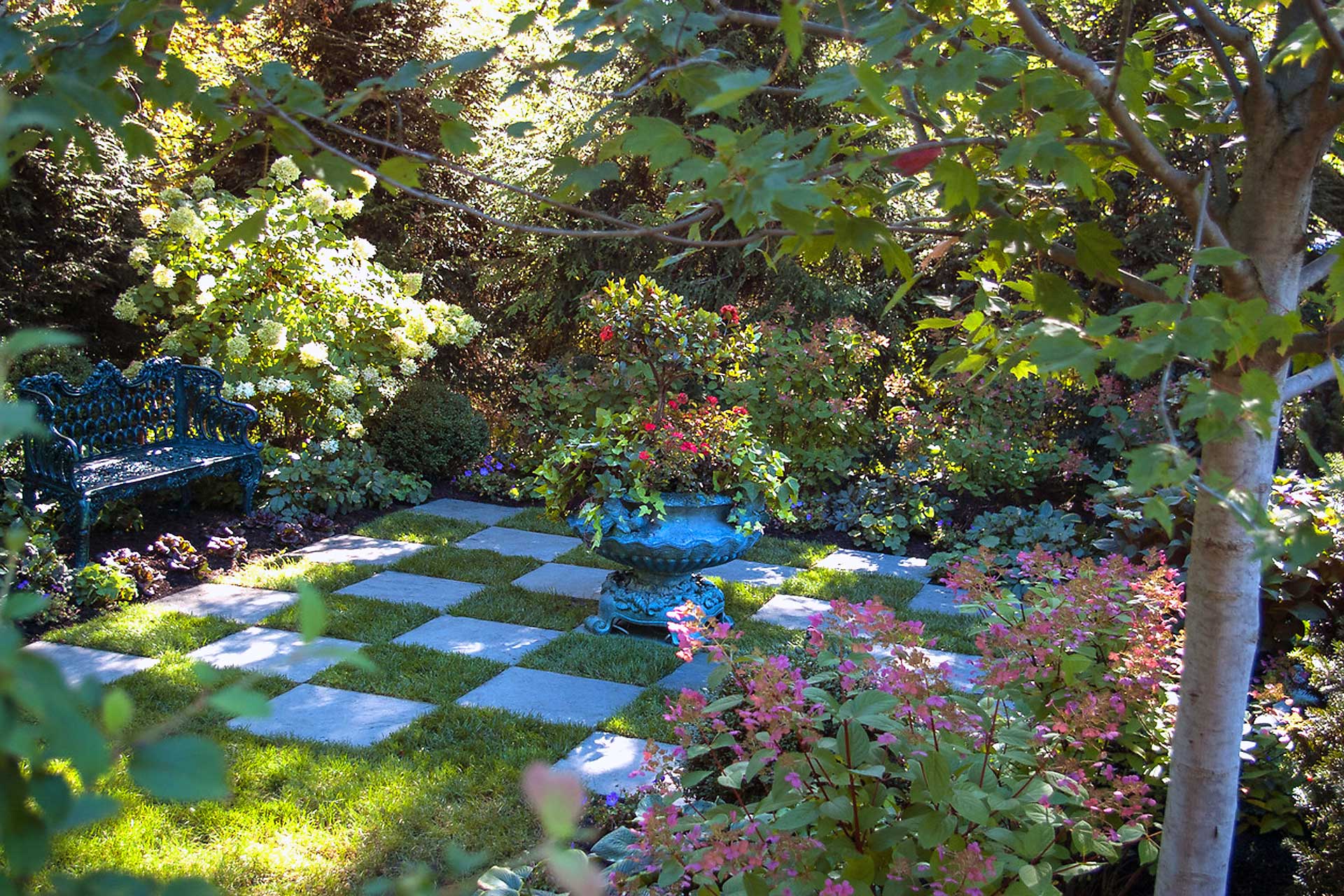
Panicle hydrangeas combine well with evergreen structure, smaller shrubs, ornamental grasses, perennials and groundcovers. They can also soften patios and terraces when there’s enough room for the plants to develop naturally.
The hydrangea provides mass and summer bloom while other plants carry different seasons.
Informal Screening
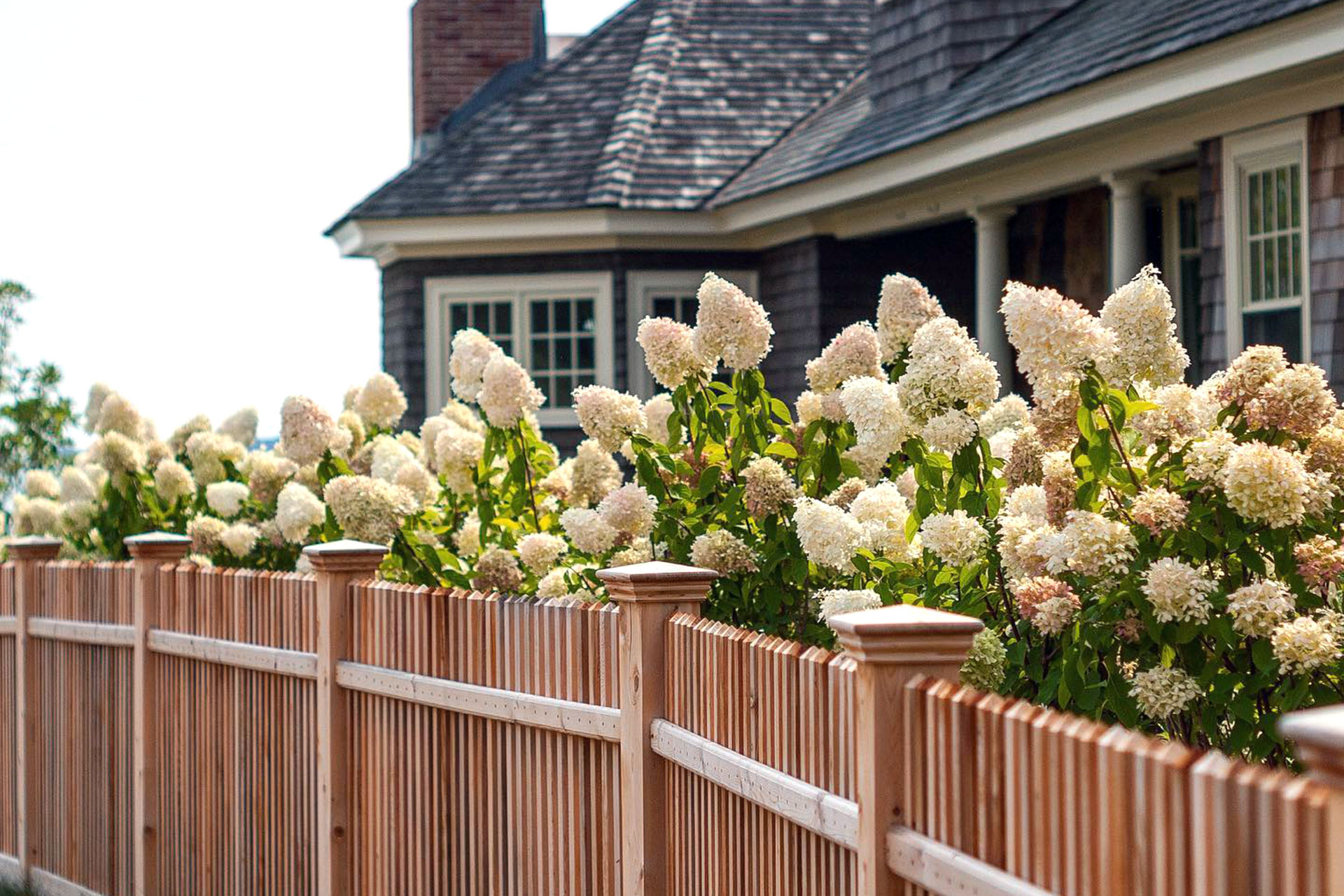
Panicle hydrangeas can provide considerable summer fullness and can work well in mixed screens, something we discuss in Creating Privacy With Trees and Hedges in Residential Landscapes.
But they’re deciduous.
If you need screening from a neighbor’s house in February, hydrangeas aren’t going to solve that problem by themselves. We might instead use them as the flowering layer in front of evergreen structure.
Repetition and Massing
We often prefer repeating the same cultivar through a planting rather than scattering several unrelated flowering shrubs around a property.
Repetition creates rhythm and allows the flowers to read as part of the larger landscape rather than isolated decorations.
Where We Wouldn’t Use Panicle Hydrangea
We like this plant. That doesn’t mean we recommend it everywhere.
We’d think twice about using panicle hydrangea:
- in deep shade where flowering and form are likely to suffer
- in poorly drained soil that stays saturated
- where deer pressure is severe and there’s no management strategy
- in a narrow bed that can’t accommodate the cultivar’s mature size
- where year-round privacy is the primary objective
- where the planting already relies too heavily on large flowering shrubs
That last point is worth considering. Hydrangeas are so effective that it’s easy to use too many of them.
Sometimes the better choice is an evergreen, a native shrub with berries, an ornamental grass or simply a quieter foliage plant.
The goal isn’t to fit a hydrangea into every available opening. It’s to create a landscape that feels balanced.
What Should You Plant With Panicle Hydrangeas?
We think about companion plants in terms of what the hydrangea is missing rather than which plants happen to look good next to it at the garden center.
Evergreen Structure
Because panicle hydrangeas are deciduous, evergreens can hold the composition together after the hydrangeas lose their leaves.
Depending on the site, that might mean inkberry, holly, boxwood or a larger evergreen backdrop.
Finer Texture
Hydrangea foliage and flowers can feel visually heavy. Grasses and fine-textured perennials provide useful contrast and movement.
Our guide to ornamental grasses for Boston-area landscapes explores several options for creating that softer texture.
Lower and Seasonal Layers
Groundcovers and lower perennials help connect a large shrub to the ground plane, while bulbs, flowering trees, earlier perennials and fall grasses keep the garden from peaking all at once.
That’s the larger goal: not simply finding plants that coexist, but building a composition that changes throughout the year.
How Much Maintenance Does a Panicle Hydrangea Need?
Panicle hydrangeas are relatively manageable when they’re planted in the right location. A correctly sized plant may need periodic pruning, watering during dry periods, mulch and routine monitoring. A hydrangea that’s twice as large as the available space becomes a maintenance project.
Good plant selection is one of the simplest forms of long-term landscape maintenance.
When Should Panicle Hydrangeas Be Pruned in Massachusetts?
This is one of the species’ biggest advantages.
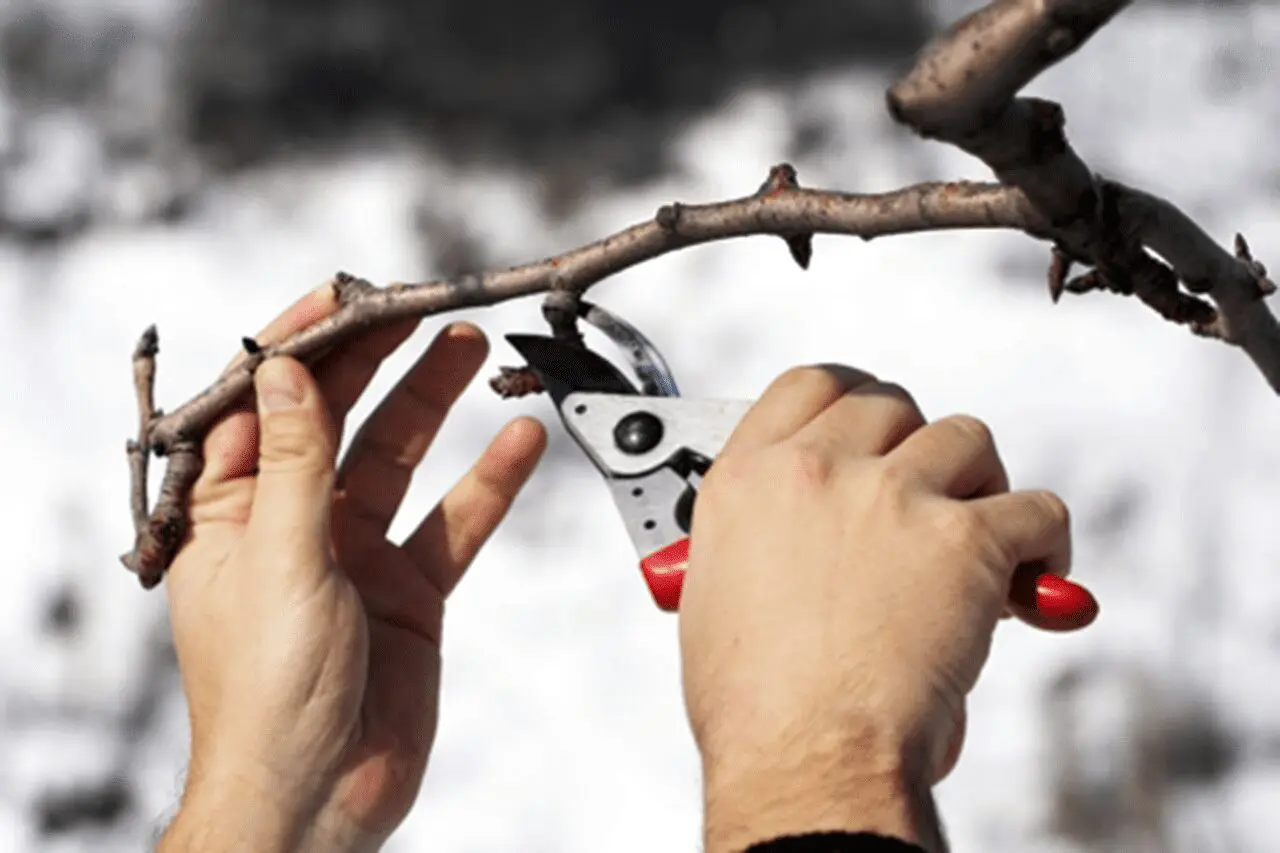
Panicle hydrangeas bloom on new wood, meaning flowers develop on growth produced during the current season. University of Maryland Extension horticulturists recommend early spring as a typical pruning period for Hydrangea paniculata.
As Extension horticulturist Emily wrote when answering a homeowner’s pruning question:
“These Hydrangea bloom on new wood and are very hardy.”
Our Boston landscape maintenance calendar explains this distinction in more detail. Panicle hydrangeas can generally be pruned in late winter or very early spring without sacrificing that summer’s flowers.
But being able to prune heavily doesn’t mean we always should.
We prefer pruning that improves structure and removes weak or crossing growth. If annual pruning is primarily an attempt to keep a six-foot shrub in a three-foot space, we’d rather reconsider the plant.
Are Panicle Hydrangeas Deer Resistant?
We wouldn’t describe them that way.
Deer browsing varies tremendously from one Massachusetts property to another. A plant largely ignored in one garden may be regularly browsed a few miles away.
If deer pressure is significant, we’d factor that into the entire planting plan rather than depending on panicle hydrangea as a resistant shrub.
Are Panicle Hydrangeas Native?
No. Hydrangea paniculata is native to eastern Asia.
Does that mean we wouldn’t use it? No.
We value native plants and the ecological benefits they bring to residential landscapes, but we don’t believe every ornamental plant has to perform exactly the same role.
A thoughtfully designed landscape might combine native canopy trees, berry-producing shrubs, pollinator-supporting perennials and groundcovers with selected non-native ornamentals that provide structure or a particular seasonal effect.
The more useful question is what the entire landscape is doing.
Panicle Hydrangea vs. Other Hydrangeas
The name “hydrangea” covers plants that behave quite differently.
| Hydrangea Type | Botanical Name | Bloom Habit | General Character |
|---|---|---|---|
| Panicle | H. paniculata | New wood | Sun tolerant, hardy, cone-shaped flowers |
| Smooth | H. arborescens | New wood | Rounded flowers, adaptable, includes North American native species |
| Bigleaf | H. macrophylla | Often old wood; some rebloomers differ | Familiar mophead/lacecap flowers, more sensitive to winter bud damage |
| Oakleaf | H. quercifolia | Old wood | Distinctive foliage, flowers and strong fall interest |
That’s why “my hydrangea isn’t blooming” isn’t enough information for us to diagnose the problem.
We first want to know which hydrangea you have.
So, Is Panicle Hydrangea a Good Choice for a Massachusetts Landscape?
In many cases, absolutely.
It’s one of those shrubs we return to because it combines reliable flowering, adaptability, useful scale and a long season of interest. It works with traditional New England architecture, contemporary landscapes, informal gardens and more structured planting designs.
But the best panicle hydrangeas we see aren’t necessarily the biggest or the ones with the most flowers. They’re the ones that look as though they naturally belong where they were planted.
They have enough room. Their scale makes sense next to the house. Other plants carry the landscape before and after they bloom. And nobody has to fight them every spring with a pair of pruning shears just to keep them in bounds.
A good plant isn’t simply one that grows in Massachusetts. It’s one that can grow into the space you’ve given it and become a better part of the landscape as it matures.
Frequently Asked Questions About Panicle Hydrangeas
Q: How big do panicle hydrangeas get?
A: It depends heavily on the cultivar. Compact varieties may mature around 3 feet tall and wide, while traditional forms can reach 10 feet or considerably larger. Choose based on the mature dimensions of the specific cultivar rather than its size at purchase.
Q: Can panicle hydrangeas grow in full sun?
A: Yes. They generally tolerate more sun than many other hydrangea species and can perform well in full sun in Massachusetts when soil moisture is adequate.
Q: When should I prune panicle hydrangeas in Massachusetts?
A: Late winter or early spring is generally a good time. Panicle hydrangeas bloom on new wood, so pruning before new growth gets underway does not remove flower buds formed the previous season.
Q: Are panicle hydrangeas deer resistant?
A: Not reliably. On properties with significant deer populations, they should be used as part of a broader deer-management and plant-selection strategy.
Q: What’s the best panicle hydrangea for a small garden?
A: Compact cultivars such as Bobo®, Little Lime® and Little Quick Fire® can be better suited to smaller spaces than full-size forms. The best choice still depends on the available space, sunlight, surrounding plants and the role the shrub needs to play.
Choosing Plants as Part of the Larger Landscape
Plant selection works best when we stop looking at shrubs one at a time.
A panicle hydrangea may be exactly right for one corner of your property and completely wrong twenty feet away. Sun, drainage, architecture, mature size, neighboring plants and the way you use the space all change the answer.
At a Blade of Grass, our landscape designers look at those relationships across the entire property. If you’re planning a new garden, renovating established planting beds, or trying to make an existing landscape feel more cohesive, contact us to start a conversation about your property.
Sources and Further Reading