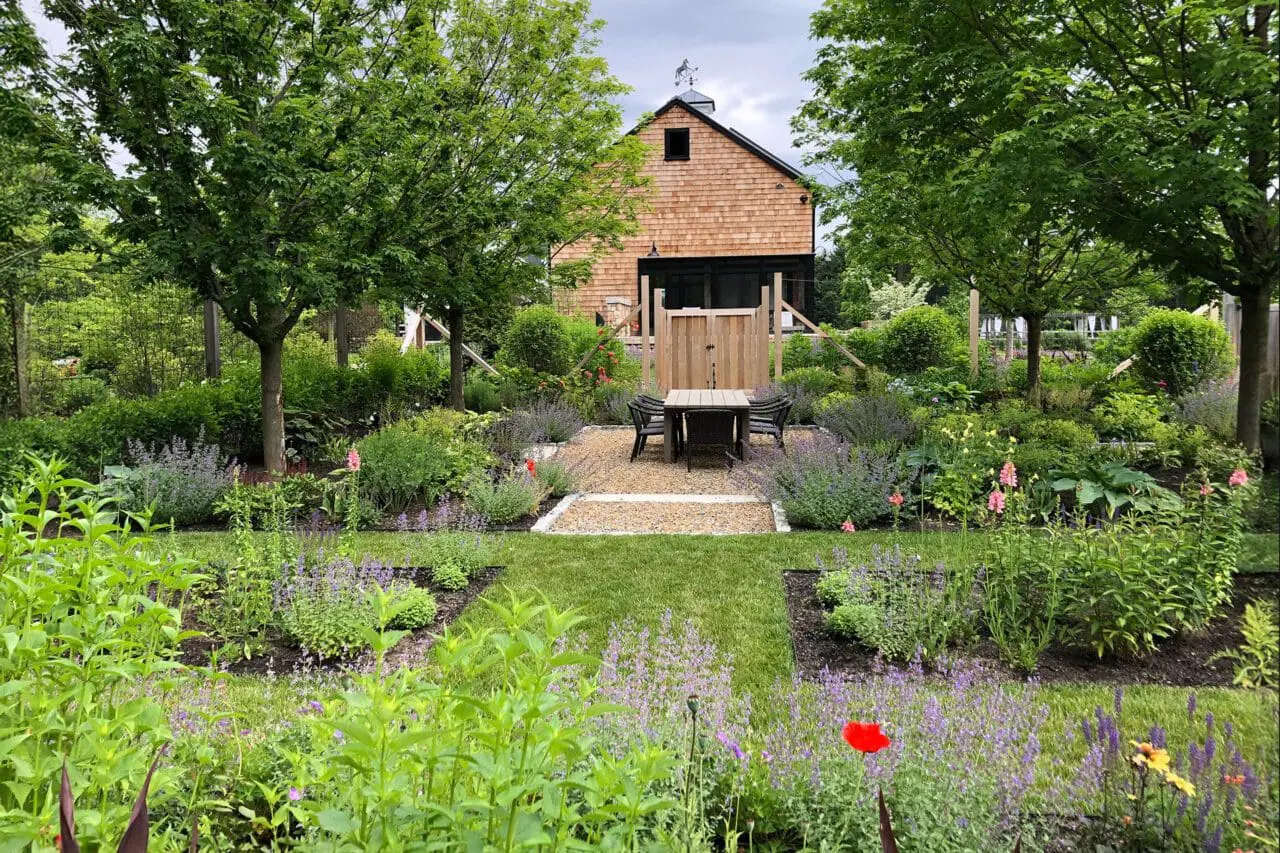
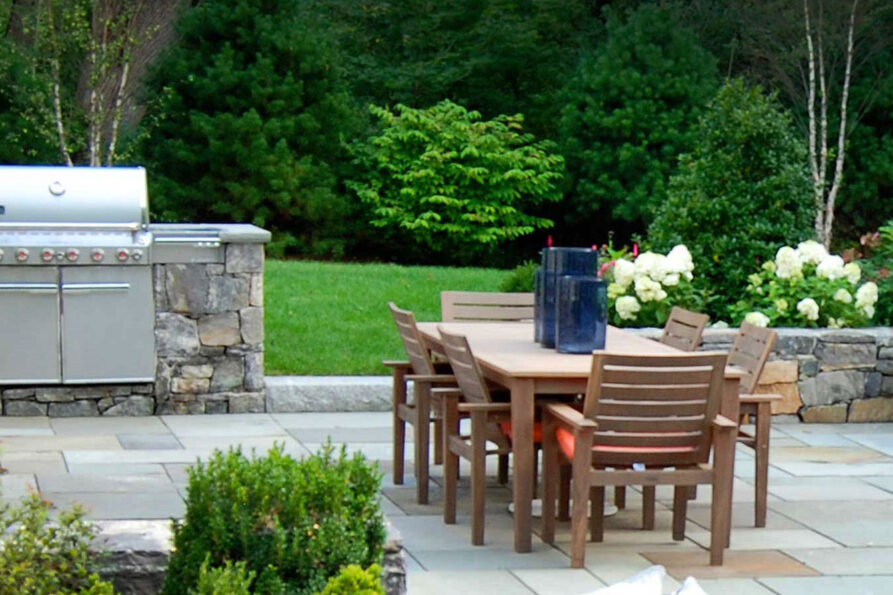
The driveway is one of the first things people experience when they arrive at a home, yet it is often planned as a purely functional surface. It brings cars in from the street, provides guest parking, connects to the garage, and supports the daily rhythm of the household. On many Greater Boston properties, however, the driveway also plays a major visual role in the front landscape.
When the layout feels awkward, the paving is too dominant, or guests are unsure where to park, the arrival experience can feel less polished than the home itself. On larger properties in Weston, Wellesley, Dover, Concord, Lincoln, and Carlisle, a long drive or motor court may need to create a graceful approach from the street to the house. On tighter lots in Newton, Brookline, Cambridge, Belmont, Needham, and Sudbury, the design may need to balance parking, privacy, planting, drainage, and curb appeal within a much smaller footprint.
This is where driveway landscape design becomes more than paving. A well-designed driveway, motor court, or arrival court can frame the architecture, organize vehicle and pedestrian movement, reduce visual clutter, manage stormwater, improve lighting, soften hardscape, and make the property feel more intentional from the moment someone arrives.
For homeowners planning a renovation, addition, front yard redesign, garage update, or larger landscape improvement, the arrival experience deserves the same level of care as the patio, garden, pool, or outdoor kitchen.
Key Takeaways
- Driveways, motor courts, and arrival courts shape the first impression of a Boston-area home.
- A well-designed arrival area should organize vehicles, guests, pedestrians, planting, lighting, drainage, and architecture.
- Drainage and stormwater planning should happen before paving decisions are finalized.
- Planting around driveways must be selected for scale, visibility, snow, salt, heat, and maintenance needs.
- Lighting should be planned early so fixtures, conduit, walls, steps, and planting work together.
- The best driveway landscape design feels practical, polished, and connected to the whole property.
Why the Driveway Shapes the Whole Property
The driveway is not separate from the landscape. It affects how people see the house, how they move through the property, where water flows, where snow is stored, how plants survive, and how the home feels from the street.
In many Boston-area landscapes, driveway problems are easy to overlook because homeowners have lived with them for years. The garage doors face the street. Guests park awkwardly near the front walk. The driveway cuts through the best part of the front yard. Planting beds feel like leftover strips along the edge of pavement. The house may be attractive, but the arrival experience feels unresolved.
A thoughtful driveway or motor court design can help solve several issues at once:
- Clarify the route from the street to the front door.
- Create a more graceful arrival sequence.
- Provide practical guest parking and turnaround space.
- Reduce the visual dominance of asphalt or paving.
- Improve drainage and snow management.
- Frame views of the home and garden.
- Coordinate lighting, planting, edging, and hardscape materials.
- Protect lawns, trees, and planting beds from vehicle wear.
This is especially important for established properties where the original driveway may no longer fit how the home is used. A house addition, new garage, expanded household, renovated entry, or mature landscape can all change what the driveway needs to do.
Driveway, Motor Court, and Arrival Court: What Is the Difference?
These terms are sometimes used casually, but each one describes a slightly different design condition.
Driveway
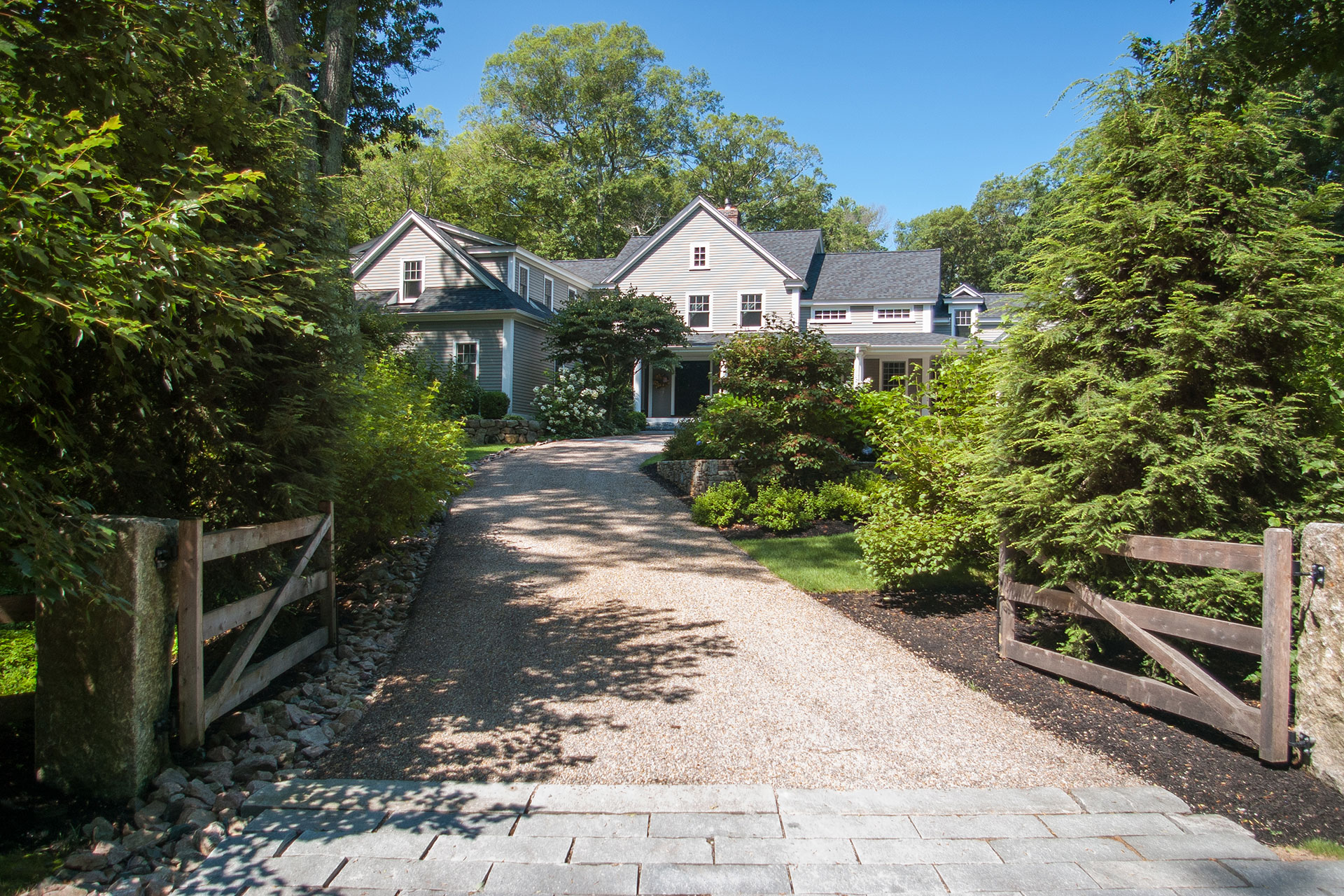
The driveway is the main vehicle route from the street to the home, garage, parking area, or service area. On some properties, it is short and direct. On others, it may curve through the landscape or travel a significant distance before reaching the house.
Motor Court
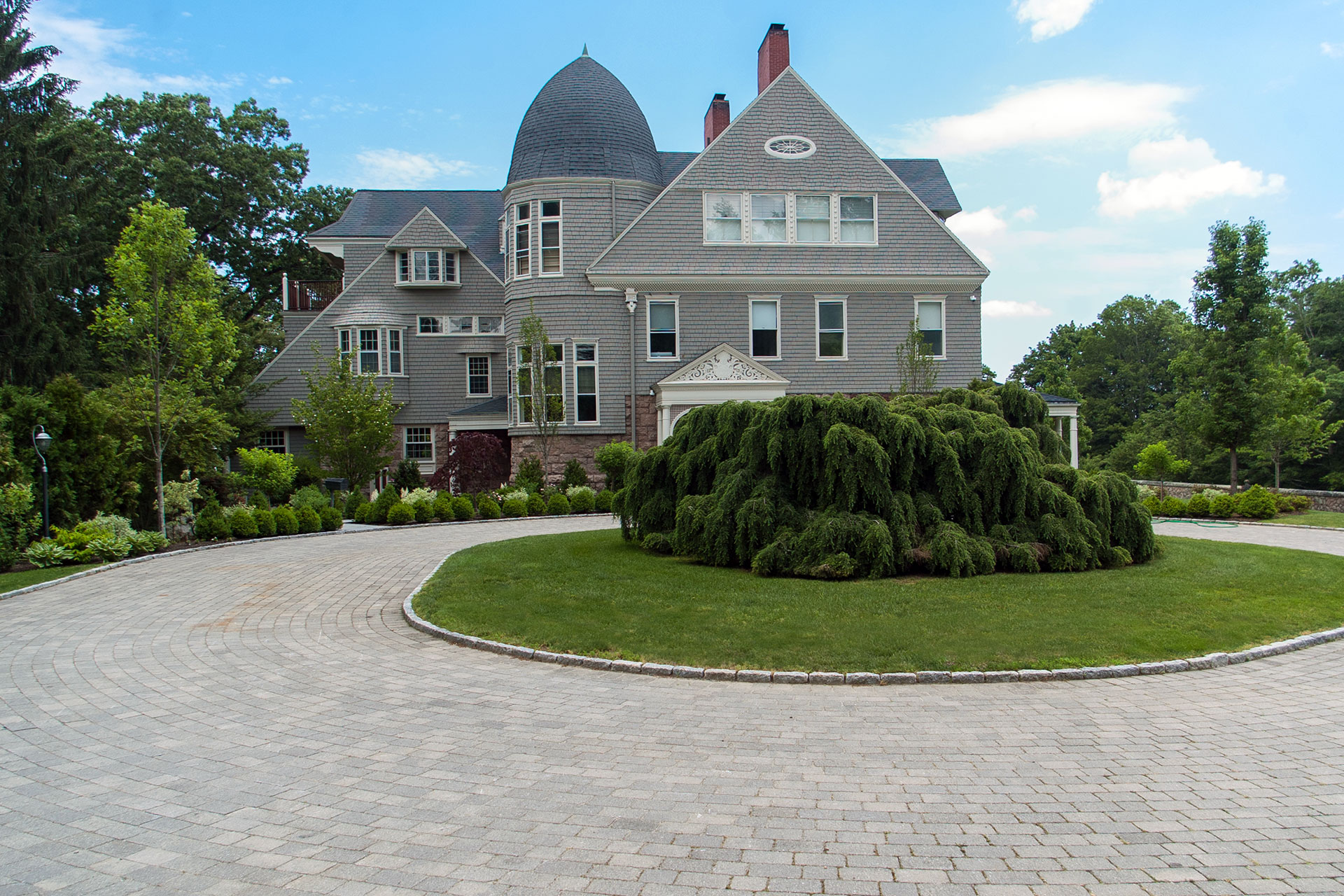
A motor court is a more formal vehicle arrival and turnaround area, often located near the front entry, garage, or guest entrance. It may serve everyday parking, guest drop-off, and circulation. On larger properties, a motor court can feel almost like an outdoor room made of paving, stone, edging, planting, and architecture.
Arrival Court
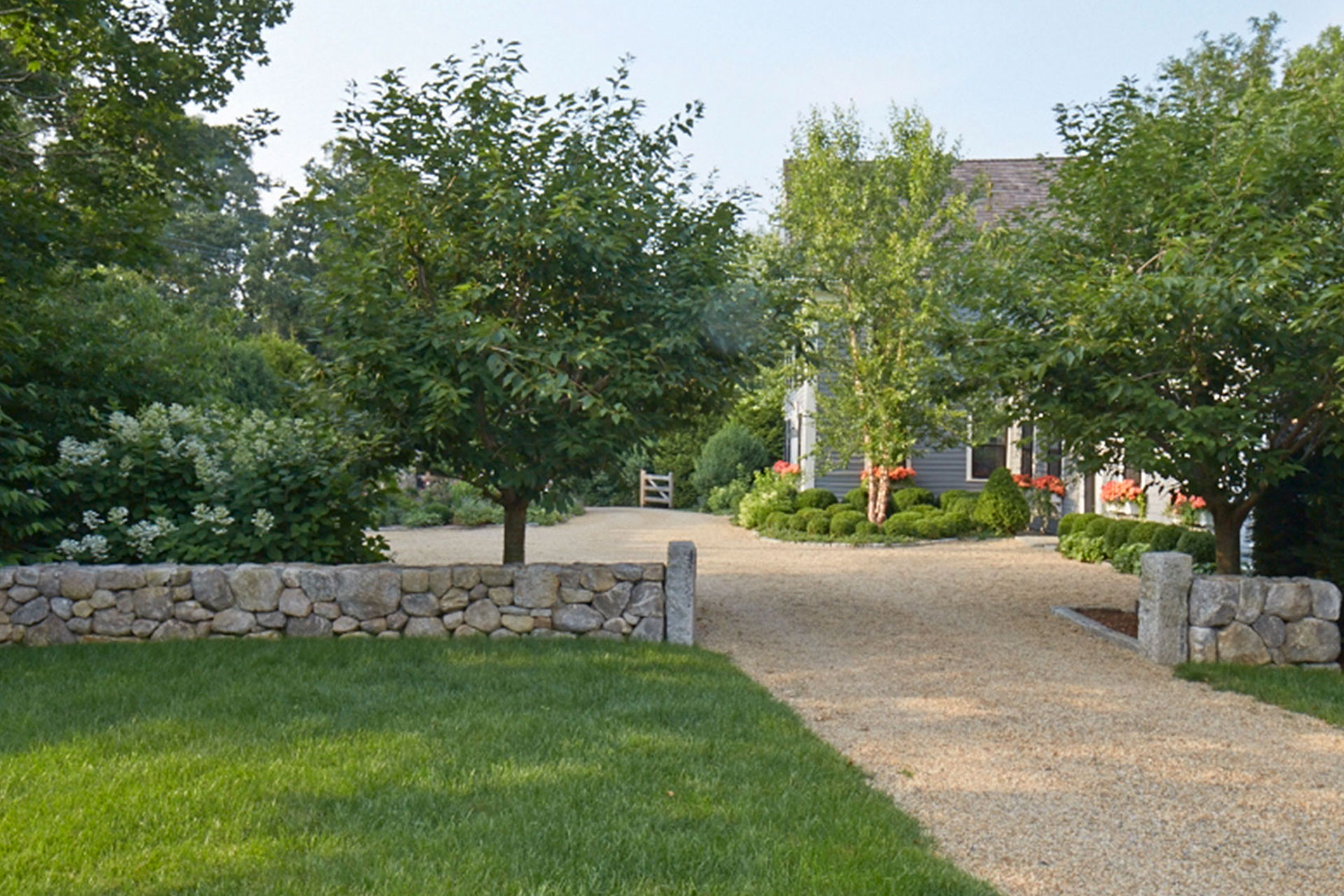
An arrival court is the broader designed arrival area where vehicles, pedestrians, planting, lighting, and the architecture come together. It may include a motor court, front walk, entry garden, walls, steps, containers, gates, or a courtyard-like space.
For a Blade of Grass, the most successful arrival areas are not defined by one feature. They are designed as part of the full landscape design.
Related Blog: Curb Appeal by Design for Boston Homes
Common Driveway Design Challenges Around Greater Boston
Every property is different, but certain driveway and arrival court issues come up often across Greater Boston, MetroWest, and Cape Cod.
The Driveway Dominates the Front Yard
On many properties, the paved surface is the first thing visitors see. This can happen when the driveway is too wide, too straight, too exposed, or not balanced by planting. A large expanse of asphalt can make even a refined home feel more utilitarian than welcoming.
The solution is rarely just adding plants along the edges. The better question is how the driveway, lawn, trees, walkway, front entry, lighting, and architecture should work together.
Guests Do Not Know Where to Park
A beautiful front entry can still feel awkward if guests are unsure where to stop, park, or walk. This is common on properties with long driveways, side-loaded garages, circular drives, or deep setbacks.
A good arrival court design makes movement intuitive. Parking areas, turnaround space, pathways, and lighting should quietly guide visitors without relying on signage or explanation.
The Garage Overpowers the Arrival
Many newer and renovated homes have prominent garages. If the driveway leads directly to large garage doors, the front door can become visually secondary. Landscape design can help shift attention back toward the entrance through planting, walls, paving transitions, lighting, and a more deliberate pedestrian route.
Drainage Problems Appear Near the Driveway
Driveways collect and shed a significant amount of water. If grading is poor, runoff can move toward the garage, foundation, lawn, planting beds, walkway, or neighboring property. In New England, freeze-thaw cycles can make drainage problems more visible through cracking, heaving, erosion, and icy surfaces.
The EPA notes that permeable pavement alternatives can help reduce runoff by allowing rainwater and melting snow to move through the surface into underlying soil and gravel layers. These systems may include pervious asphalt, pervious concrete, interlocking pavers, and grid pavers. The EPA’s Soak Up the Rain program describes permeable pavement as one tool for reducing runoff and filtering pollutants.
Permeable paving is not right for every driveway or every site, but stormwater should always be part of the conversation. For properties with recurring runoff or wet areas, see our guidance on when a yard may need a professional drainage solution.
Existing Trees Are at Risk
Driveway changes can affect mature trees through root disturbance, soil compaction, grade changes, excavation, and construction traffic. UMass Extension explains that soil compaction can reduce oxygen availability in the soil, limiting root respiration and nutrient uptake. Their guidance on compaction and cultivation notes that oxygen is essential for root respiration and growth.
That matters when a driveway is widened, regraded, or rebuilt near established trees. The design should consider root zones, construction access, drainage, and long-term plant health before equipment arrives.
Designing the Arrival Sequence
A strong arrival sequence is not only about how the driveway looks from the street. It is about how the property reveals itself.
On some homes, the arrival should feel understated and traditional. On others, especially larger properties, it may feel more formal, with a clear progression from road to drive, drive to court, court to entry, and entry to garden. In compact urban or suburban settings, the goal may be to create a calm, organized transition from street exposure to private home.
Start With the View From the Street
The first question is simple: what does someone see when approaching the property?
The answer may include a garage, a front door, a mature tree, a stone wall, a hedge, a driveway apron, a slope, a fence, or a broad open lawn. A designer looks at how those elements work together and whether they support the character of the home.
For example, a Colonial home in Wellesley may need a more symmetrical and restrained arrival. A contemporary house in Weston may call for cleaner paving lines, architectural planting, and subtle lighting. A historic home in Concord may benefit from reclaimed stone, softened edges, and planting that feels established rather than newly installed.
Clarify the Pedestrian Route
A common mistake is allowing the driveway to become the default walkway. This can make the front entry feel secondary and create awkward moments when guests walk across vehicle areas.
A better approach is to give pedestrians a clear route. That may mean a stone walk from guest parking to the front door, a landing that connects the motor court to the entry, or a planting bed that separates cars from people without making the space feel cramped.
Use Paving Changes With Restraint
Paving transitions can help signal where to drive, park, turn, or walk. But too many materials can make an arrival court feel busy.
Common options include:
- Asphalt with stone edging for a clean and cost-conscious approach.
- Gravel or stabilized gravel for a softer estate feel where appropriate.
- Granite cobbles at the apron, border, or threshold.
- Natural stone or concrete pavers for smaller courts or pedestrian areas.
- Permeable pavers where stormwater goals, site conditions, and maintenance expectations align.
The material choice should suit the home, the grade, the maintenance plan, and the amount of vehicle use.
Planning for Vehicle Circulation and Everyday Use
A driveway can look beautiful on paper and still fail in daily life if it does not accommodate real movement.
Turning Radius and Maneuvering
The design needs to account for how vehicles enter, turn, park, and leave. This includes family cars, delivery vehicles, contractors, snow removal equipment, and occasional larger vehicles.
On properties with tight lots, ledge, slopes, walls, or mature trees, circulation may require careful layout. On larger properties, the challenge is often the opposite: making a broad paved area feel intentional rather than oversized.
Guest Parking
Guest parking should feel obvious without overwhelming the front landscape. In some cases, this means a widened area near the court. In others, it may mean a small parking bay, a secondary gravel area, or a subtle edge treatment that allows occasional overflow parking without turning the front yard into a lot.
Service Access
High-end residential properties still need practical service access. Landscapers, maintenance crews, caterers, contractors, delivery drivers, and snow removal teams all interact with the driveway. A good design considers how service access works without allowing service needs to define the entire front landscape.
Snow Storage
In Boston and MetroWest, snow storage is part of driveway design. Plowed snow needs somewhere to go without damaging stonework, blocking views, burying important plants, or creating icy pedestrian routes.
This is one reason front-yard planting near driveways should be designed with winter in mind. Salt exposure, snow load, plow damage, and drainage all influence plant selection and placement.
Drainage and Stormwater Should Be Designed Early
Driveways and motor courts are hardscape systems. They change how water moves across the property.
When drainage is treated late, the design can become compromised. Catch basins, trench drains, swales, permeable paving, grading, planting beds, and subsurface drainage should be considered before final paving decisions are made.
The EPA’s stormwater research has found that pervious pavement systems can reduce stormwater runoff volume and help remove solids from runoff. EPA research on permeable pavement and rain gardens highlights how pavement and planting can work together as part of stormwater management.
For residential properties, the right answer depends on the site. A shaded driveway with heavy leaf drop, a steep slope, or a clay-heavy base may require a different solution than a sunny, gently sloped arrival court. Maintenance expectations also matter. Permeable systems, gravel areas, and drainage structures need to be kept functioning.
A Blade of Grass often looks at driveway drainage in relation to the entire property:
- Where does roof runoff go?
- Does driveway runoff move toward the garage or foundation?
- Are there low spots that become icy in winter?
- Will new paving increase runoff toward planting beds or neighboring properties?
- Can grading, planting, or permeable surfaces reduce water problems?
- Will drainage systems be accessible for future maintenance?
This is one of the strongest reasons to involve the landscape design and construction team before a driveway is simply resurfaced.
Related Blog: Why Professional Landscape Drainage Should Be Part of Every Boston Landscape Plan
Planting Around Driveways and Motor Courts
Planting is what keeps driveway landscape design from feeling like an engineering exercise. It softens paving, frames the house, screens views, guides movement, and brings seasonal interest to a highly visible part of the property.
Frame the Approach, Do Not Crowd It
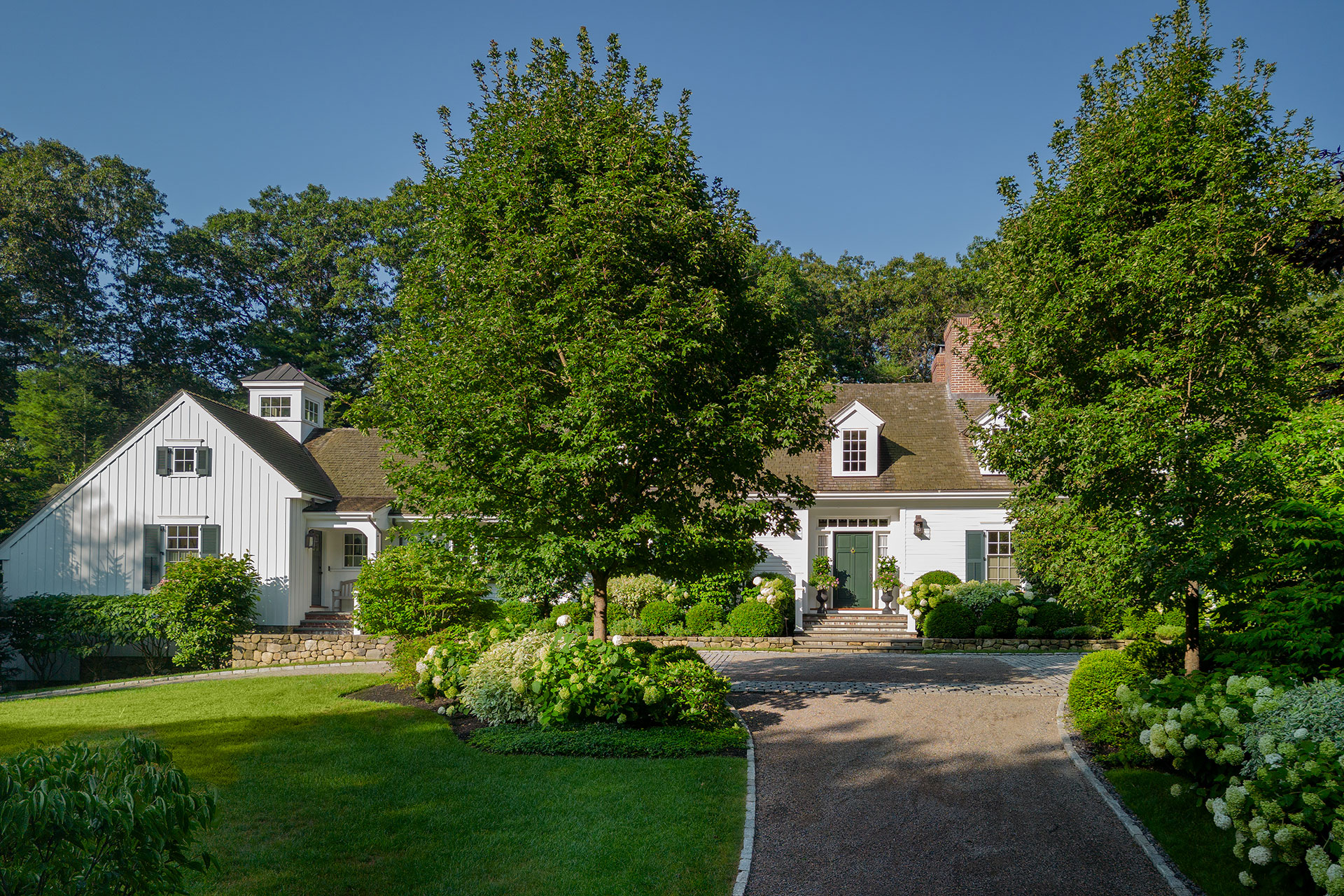
Driveway planting should guide the eye without blocking visibility. Dense shrubs placed too close to the drive can make the approach feel narrow, create winter damage, and reduce sightlines. Overly small plantings, on the other hand, may feel insignificant next to the scale of the paving.
A successful planting plan balances structure and softness. Evergreen shrubs, ornamental trees, layered perennials, groundcovers, and seasonal containers can all play a role.
Choose Plants That Can Handle the Conditions
Driveway edges can be tough places for plants. They may face reflected heat, compacted soil, snow load, salt exposure, and inconsistent moisture. The right plant palette depends on the site, but the design should account for stress before installation.
New plantings also need careful establishment. UMass Extension notes that newly planted trees and shrubs need consistently moist, but not soggy, soil as roots establish. Their guidance on watering new plantings emphasizes thorough watering at planting and steady moisture during establishment.
For a motor court or arrival area, irrigation and maintenance planning can be just as important as plant selection. Blade’s post on proper watering after a new landscape installation explains why establishment care matters after new planting work is complete.
Use Trees Strategically
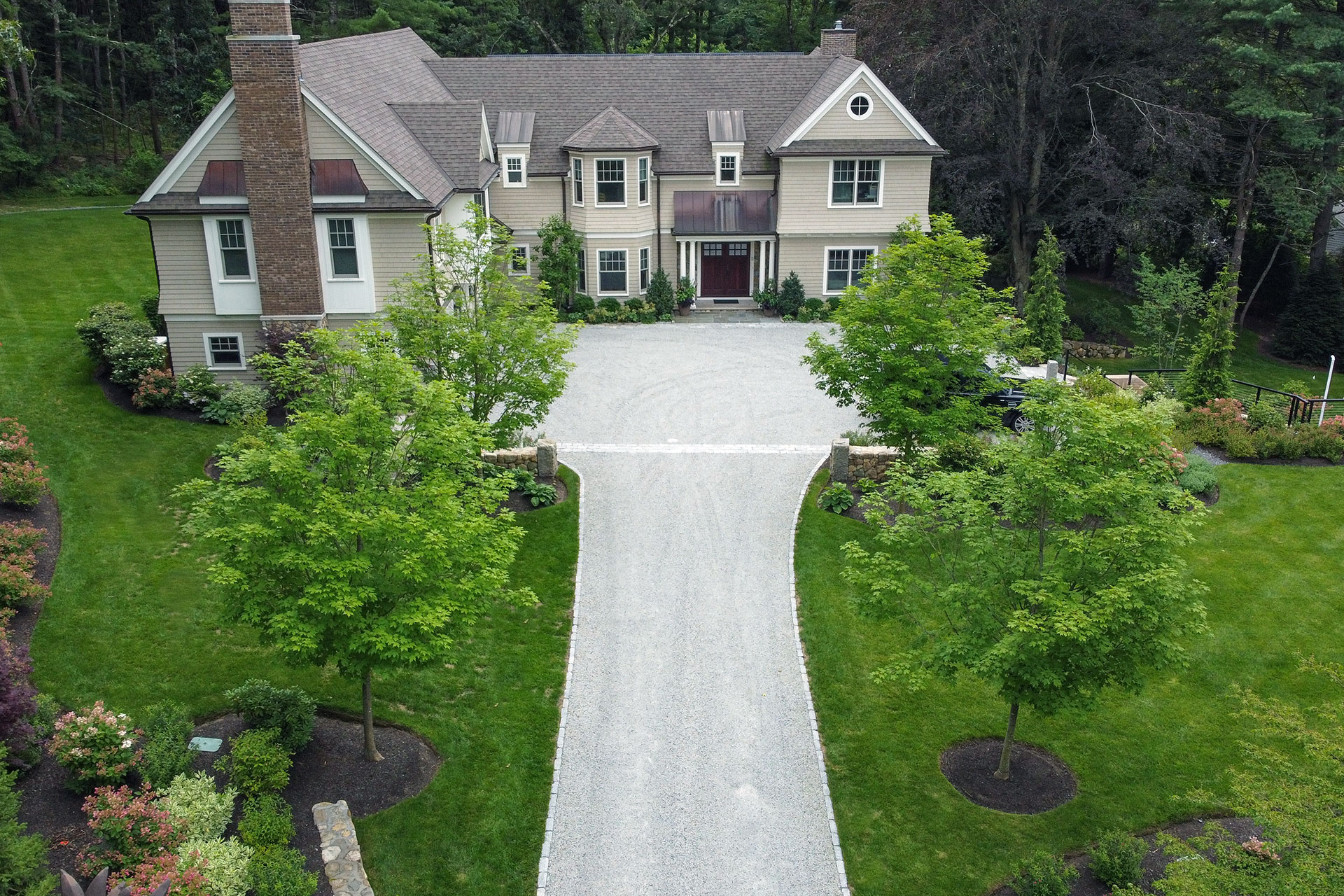
Trees can transform a driveway. They can frame the entry, soften the scale of the paving, create shade, screen neighboring views, and make a long drive feel more composed. But trees should not be placed casually.
Designers consider mature canopy size, root behavior, sightlines, snow clearance, overhead wires, house scale, and maintenance. On older properties, existing trees may become the central organizing feature of the arrival sequence.
Lighting the Arrival Experience
Landscape lighting is especially valuable in driveway, motor court, and arrival court design because it supports both safety and atmosphere.
The goal is not to over-light the front yard. The best lighting feels layered and intentional. It helps people understand where to go while highlighting the architecture and landscape.
Where Lighting Matters Most
Driveway and arrival court lighting may include:
- Subtle entry lighting near the driveway apron or gate.
- Path lights along pedestrian routes.
- Step lights at grade changes and front entry steps.
- Wall lights integrated into stonework.
- Tree uplighting to create depth and structure.
- Low-glare fixtures near guest parking or turnaround areas.
- Lighting near house numbers or address markers.
Lighting should be planned before hardscape is installed whenever possible. Sleeves, conduit, transformer locations, fixture placement, and planting relationships are easier to coordinate before paving, walls, and beds are complete.
For more on how lighting supports the broader landscape, see Blade’s landscape lighting services.
Related Blog: Landscape Lighting Ideas to Highlight Your Boston Property’s Best Features
Material Choices for Boston-Area Driveway Landscapes
The best driveway material is not just the one that looks good on installation day. It needs to work with the home, site conditions, maintenance expectations, budget, and New England weather.
Asphalt With Refined Edging
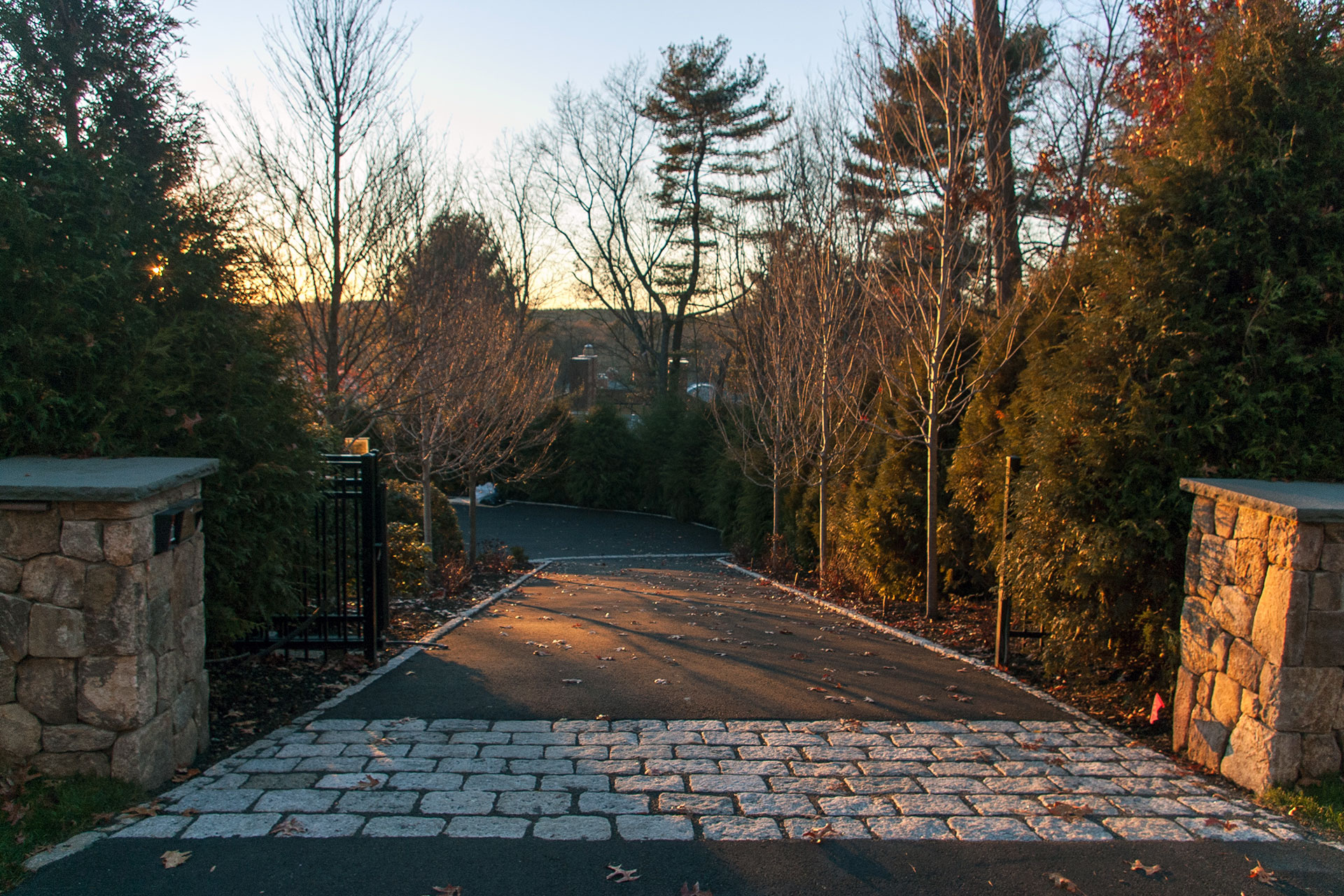
Asphalt is common and practical for many Boston-area homes. It can look more refined when paired with granite cobble, steel edging, stone borders, or thoughtful planting. For long drives, asphalt may be the most practical main surface while higher-end materials are reserved for aprons, thresholds, or arrival courts.
Gravel and Stabilized Gravel
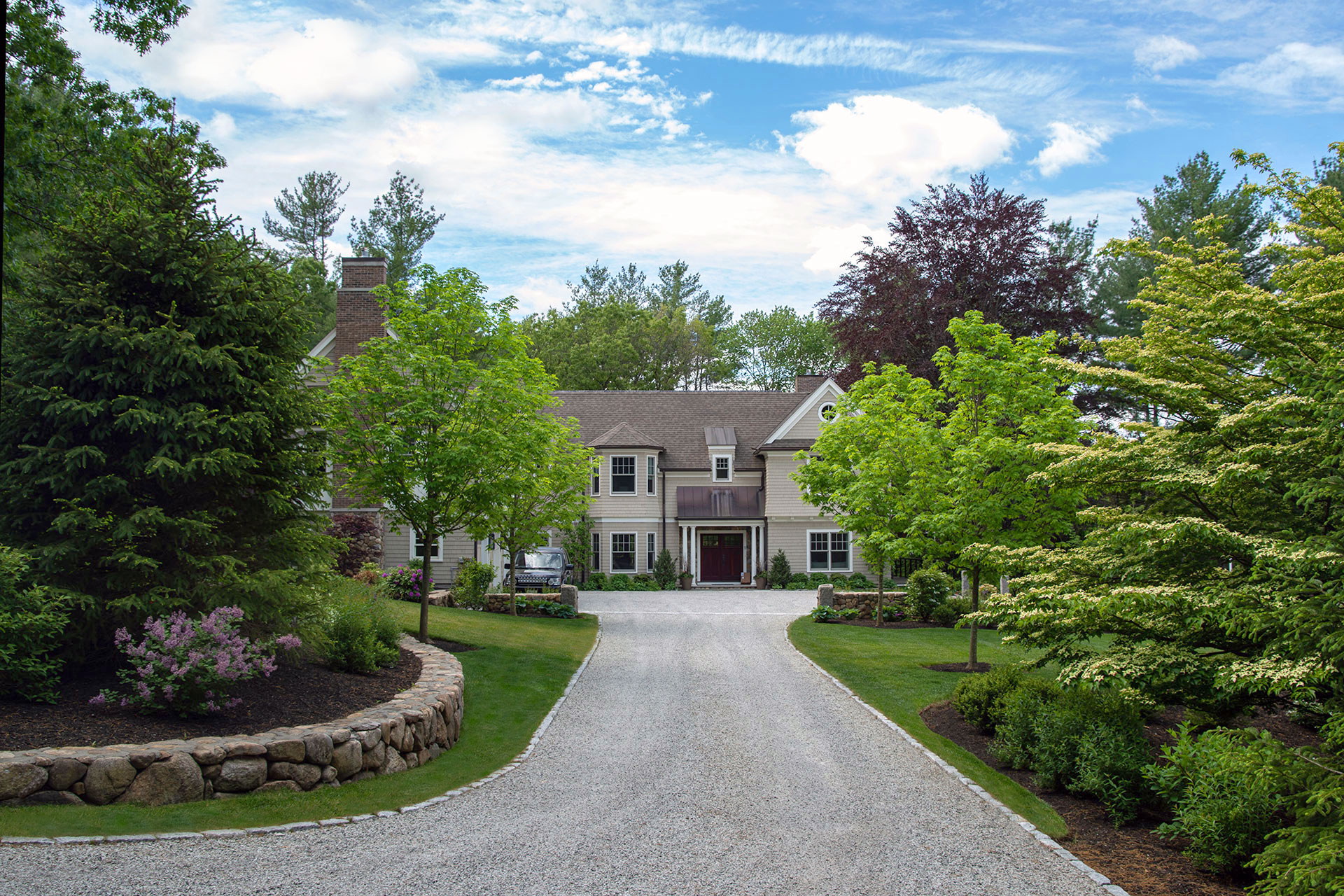
Gravel can feel appropriate for older estates, rural properties, coastal homes, and long drives. It brings texture and softness, but it also requires maintenance. Snow removal, migration, ruts, and accessibility should be considered carefully.
Granite, Cobble, and Stone Accents
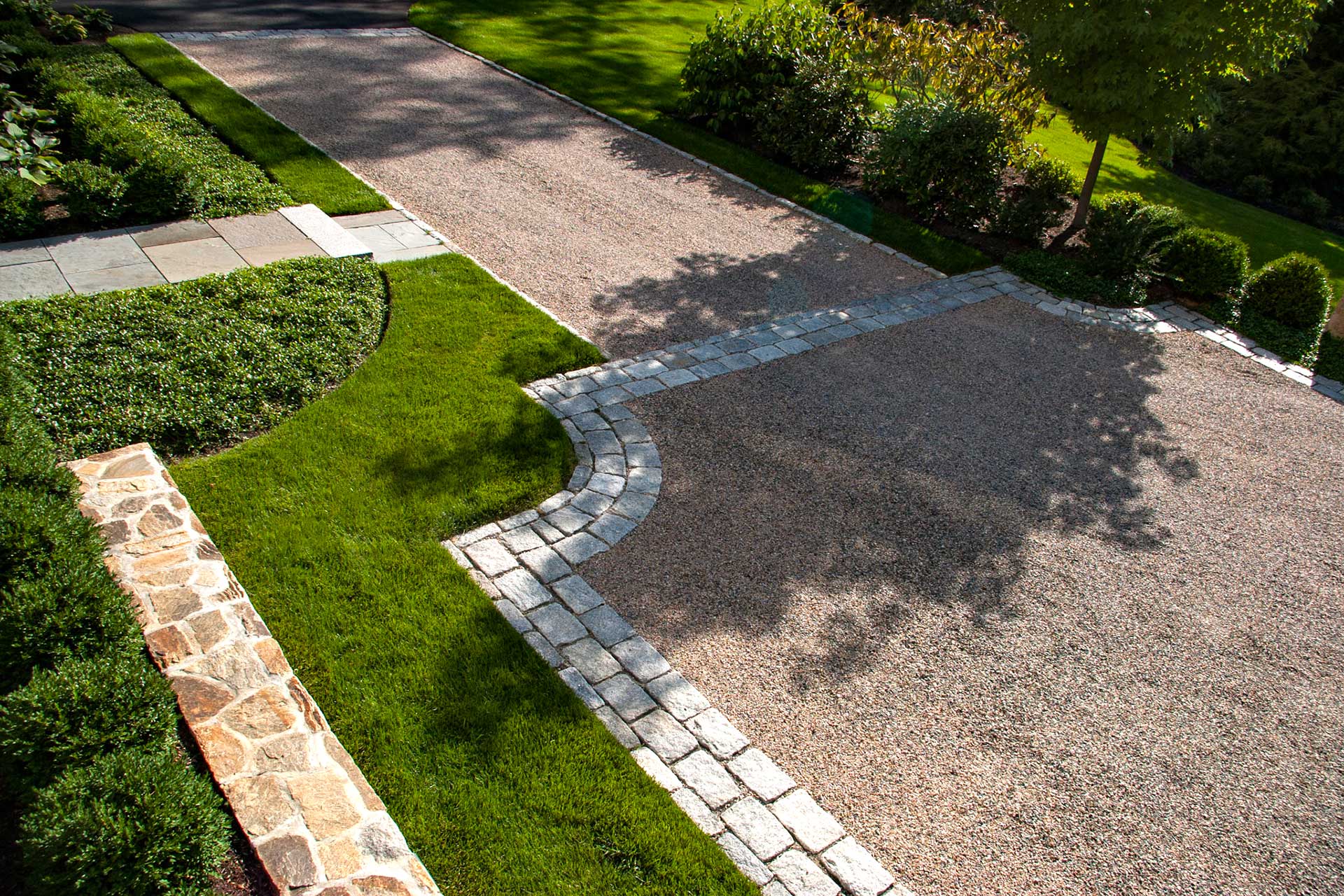
Granite and cobble are especially suited to New England properties when used with restraint. They can define edges, mark transitions, reinforce aprons, or connect new work to older stone walls and walkways.
For more on local hardscape considerations, see Blade’s guide to stone hardscape materials for Boston landscapes.
Concrete or Natural Stone Pavers
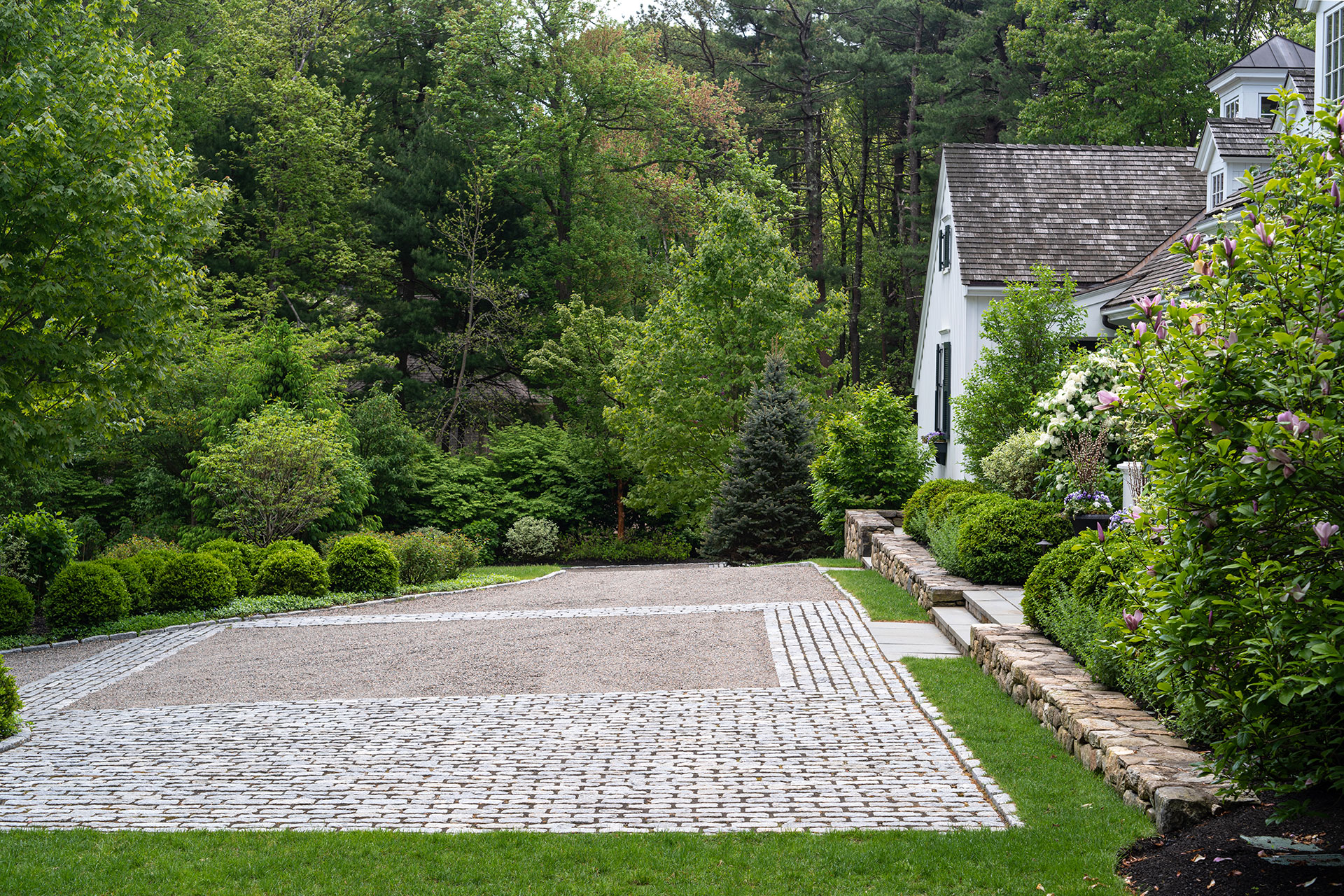
Pavers can be useful for motor courts, arrival courts, walkways, and smaller driveway areas. They offer pattern, scale, and permeability options depending on the system. The base preparation, edge restraint, drainage, and installation quality are critical.
Permeable Paving
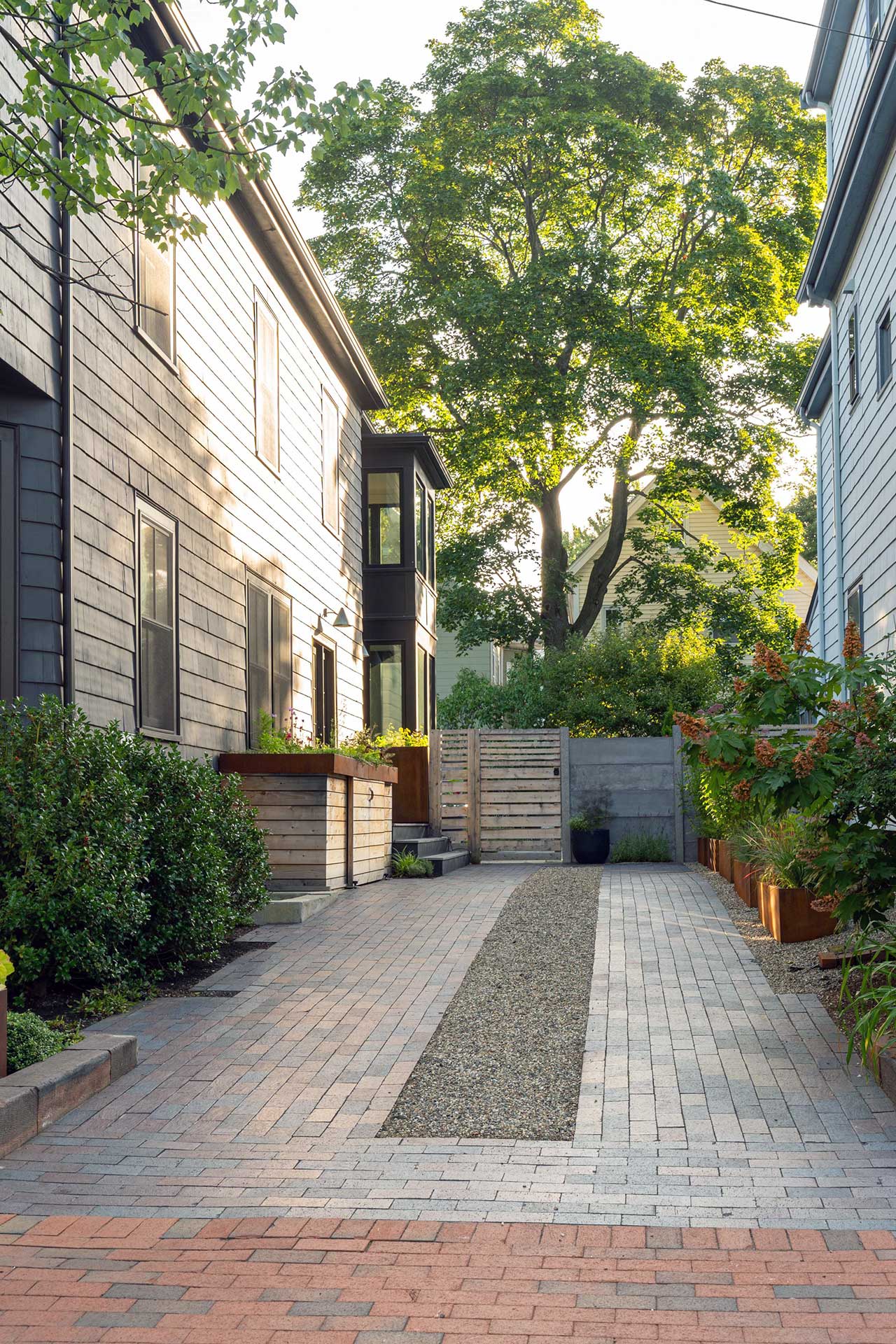
Permeable paving may be worth considering where stormwater management is a priority and site conditions support it. It is not a universal solution, and it should be designed as a full system that includes the surface material, base, storage layer, soil conditions, drainage strategy, and maintenance plan.
Driveway Design for Different Boston-Area Property Types
A driveway in Brookline does not need to behave the same way as a driveway in Dover. The property context should guide the design.
Large Suburban and Estate Properties
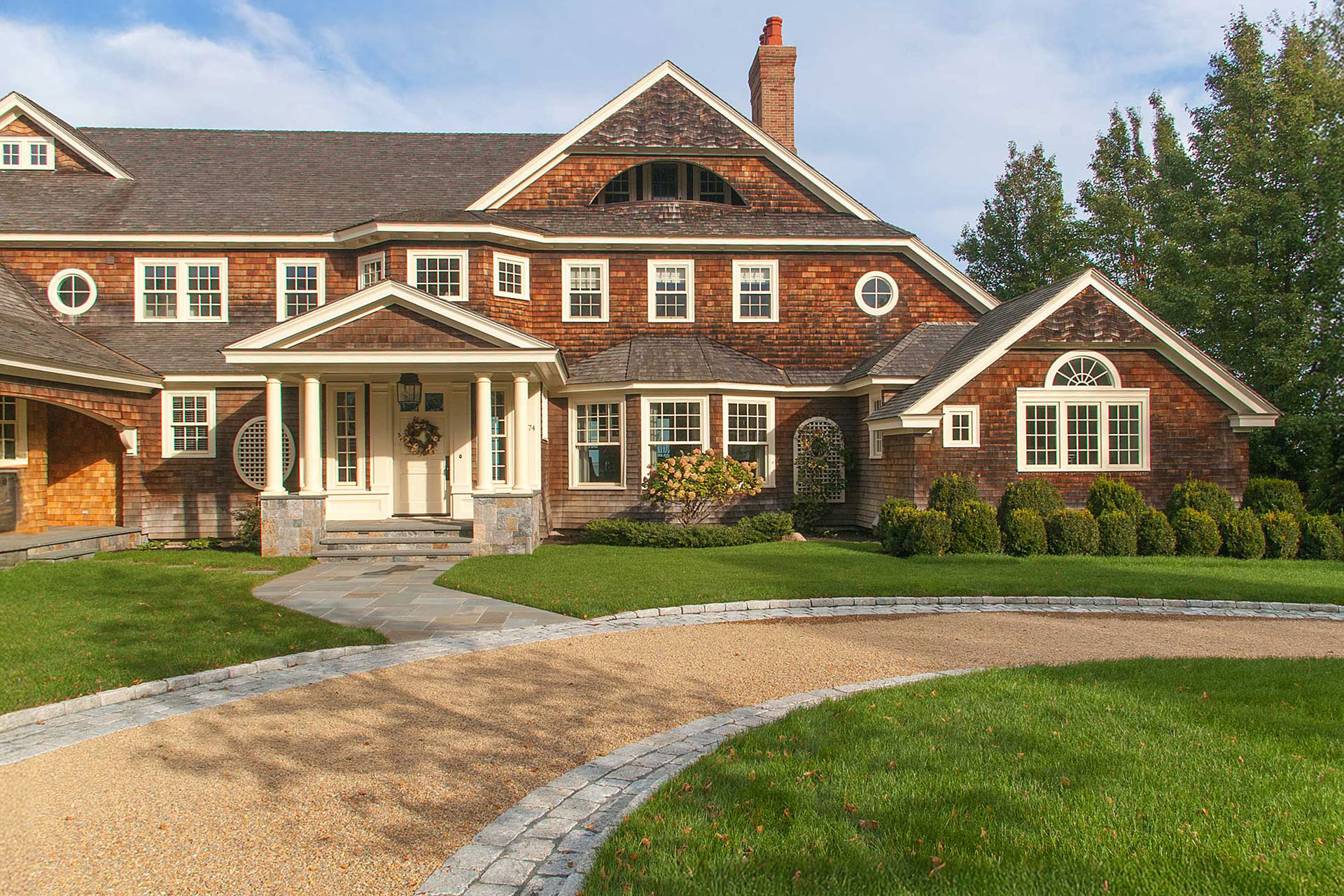
In Weston, Wellesley, Dover, Lincoln, Concord, Carlisle, and parts of Sudbury and Wayland, longer drives and larger front setbacks create opportunities for a more layered arrival sequence. These properties may benefit from tree-lined approaches, subtle curves, motor courts, guest parking, stone edging, and lighting that reveals the home gradually.
The challenge is scale. Too much paving can feel cold. Too little structure can feel unresolved. The landscape should make the arrival feel natural, not overbuilt.
Compact Urban and Inner-Suburban Properties
In Newton, Brookline, Cambridge, Belmont, Needham, and Boston neighborhoods, driveway space is often limited. The design may need to balance parking, front entry, planting, trash storage, fencing, privacy, and pedestrian circulation in a compact area.
Small changes can make a large difference: a clearer walkway, a better planting edge, a new surface transition, a more graceful gate, or lighting that makes the entry feel safer and more welcoming.
Historic and Older Homes
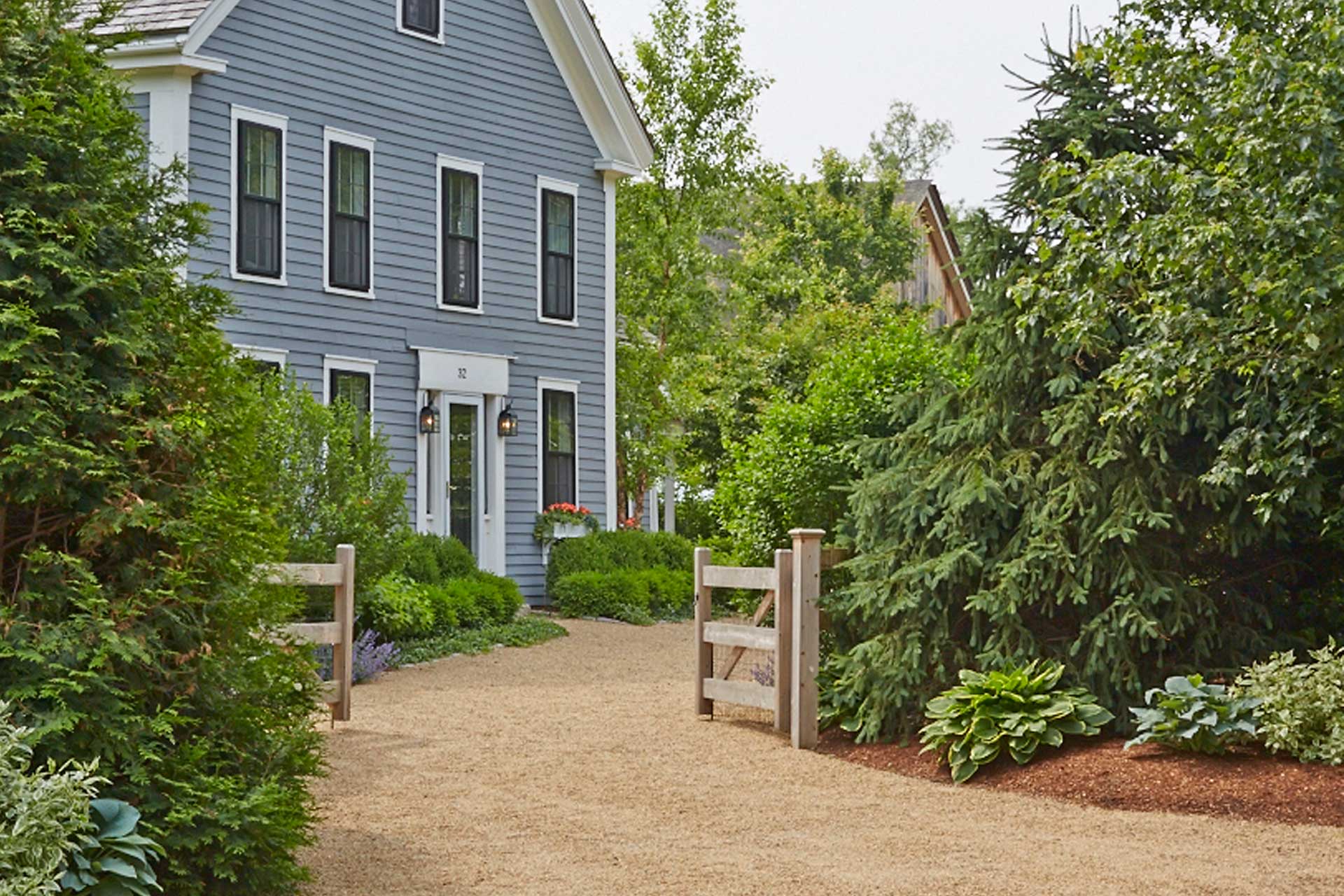
Older homes often have mature trees, stone walls, narrow drives, nonstandard grades, and established planting. The goal is often to modernize function without stripping away character.
A driveway redesign for an older home may involve preserving existing stonework, protecting tree roots, improving drainage, adding discreet lighting, and choosing materials that feel connected to the architecture.
Coastal and Cape Cod Properties
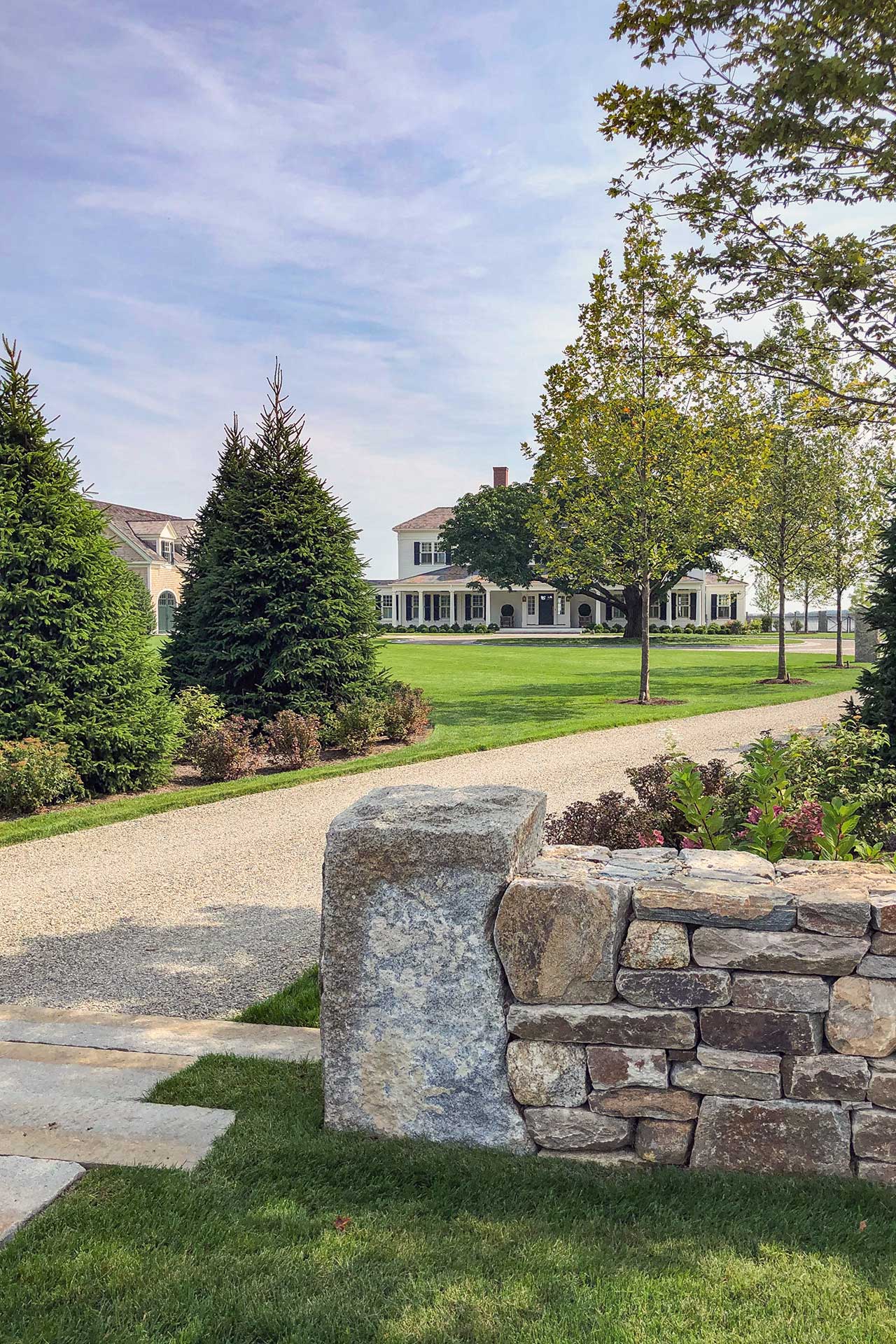
For Cape Cod and coastal properties, driveway design may need to account for sandy soils, salt exposure, wind, seasonal occupancy, conservation restrictions, and a lighter visual touch. Gravel, shell-like tones, native or coastal-tolerant planting, and subtle lighting may be appropriate depending on the property.
When to Bring in a Landscape Design Team
Driveway projects are often started with a paving contractor because the visible need appears to be resurfacing or replacement. That may be enough for a straightforward repair. But when the driveway affects the front yard, entry, drainage, planting, walls, lighting, or property circulation, a broader design conversation is often worth having first.
A landscape design team should be involved when:
- The driveway feels too dominant from the street.
- Guest parking or turnaround space is unclear.
- The front entry feels disconnected from the driveway.
- Water runs toward the house, garage, walkway, or planting beds.
- The driveway is being changed during a home renovation or addition.
- Existing trees, walls, or mature plantings could be affected.
- You want the driveway, front walk, lighting, and planting to feel cohesive.
- You are considering a motor court, circular drive, or formal arrival area.
For larger improvements, driveway design should be coordinated with landscape design, landscape construction, drainage, lighting, planting, and long-term maintenance.
FAQs About Driveway and Motor Court Landscape Design
Q: What is the difference between a driveway and a motor court?
A: A driveway is the main vehicle route from the street to the home or garage. A motor court is a more designed arrival and turnaround area, often near the front entry or garage. It may include paving, stone edging, planting, lighting, and guest parking.
Q: When should driveway design be part of a larger landscape plan?
A: Driveway design should be part of a broader plan when it affects drainage, guest parking, front entry circulation, planting, lighting, retaining walls, mature trees, or the overall curb appeal of the home.
Q: Are permeable pavers a good choice for Boston-area driveways?
A: Permeable pavers can be useful in some situations, especially where stormwater management is important. They need the right base, grading, soil conditions, and maintenance plan. They are not automatically the best choice for every property.
Q: How can planting make a driveway look better?
A: Planting can soften paving, frame the house, guide visitors, screen service areas, and add seasonal interest. The key is choosing plants that fit the scale of the driveway and can tolerate driveway conditions such as snow, salt, reflected heat, and compacted soil.
Q: Can a driveway redesign improve curb appeal?
A: Yes. Because the driveway is often one of the largest visible features in the front landscape, improving its layout, edges, materials, lighting, drainage, and surrounding planting can significantly change how the property feels from the street.
Plan the Arrival Before You Repave
A driveway does not have to be the least interesting part of the property. With the right design approach, it can become part of a more graceful arrival sequence, one that supports the architecture, improves circulation, manages water, welcomes guests, and makes the front landscape feel complete.
If your driveway, motor court, or front arrival area no longer fits the home, the landscape should be part of the plan from the beginning. Contact the Blade team to discuss how thoughtful landscape design, construction, planting, lighting, drainage, and long-term care can help your outdoor spaces feel connected, durable, and true to the home.
Contact a Blade of Grass to start a conversation about your property.