The front yard does more than frame the house. It sets expectations.
Before a guest reaches the front door, before a delivery driver notices the address, and before a potential buyer ever steps inside, the front yard has already started telling a story about the property. In the Boston area, where architecture often carries real presence and history, that story should feel intentional. A stately Colonial in Wellesley should not be approached the same way as a richly detailed Victorian in Cambridge or a clean-lined contemporary home in Brookline.
That is where front yard landscape design becomes more than decoration. It becomes part of the architecture.
According to the National Association of REALTORS, 92% of agents recommend improving curb appeal before listing a home, and 97% believe curb appeal is important in attracting a buyer. Their outdoor remodeling research also found that 37% of homeowners said beauty and aesthetics were the single most important result of an exterior project.
“The front yard should feel like an extension of the house, not a separate decorating project. When the architecture and landscape start speaking the same language, curb appeal follows naturally.”
— Richard Duhamel, Design Associate, a Blade of Grass
At the same time, successful front yard landscaping in Greater Boston has to do more than look good in June. It has to work with narrow urban setbacks, mature trees, winter salt exposure, freeze-thaw cycles, and the fact that many of the region’s best homes have architecture strong enough to expose generic design decisions immediately. UMass Extension notes that woody plants are a significant investment and that site fit, mature size, and environmental stress tolerance matter. MassDOT guidance also notes that roadside planting areas need to tolerate salt runoff and spray from de-icing operations.
Key Takeaways
- The best front yards are shaped by the house, not a generic trend.
- Entry, planting, walkways, walls, lighting, and planters should feel connected.
- Colonial homes often suit symmetry, while Victorian homes allow more layering.
- Tudor homes benefit from depth and weight, while contemporary homes need clean, edited lines.
- In Greater Boston, durable materials and four-season structure matter.
- A well-designed front yard improves arrival, curb appeal, and the overall feel of the home.
Why Front Yard Landscaping Works Best When It Starts With the House
A lot of front yard advice online treats curb appeal as a checklist: add a walkway, install a few shrubs, place containers by the door, swap in nicer lighting. Those upgrades can help, but they do not automatically create a front yard that feels right.
What usually makes a front yard memorable is alignment.
The scale of the walk aligns with the scale of the façade. The material palette supports the architecture. The foundation planting softens the base of the house without hiding what makes the architecture beautiful. The lighting helps the entry feel inviting without turning the front elevation into a stage set.
The American Society of Landscape Architects describes residential landscape design as work that enhances comfort, sustainability, ecological function, and connection to nature. That is a useful lens here because a front yard needs to perform as well as impress. It should guide movement, handle water, support plant health, and stay visually composed through more than one season.
As UMass puts it, “the right plant for the right place” remains the essential rule.
If the front yard is only one part of a larger property improvement, a landscape master plan can help determine whether entry work, foundation planting, walkways, lighting, drainage, or backyard improvements should come first.
The Four Parts of a Strong Front Yard Composition
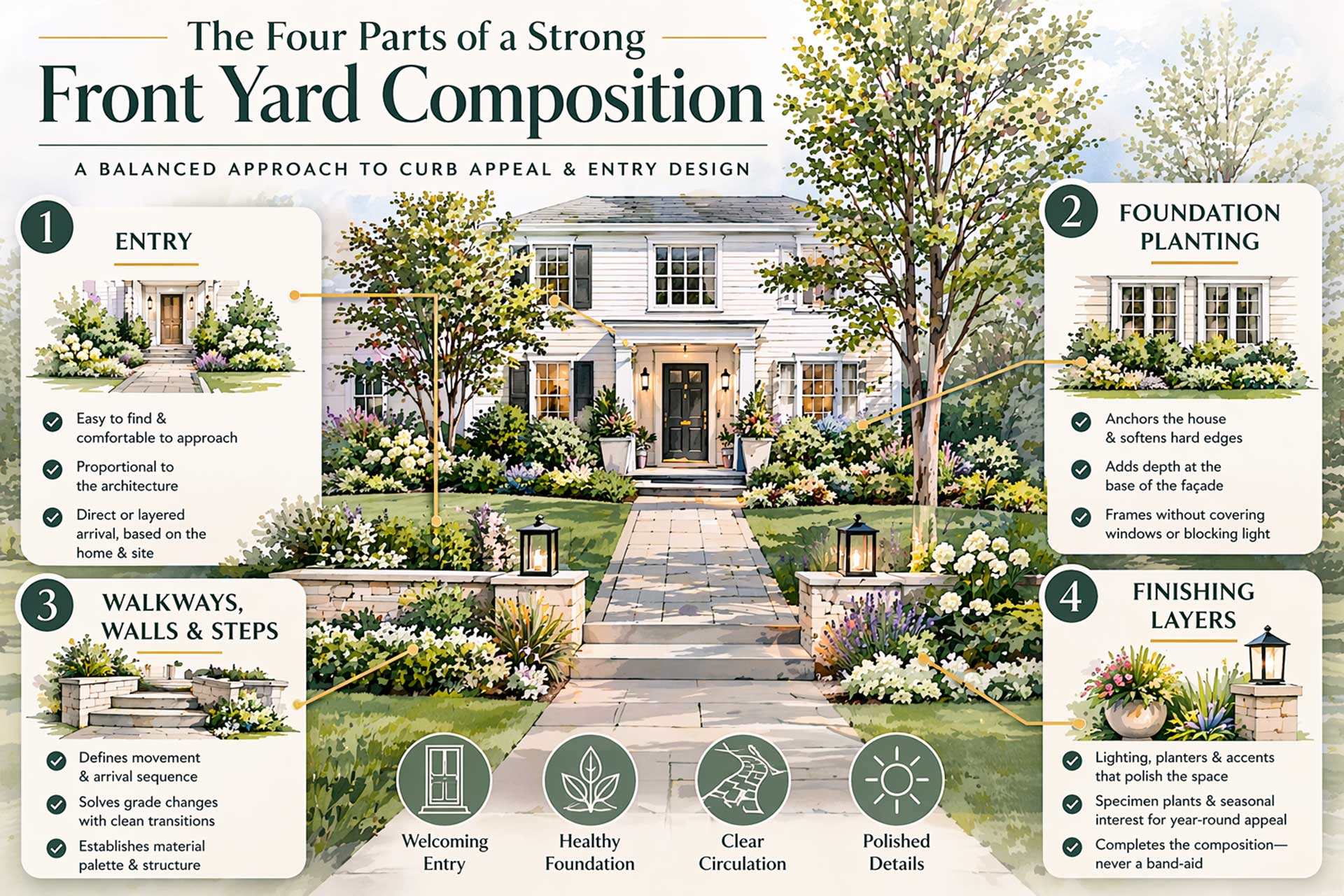
- Entry
The entry is where hospitality becomes visible. It should be easy to find, comfortable to approach, and proportionate to the house. On some properties that means a direct axial walk. On others it means a more gradual, layered approach that makes the front door feel discovered rather than announced. - Foundation Planting
Foundation planting should anchor the house, soften hard edges, and create depth at the base of the architecture. It should not swallow windows, block light, or make the façade feel cramped. - Walkways, Walls, and Steps
These are the structural elements that give the front yard legibility. They define movement, solve grade changes, and establish a material language before a single shrub goes in. - Finishing Layers
Lighting, planters, edging, specimen plants, ornamental elements, and seasonal accents are often what make a front yard feel polished. They should complete the composition, not rescue it.
Front Yard Landscaping Ideas for Colonial Homes
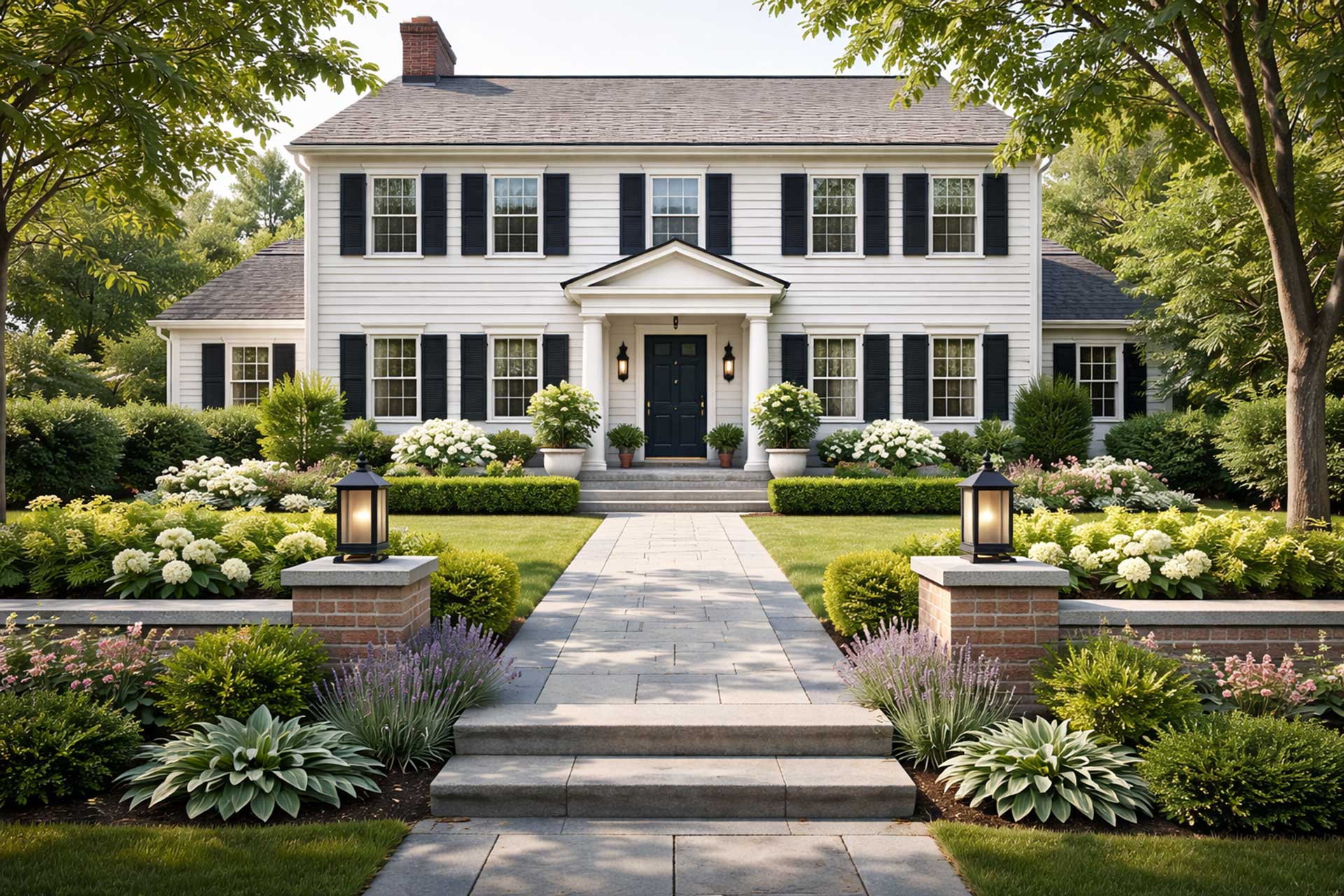
Colonial homes are common across Newton, Wellesley, Weston, and parts of Brookline, and they tend to reward order. Their façades often rely on symmetry, centered entries, balanced window placement, and clear rooflines. The landscape should reinforce that clarity.
Why These Design Choices Work
A Colonial home usually looks best when the front yard feels composed and measured. Symmetry at the entry often makes sense because the house already carries that visual discipline. Foundation planting should feel layered but controlled. Walkways should be crisp. Materials such as brick, bluestone, and granite typically feel at home here because they echo the formality and permanence of the architecture.
Best Ideas for Colonial Front Yards
A centered front walk can create immediate harmony, especially when it aligns with the front door and is framed by understated planting. Low evergreen hedges, clipped forms, structural shrubs, and repeated masses of perennials often work better than an overly mixed collection of plants. The goal is not stiffness. It is order with softness.
This is also a strong setting for classic front steps, stone cheek walls, discreet path lighting, and a pair of planters that mark the entry without overpowering it.
For larger properties in Weston or Wellesley, a Colonial front yard may also benefit from broad lawn panels, long views, and flanking trees placed far enough from the house to preserve the architecture rather than crowd it.
What to Avoid
Colonial homes can quickly feel visually confused when the front yard becomes too loose, too colorful, or too eclectic. Large, overgrown shrubs under windows are a common problem. So are undersized walks that do not match the scale of the façade.
“With Colonial homes, restraint is often what makes the design feel expensive. The landscape does not need to compete with the architecture. It needs to clarify it.”
— Kate Notman, Senior Landscape Architect, a Blade of Grass design team
Front Yard Landscaping Ideas for Victorian Homes
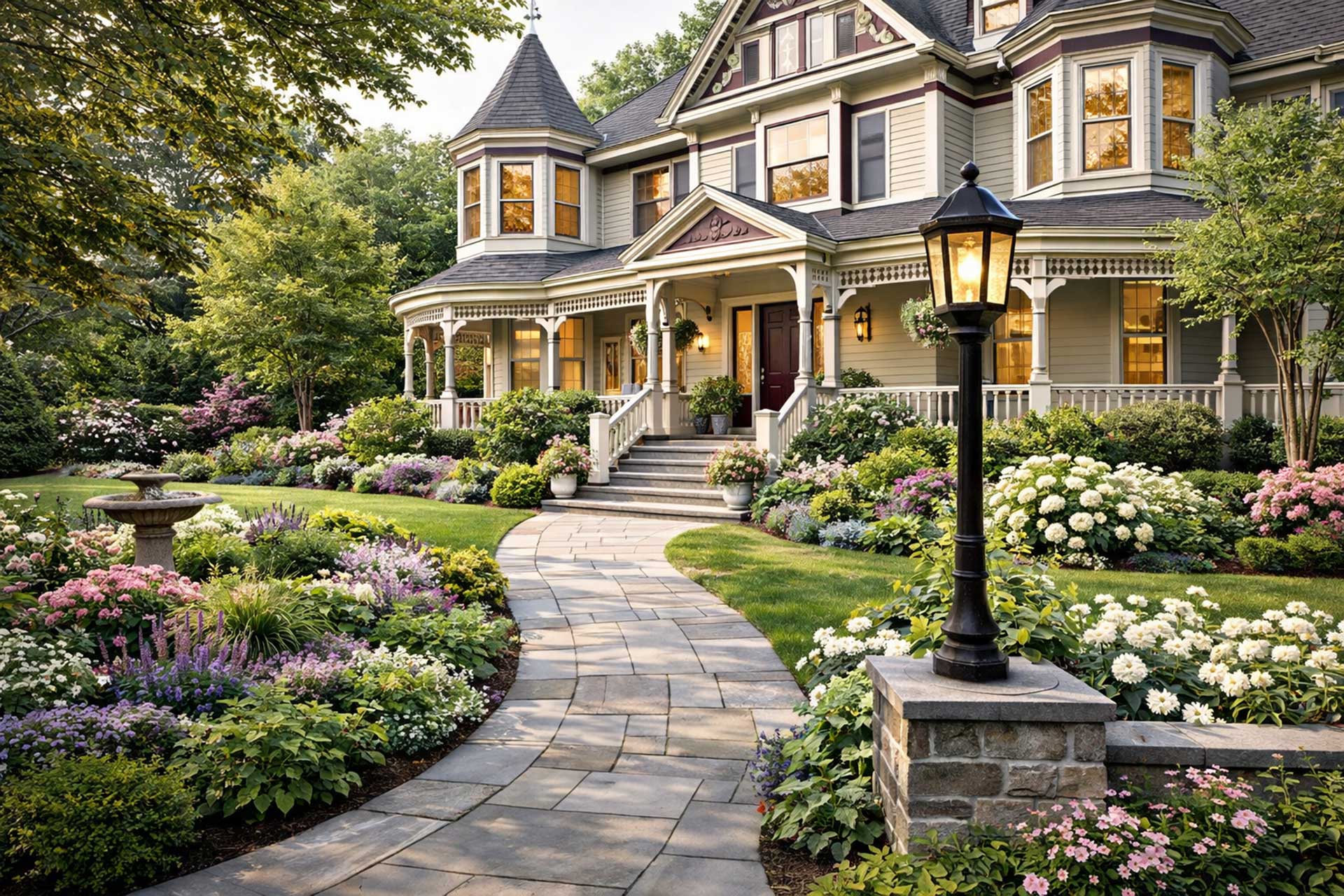
Victorian homes often invite more complexity. That can make them exciting to design, but it also raises the risk of too much visual noise.
Why These Design Choices Work
Victorian architecture often includes texture, asymmetry, porches, trim, and layered rooflines. The landscape can respond with a richer planting palette, more nuanced transitions, and a slightly more romantic arrival sequence. Curving edges, seasonal color, and ornamental detail can feel appropriate here in a way that might seem misplaced in front of a stricter Colonial façade.
Best Ideas for Victorian Front Yards
A Victorian front yard often benefits from layered planting with a mix of textures and bloom times. The front walk can soften the approach rather than simply slice straight to the door. Porch-adjacent planting, containers, and carefully placed specimen shrubs can reinforce the architectural detail and make the entry feel inhabited.
This is also a place where foundation planting should frame the house, not flatten it. Air space matters. If every inch is filled, the architecture loses the breathing room that makes its detailing visible.
In Cambridge and Brookline, where many Victorian properties sit closer to the street, compact but layered front gardens can be especially effective. In those tighter conditions, vertical interest, fine-textured planting, and elegant hardscape details often do more than sheer plant quantity.
What to Avoid
Victorian homes can absorb more richness than many other styles, but they still need editing. Too many unrelated plant colors, too many decorative accessories, or hardscape that feels starkly modern can all make the property feel unresolved.
Front Yard Landscaping Ideas for Tudor Homes
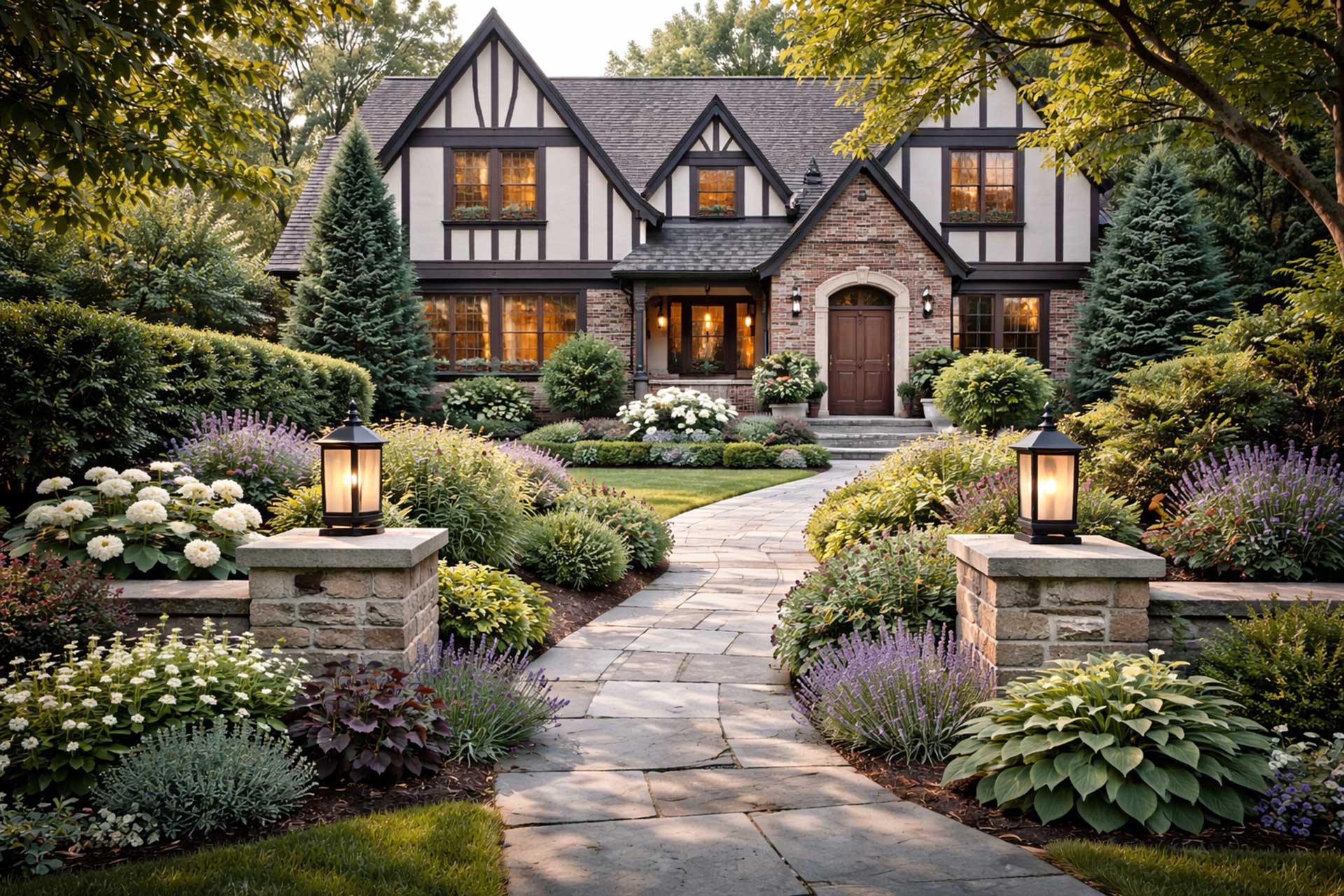
Tudor homes tend to look best when the front yard feels established. They usually carry visual weight, strong materials, and a sense of enclosure. The landscape should support that character.
Why These Design Choices Work
Stone, brick, layered evergreen structure, and deeper planting beds often suit Tudor architecture because they echo its solidity and age. A Tudor front yard usually benefits from a little mystery. It does not need to reveal everything at once.
Best Ideas for Tudor Front Yards
Natural stone walks and steps often feel especially appropriate in front of Tudor homes. Layered evergreen shrubs, flowering understory trees, and woodland-edge planting can create the sense of maturity these homes wear so well. The entry may benefit from framed moments such as low walls, clipped hedges, or a subtle narrowing of the walk near the door.
Where there is enough room, a Tudor front yard can also support a more immersive threshold: a sequence of steps, a canopy of trees, or a transition through layered planting that makes the house feel anchored into the site.
Warm lighting matters here too. It should draw out texture in masonry, timber, and planting rather than flood the front yard with brightness.
What to Avoid
Tudor homes usually do not benefit from sparse, minimalist planting or overly slick modern detailing. If the front yard is too bare, the house can feel exposed. If the plant palette is too bright or tropical in character, the architecture can start to feel disconnected from the landscape.
Related Blog: What Is Layered Planting? A Guide to Depth, Structure, and Four-Season Interest
Front Yard Landscaping Ideas for Contemporary Homes
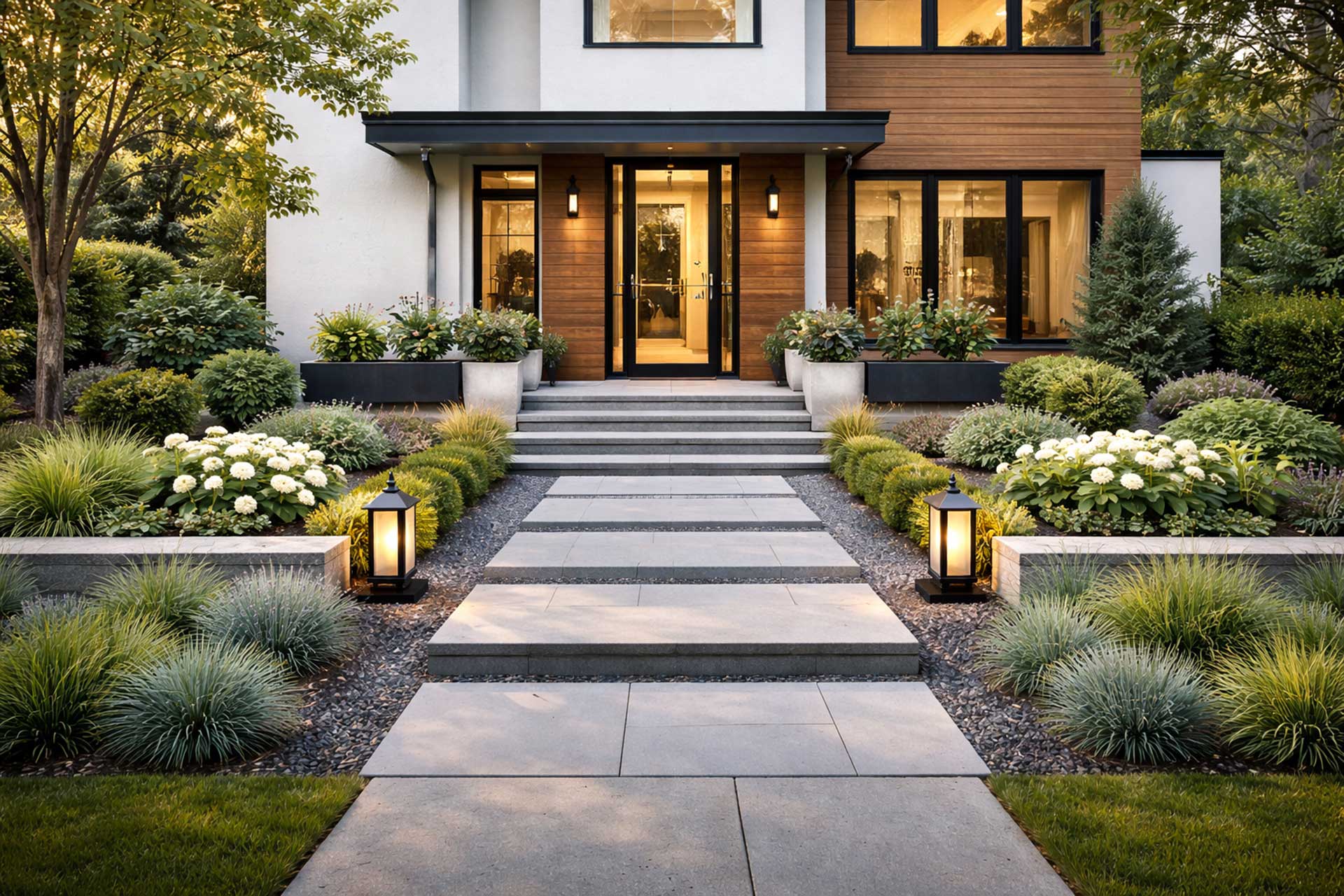
Contemporary homes require discipline. They usually look best when the landscape is intentional, architectural, and edited.
Why These Design Choices Work
Contemporary architecture often relies on strong geometry, contrast, repetition, and negative space. The front yard should pick up those cues. In many cases, hardscape and layout do as much of the visual work as planting.
Best Ideas for Contemporary Front Yards
Clean-lined walkways, large-format paving, seat walls, integrated steps, and restrained planting palettes can all support a contemporary front elevation. Sculptural shrubs, ornamental grasses, and repeated masses are usually more effective than a mixed border of unrelated species.
A contemporary front yard can also handle sharper material transitions, such as gravel against concrete or corten steel against planting, especially when the architecture already contains those kinds of clean contrasts.
Lighting often becomes more integrated here as well. Instead of decorative lantern-style fixtures, the strongest solution may be a low, precise lighting strategy that reveals planes, edges, and approach.
What to Avoid
A contemporary front yard usually loses strength when it becomes too busy. Too many plant types, too many colors, or details borrowed from more traditional landscape styles can dilute the architecture very quickly.
How Entry, Foundation, Walkways, and Curb Appeal Work Together
The strongest front yards are rarely built around one feature. They are built around a sequence.
A homeowner may start by thinking about foundation planting, but if the front walk is too narrow, the planting will not fix the arrival experience. Someone else may focus on front steps, but if the grading is awkward or the plant material is oversized, the composition will still feel off.
This is why front yard design works best when it is approached as a whole. UMass Extension recommends site preparation and correct planting practices because improper depth, compaction, and poor location can lead to decline even when the initial design looks good. UMass also recommends soil testing to understand nutrient levels, pH, and amendment needs before investing in plant material.
In practical terms, that means a successful Boston-area front yard often includes:
- a front walk wide enough to feel comfortable and proportionate
- steps and landings that solve grade changes cleanly
- foundation beds sized for mature growth
- plant choices that can tolerate the site’s exposure, soil, and winter conditions
- lighting placed to support visibility and atmosphere
- finishing details that feel consistent with the architecture
Related Blog: Foundation Landscaping Ideas for Boston Homes: A Designer’s Guide to Curb Appeal
Front Yard Considerations for Boston-Area Properties
The same architectural style can call for a different landscape response depending on where the property sits and how the lot behaves.
Brookline and Cambridge
These front yards are often tighter, more visible from the street, and less forgiving of clutter. Every decision needs to earn its place. Hardscape detailing, entry definition, compact planting, and crisp lighting often carry more weight than broad gestures.
Newton
Newton properties often include grade changes, mature trees, and a mix of historic and updated homes. Front yard landscapes here frequently need to solve for steps, retaining walls, drainage, and the relationship between the driveway and entry walk.
Wellesley and Weston
Larger setbacks and wider frontages can create real opportunity, but they also require discipline. A long walk, a deep lawn, and a broad façade need enough structure to feel composed. Under-scaled planting or too few hardscape anchors can make a large front yard feel unfinished.
Across all of these towns, winter conditions matter. Salt exposure near walks and roads, compacted snow, and freeze-thaw cycles should influence both plant selection and detailing. MassDOT specifically notes that roadside plantings must tolerate salt runoff and spray, which is one reason the prettiest front-yard idea on paper is not always the best choice for a Boston-area site.
What Adds the Most Curb Appeal Without Making a Front Yard Feel Overdone
Homeowners often assume curb appeal comes from adding more. In many cases, it comes from editing better.
A stronger front yard may come from simplifying the plant palette, replacing undersized or mismatched materials, widening a front walk, reframing the entry, or correcting the scale of the foundation planting. It may also come from improving four-season structure so the property still looks intentional in November and February, not just in spring.
That idea aligns with broader remodeling research too. NAR’s outdoor features report found that homeowners pursue these projects not only for appearance, but also for better livability and long-term satisfaction, with a typical joy score of 9.7 after project completion.
Related Blog: Transform Your Property: The Real Numbers Behind Landscaping ROI
Frequently Asked Questions
Q: What is the best front yard landscaping style for a Colonial home?
A: Usually, the best approach is structured and balanced. Symmetry, layered but restrained foundation planting, clean walkways, and classic materials often suit Colonial homes better than loose or highly eclectic front-yard compositions.
Q: How can I improve curb appeal without redoing the entire front yard?
A: Start with the arrival sequence. A clearer front walk, better-scaled planting, refined lighting, and thoughtfully placed planters can make a major difference even before a full redesign.
Q: What should I plant in front of a Boston-area home?
A: That depends on the architecture, sun exposure, soil, drainage, and salt exposure. In New England, site fit matters. UMass Extension recommends choosing plants based on mature size and environmental tolerance, not just appearance.
Q: Are foundation plantings enough to improve the front of the house?
A: Not always. Foundation planting is important, but curb appeal also depends on entry design, walkway proportions, materials, lighting, and how the house meets the street.
Q: What front yard upgrades are most worth it?
A: The most valuable upgrades are usually the ones that improve the whole composition: better walkways and steps, properly scaled foundation planting, stronger entry definition, and lighting that makes the property feel welcoming after dark. NAR reports that curb appeal carries real weight with both agents and buyers.
Avoid the Trends. Find the Fit.
The best front yard landscaping ideas are not really about trends. They are about fit.
A Colonial home in Wellesley should feel different from a Victorian in Cambridge. A Tudor in Newton should not be landscaped like a contemporary renovation in Brookline. When the front yard responds to the architecture, the lot, and the way people actually arrive at the house, curb appeal stops feeling like a cosmetic layer and starts feeling built in.
That is the point. Not simply to make the house look nicer from the street, but to make the property feel more coherent, more welcoming, and more complete every time you come home.
A Cohesive Approach to Front Yard Design, Construction, and Care
For more than three decades, a Blade of Grass has been designing, building, and caring for award-winning residential landscapes throughout Greater Boston and MetroWest. Our team brings together landscape design, construction, horticultural expertise, and long-term maintenance so front-yard improvements are not treated as isolated upgrades, but as part of a cohesive property vision. Whether the goal is to refine a front entry in Brookline, rework foundation planting in Newton, improve walkway and step design in Wellesley, or create a more complete arrival experience in Weston or Cambridge, we help homeowners shape landscapes that are beautiful, practical, and built to mature well over time. If you are considering updates to your front yard, entry, planting, lighting, or hardscape, contact a Blade of Grass to start the conversation.