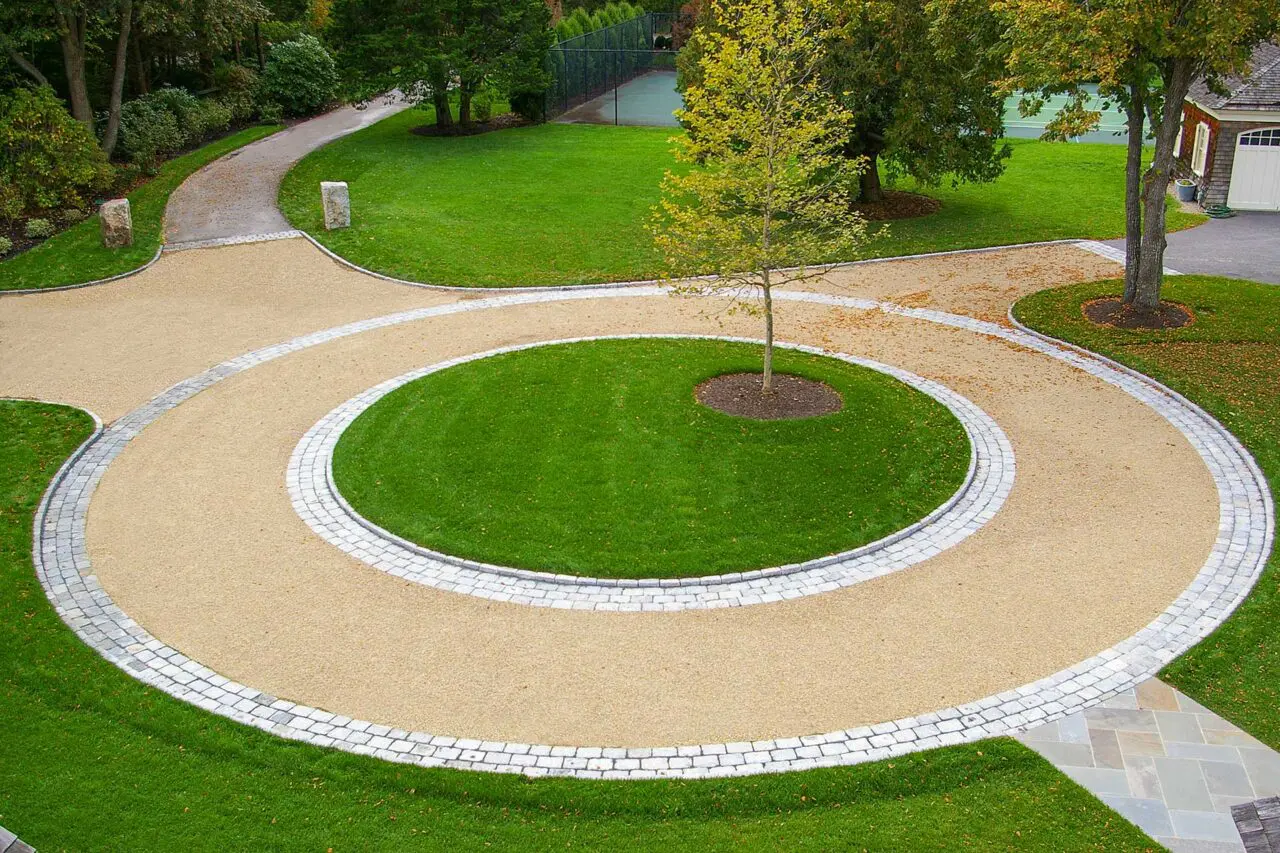
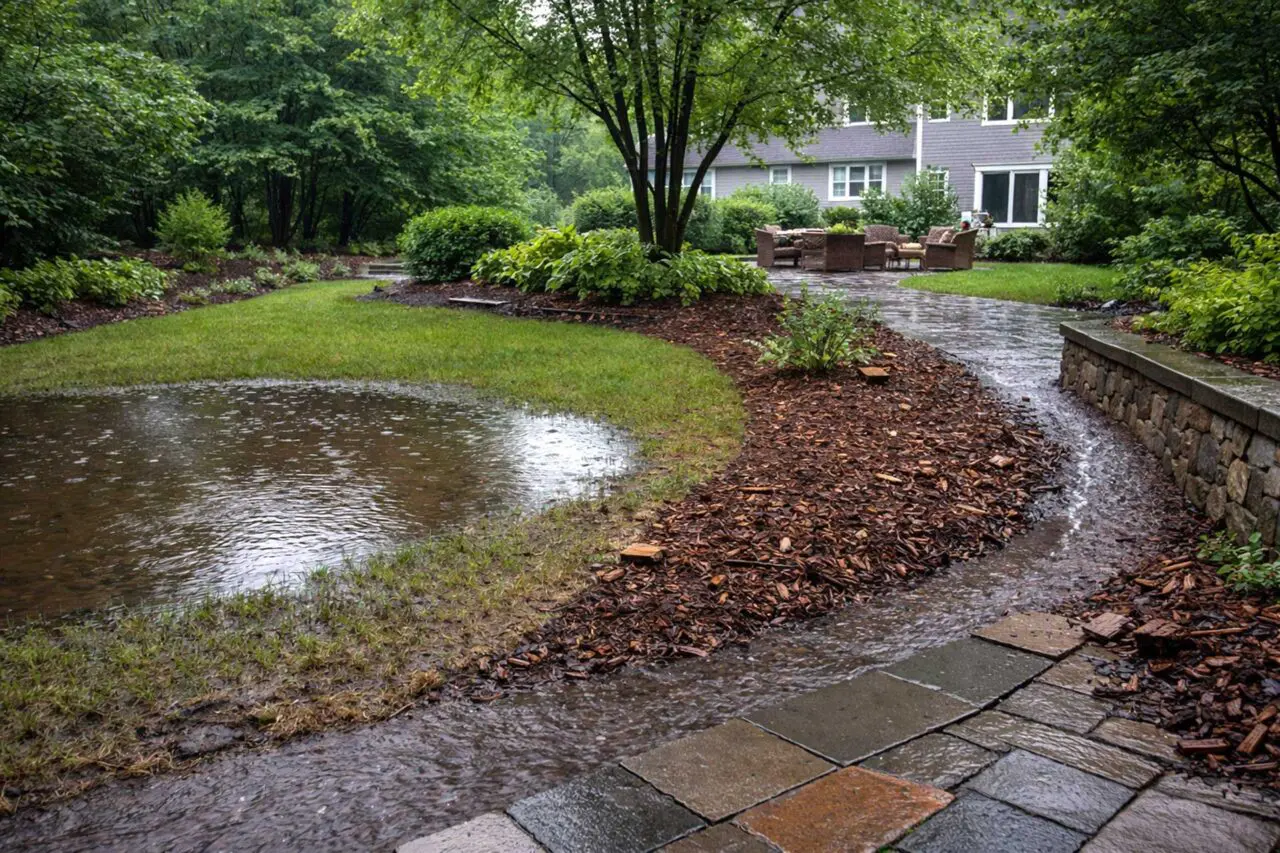
A driveway or patio has to do more than look good. It needs to handle regular use, complement the home, and withstand heavy rain, snow, ice, and seasonal temperature changes. On Massachusetts properties, drainage is particularly important, especially where existing pavement directs water toward a garage, foundation, or nearby planting beds.
Permeable pavers offer an alternative to conventional paving by allowing rainwater and snowmelt to pass through the surface into a specially constructed base below. This can help reduce runoff and manage surface water, but it does not automatically solve every drainage problem.
Choosing permeable paving involves more than selecting the right material. The finished surface should complement the home’s architecture and accommodate how the space is used, while the underlying system must account for soil conditions, grading, groundwater, and long-term maintenance. Understanding how these elements work together is essential to determining whether permeable pavers are a practical choice for a particular property.
Key Takeaways
- Permeable pavers are part of a complete construction system that includes open joints, specialized aggregates, a stone reservoir, and a drainage strategy.
- These systems can reduce surface runoff, but their effectiveness depends on soil conditions, groundwater, slope, and proper design.
- Permeable paving can complement traditional and contemporary Massachusetts homes, with options for driveways, patios, and walkways.
- Properly designed systems can perform through New England winters, although snow removal, de-icing, and sediment management require attention.
- Permeable paving is not right for every property. Conventional paving combined with other drainage improvements may sometimes be the better choice.
What Makes a Paver System Permeable?
The first distinction worth understanding is that permeable pavers are not simply conventional pavers with wider spaces between them.
In a typical interlocking paving installation, the joints may be filled with sand or polymeric sand over a compacted base. Water is generally managed through surface grading and drainage features.
A permeable interlocking concrete pavement system, often called PICP, works differently. The pavers are manufactured and arranged to create openings that allow water to move into a specially designed series of aggregate layers beneath the surface.
The pavers themselves are generally solid. It is the openings between them, along with the construction below, that make the system permeable.

The Layers Beneath the Surface
A properly designed system generally includes several connected components:
- Surface pavers: Interlocking units designed for the intended pedestrian or vehicle traffic, with openings that allow water to enter.
- Open joints: Spaces filled with clean, washed stone aggregate rather than conventional joint sand.
- Bedding layer: A layer of appropriately graded aggregate that supports the pavers while allowing water to pass through.
- Stone reservoir: A deeper layer of open-graded crushed stone that provides structural support and temporary storage for incoming water.
- Underlying soil: The subgrade through which stored water may infiltrate, provided soil conditions are suitable.
- Optional underdrain or outlet: A controlled way to release stored water when the site cannot absorb it quickly enough or when the design requires additional drainage capacity.
The stone reservoir is particularly important. Its open spaces provide room for water to collect temporarily before moving into the soil or toward a designed outlet. Unlike a conventional compacted paving base, it is intended to accommodate both structural loads and water movement.
The Federal Highway Administration’s guidance on permeable interlocking concrete pavement explains how these components work together to support traffic while managing stormwater.
For homeowners, the practical lesson is that choosing a permeable paver product is only the beginning. The excavation, aggregates, grading, edge restraints, and drainage details all contribute to whether the finished pavement works as intended.


Where Permeable Pavers Work Best, and Where They Don’t
One of the most appealing qualities of permeable paving is its ability to manage rainfall close to where it lands. Instead of immediately directing water across a driveway or patio, the system can capture it beneath the paved surface.
That can be useful on Massachusetts properties where expanding outdoor living areas, replacing aging pavement, or improving an arrival court creates an opportunity to reconsider how stormwater moves through the landscape.
But not every site provides suitable conditions.
Conditions That Favor Permeable Paving
Permeable systems are often worth considering where the site offers sufficient room for the required excavation and stone reservoir, along with soil and drainage conditions that support the intended design.
A relatively gentle grade can make water storage and distribution easier to manage. Soils with adequate infiltration capacity may allow captured rainfall to soak into the ground, reducing the amount of runoff leaving the paved area.
For a patio, the system may help manage rainfall that would otherwise collect on the surface or move into adjacent planting beds. For a driveway, it may reduce runoff from a substantial paved area while supporting the daily movement and parking of vehicles.
The potential benefits extend beyond surface drainage. By reducing or delaying runoff, an appropriately designed system can contribute to broader stormwater management goals.
When Site Conditions Make Permeable Paving More Complicated
Massachusetts properties can present substantial differences in soil and subsurface conditions, even within the same neighborhood.
A property with freely draining soil may offer opportunities that are less practical on a site with dense clay, compacted fill, shallow bedrock, or a seasonally high groundwater table.
Proximity to foundations, septic systems, retaining walls, and other structures also matters. Capturing water beneath a paved surface is only beneficial when that water can be managed without creating a new problem elsewhere.
Steep slopes introduce additional challenges because water can move through the stone base unevenly. Heavy vehicle traffic, frequent sediment deposits, and limited excavation access may affect the design as well.
The Massachusetts Stormwater Handbook establishes technical criteria for stormwater systems, including conditions that affect infiltration, storage, and appropriate site placement.
Where the underlying soil cannot provide sufficient infiltration, an underdrained system may still be feasible. In other situations, conventional paving with properly designed drainage may be more appropriate.
A permeable surface should never be treated as a substitute for understanding the property’s larger drainage patterns. Roof runoff, poorly directed grading, or persistent subsurface saturation may require separate solutions, as explored in our guide to landscape drainage solutions for Massachusetts properties.

How Permeable Pavers Can Change the Look of a Driveway or Patio
The technical benefits of permeable paving are important, but they should not overshadow the design.
A driveway is often one of the largest visible hardscape elements on a residential property. It influences the approach to the home, establishes a relationship with the architecture, and creates transitions between lawn, planting, walkways, and parking areas.
A patio serves a different purpose. It becomes an outdoor room where material scale, texture, color, furniture placement, and the surrounding garden shape the experience.
Permeable interlocking pavers are available in a variety of shapes, sizes, colors, and finishes. Depending on the product, the finished appearance can be relatively traditional or distinctly contemporary.
The open joints may be subtly visible, creating a slightly different texture from tightly jointed conventional paving. This can be an attractive quality, particularly when the pattern and scale are chosen with the architecture in mind.
Matching the Surface to the Home
On a traditional New England property, restrained earth tones, simple patterns, and carefully detailed stone edging can help a driveway feel established rather than overly decorative.
Contemporary homes may benefit from larger-format units, clean linear patterns, and a more limited material palette.
For patios, we also consider the relationship between paving and adjacent planting. The edge of a terrace might transition into a garden border, while a more formal outdoor dining space may call for a clearly defined perimeter.
Not every natural stone or concrete paving product is suitable for a permeable installation. The material, joint configuration, and supporting construction must be compatible with the intended system.
Our guide to stone and hardscape materials for Boston-area landscapes explores the broader design considerations behind choosing materials that complement the house and surrounding landscape.
A Real Example: A Compact Cambridge Driveway
At our recent Compact Cambridge landscape project, permeable pavers are incorporated into a narrow urban driveway with a central gravel band.
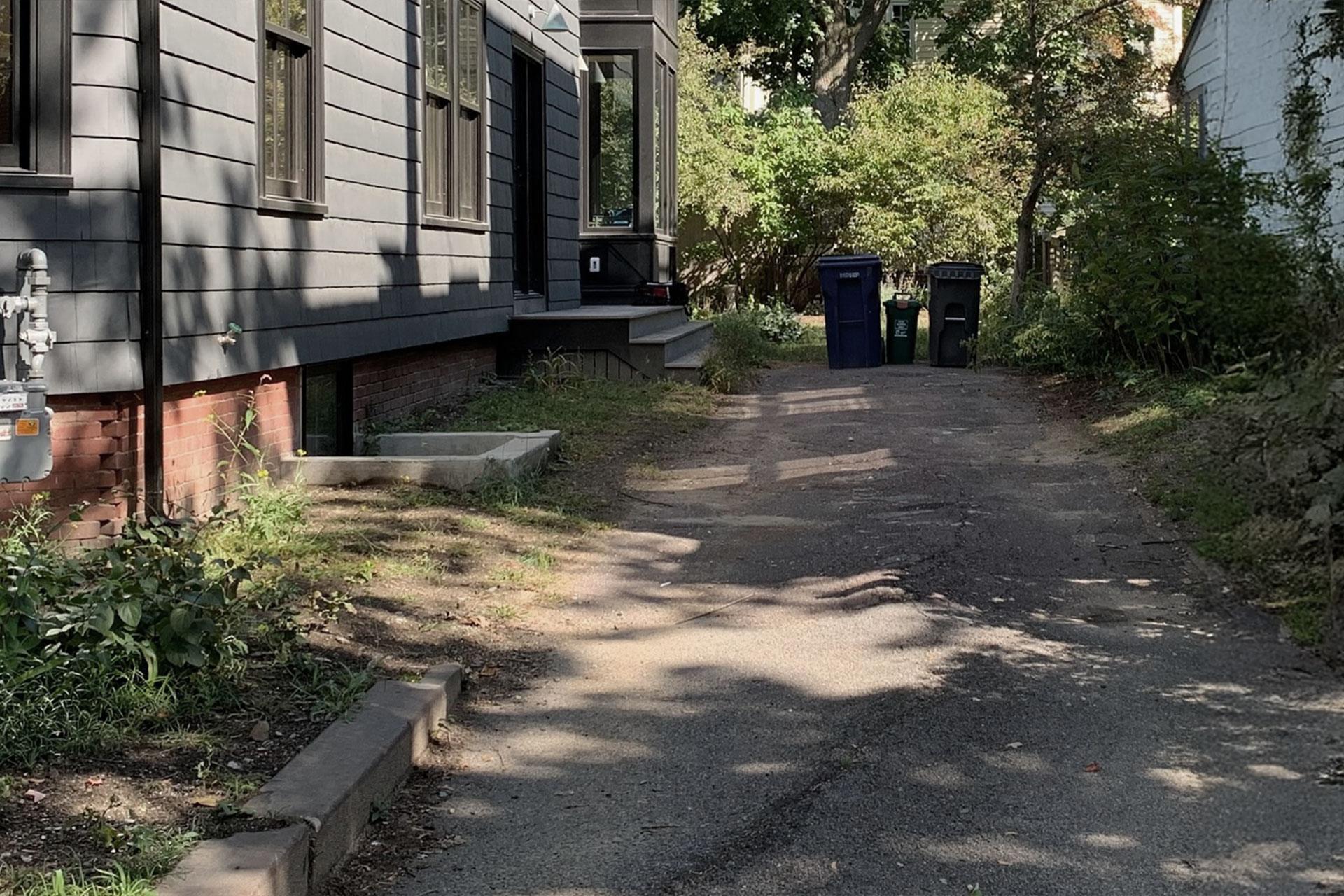
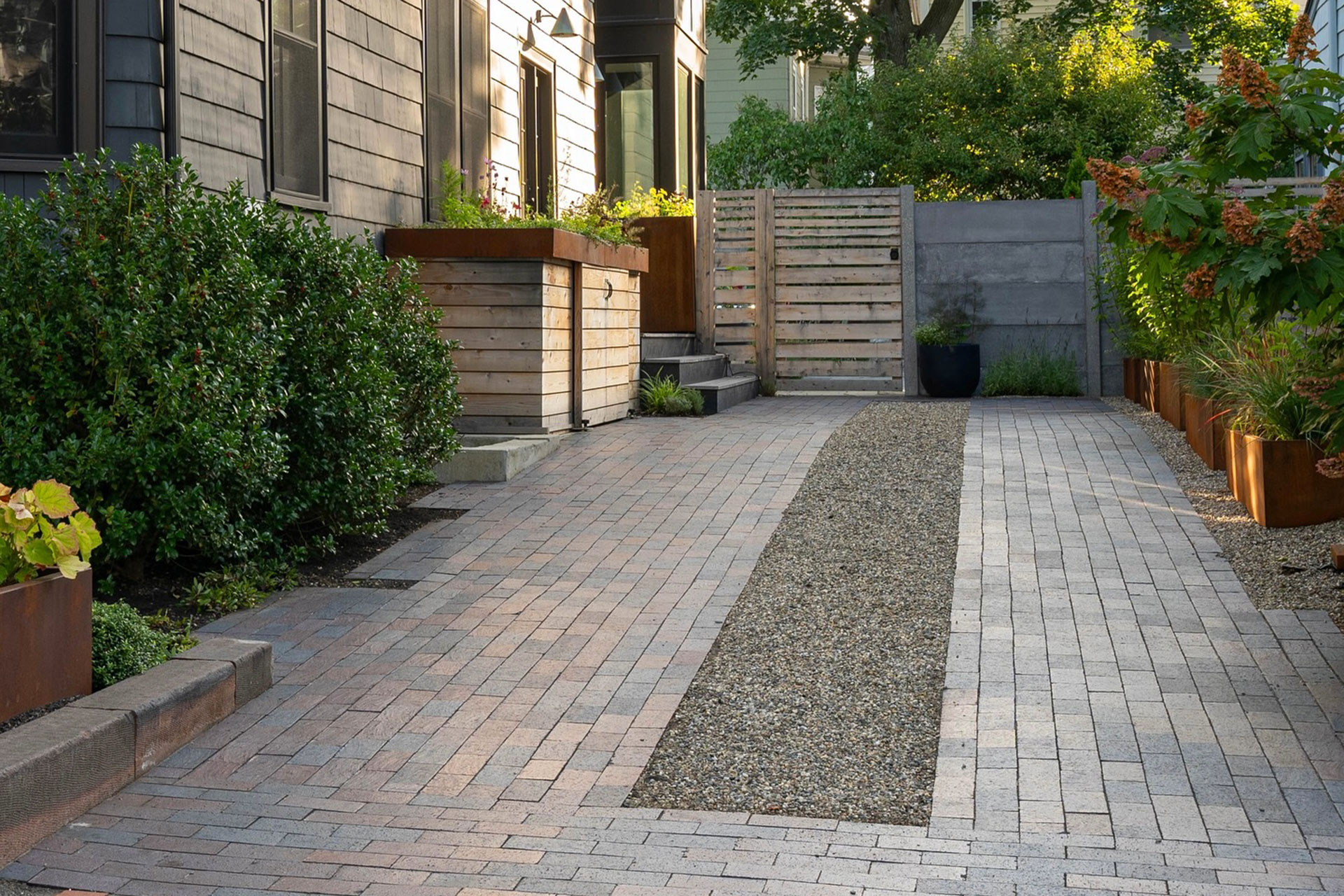
The paving helps improve drainage while reinforcing the long, linear geometry of the space. Weathering steel planters and layered privacy planting soften the hardscape and create a more composed approach to the home.
It is a useful example of how permeable paving can serve both practical and aesthetic goals. The drainage strategy does not need to dominate the visual character of the landscape. It can become part of a carefully considered design.
Permeable Pavers vs. Conventional Paving
Neither approach is universally better. Each has advantages and limitations, and the right choice depends on the property, intended use, drainage requirements, and maintenance expectations.
| Consideration | Permeable Paving | Conventional Paving |
|---|---|---|
| Surface Drainage | Allows water to pass through designed joints into the underlying system | Generally relies on surface pitch and drainage features |
| Subsurface Construction | Requires an open-graded stone reservoir and planned water management | Uses a structural base with drainage handled separately |
| Design Flexibility | Offers multiple patterns and finishes within compatible paving systems | Offers a broad range of materials and installation methods |
| Site Limitations | Requires careful evaluation of soils, groundwater, slopes, and surrounding structures | Can be more adaptable where infiltration is unsuitable |
| Maintenance | Requires sediment control, joint care, and periodic specialized cleaning | Requires material-specific cleaning, repairs, and joint maintenance |
| Initial Construction | May involve more extensive excavation and specialized materials | Can be simpler, although site preparation and drainage remain important |
For some properties, a combination of materials may make more sense than paving every area in the same way. A conventional driveway, for example, might be paired with carefully designed drainage and a different paving treatment for a nearby courtyard or walkway.
The goal is to choose a system that performs well, looks appropriate, and can be maintained over time.

What Happens to Permeable Pavers During a Massachusetts Winter?
Winter is one of the most important considerations for any driveway or patio in Greater Boston and MetroWest.
Pavement must handle freezing temperatures, snow accumulation, plowing, road salt, and repeated changes between thawing and refreezing. A material that performs well in summer still needs to support safe, practical use in February.
Properly designed permeable paving can perform successfully in cold climates, but it requires attention to drainage and maintenance.
Freeze-Thaw Cycles and Ice Formation
One potential benefit of permeable paving is that water can move below the walking or driving surface rather than remaining in shallow puddles.
When the system is functioning properly, that can reduce surface ponding and some of the conditions that lead to ice formation.
The open-graded stone reservoir also behaves differently from a conventional paving base because it contains void spaces that allow water to move and be stored temporarily.
However, this does not mean permeable pavement is immune to frost, ice, or winter damage.
Water that cannot drain adequately may remain in the system, and unfavorable subsurface conditions can still contribute to freezing and movement. Structural design, site drainage, and appropriate construction remain essential.
Cold-climate research from the University of New Hampshire Stormwater Center has examined permeable interlocking concrete pavement performance, supporting its use in northern climates when systems are properly designed and maintained.
Snow Removal, Salt, and Sand
Permeable pavers can generally be cleared with conventional snow-removal equipment, provided the surface is properly installed and the equipment is adjusted appropriately.
Plow blades should not catch raised pavers, edges, or transitions. The correct approach depends on the particular paving material, surface condition, and snow-removal equipment.
De-icing also requires judgment.
Because well-functioning permeable pavement can reduce standing water, it may sometimes require less de-icing material than conventional surfaces. But snow and ice can still develop, particularly during freezing rain, rapid temperature changes, or periods when the system is frozen or overwhelmed.
Salt should be used only as needed and in accordance with the paver manufacturer’s guidance. Excessive de-icing chemicals can affect paving materials, surrounding plants, soil, and nearby water resources.
Sand presents a different concern. The small particles used for winter traction can settle into permeable joints, eventually reducing the system’s ability to accept water.
For this reason, routine sanding is generally discouraged. Where sand must be used for safety, the maintenance plan should include appropriate cleaning to remove accumulated material.
Snow Storage Matters, Too
Where plowed snow is stored can affect how a permeable surface performs.
Large piles of snow may introduce concentrated meltwater, road grit, sediment, and de-icing residue as temperatures rise. Repeatedly placing contaminated snow on permeable paving can increase the maintenance burden.
On a property with limited snow-storage space, this should be addressed during design rather than after the driveway is installed.
The relationship between paving, nearby lawn, planting beds, and winter circulation is particularly important on compact properties where there are fewer places to move snow.
Maintenance: Keeping the System Working Year After Year
Permeable pavers can provide durable, attractive surfaces, but they should never be described as maintenance-free.
Their performance depends in part on keeping the joints and drainage openings clear.
Over time, leaves, soil, mulch, road grit, and other fine material can accumulate on the surface. If enough sediment enters the joints, water may begin moving across the pavement rather than passing through it.
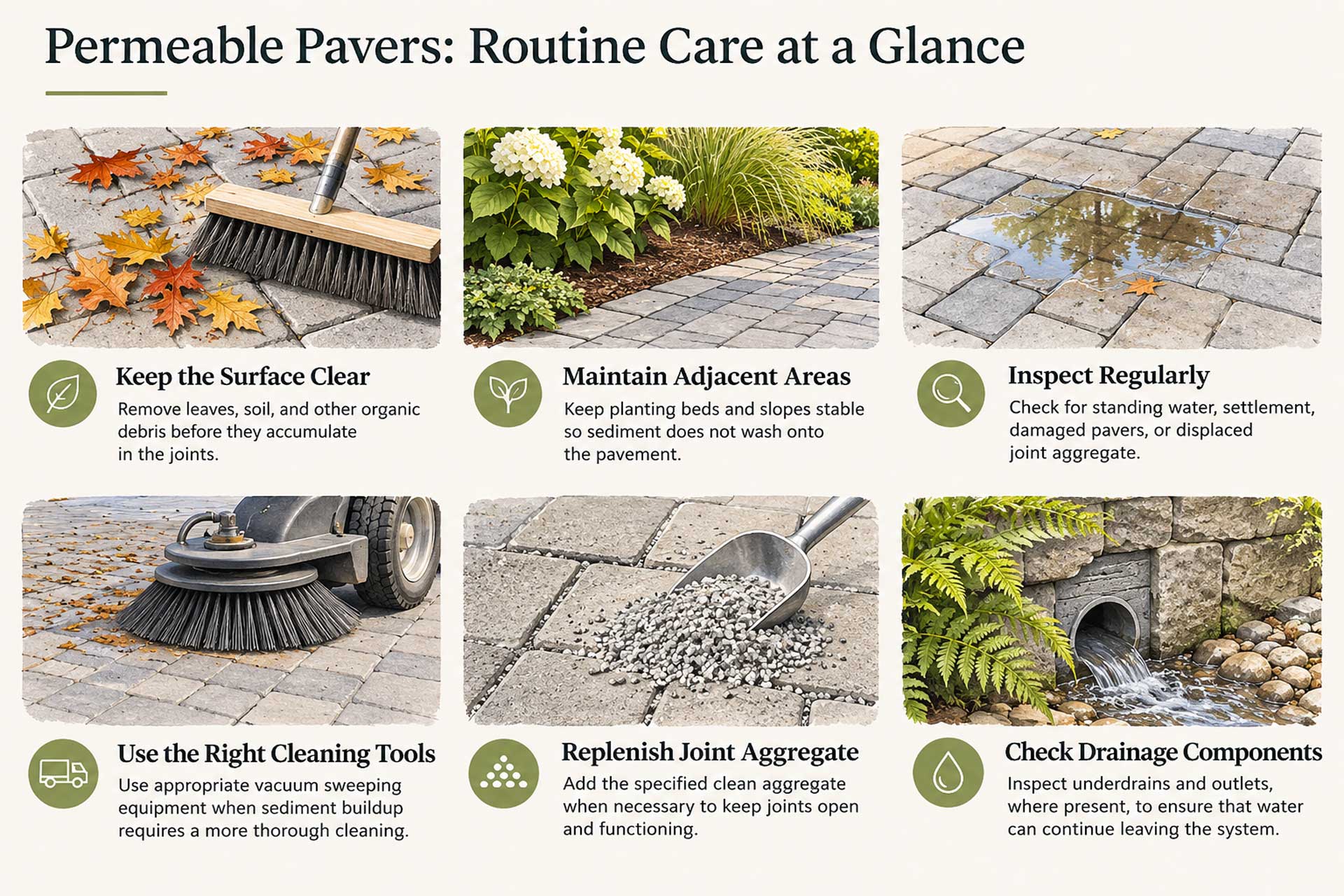
Routine care should include:
- Removing leaves, soil, and organic debris before they accumulate in the joints.
- Keeping adjacent planting beds and slopes stable so sediment does not wash onto the pavement.
- Periodically inspecting the surface for standing water, settlement, damaged pavers, or displaced joint aggregate.
- Using appropriate vacuum sweeping equipment when sediment buildup requires more thorough cleaning.
- Replenishing joint aggregate with the specified clean material when necessary.
- Checking underdrains and outlets, where present, to ensure that water can continue leaving the system.
Spring and fall are useful times to assess the surface, particularly after winter sanding or significant leaf accumulation. The actual cleaning frequency should respond to the site, surrounding landscape, and amount of sediment exposure.
The Minnesota Stormwater Manual’s maintenance guidance provides additional detail on inspection, vacuum cleaning, and managing sediment in permeable pavement systems.
One useful warning sign is water pooling in an area that previously drained readily. That change deserves investigation rather than being dismissed as a normal characteristic of the paving.
When maintenance is considered during design, it becomes easier to preserve both the appearance and the drainage performance of the finished surface.
Is Permeable Paving the Right Investment for Your Property?
Permeable paving often involves a different construction scope from conventional paving.
The surface materials are only part of the investment. Excavation depth, specialized aggregates, soil testing, drainage infrastructure, edge restraints, site access, and the intended traffic loads can all influence the project.
On a property with favorable conditions, the system may help accomplish stormwater goals that would otherwise require additional drainage improvements.
On a constrained site, the necessary excavation, underdrains, or other engineering measures may make the approach more complicated.
That is why comparing only the price of the pavers can be misleading.
We would also look at how the space is used. A driveway that serves several vehicles every day has different structural requirements from a lightly used garden patio. An arrival court with frequent turning movements requires different consideration from a narrow pedestrian path.
The best decision balances appearance, drainage performance, construction requirements, maintenance, and the overall landscape plan.
Permeable paving is a valuable option to consider, but choosing conventional pavement with an effective drainage strategy is not necessarily a compromise. On some properties, it is the more appropriate solution.
Frequently Asked Questions
Q: Can Permeable Pavers Be Installed Over an Existing Concrete Driveway?
A: Not as a conventional permeable infiltration system. An intact concrete slab would prevent water passing through the joints from reaching the underlying soil. Some specialized systems may manage water through separate drainage arrangements, but a properly functioning installation typically requires evaluating and preparing the layers beneath the surface.
Q: Do Permeable Pavers Count as Impervious Surface in Massachusetts?
A: That depends on the regulation and calculation involved. Massachusetts stormwater guidance may treat porous pavement as impervious for certain sizing purposes even when it provides stormwater benefits. Local zoning, lot-coverage limits, wetlands regulations, and permitting requirements may use different definitions. Homeowners should confirm the applicable requirements with their municipality before assuming permeable paving qualifies for an exemption.
Q: Can Permeable Pavers Support Regular Vehicle Traffic?
A: Yes. Systems specifically designed and constructed for vehicle loading can accommodate residential driveways and parking areas. The paver specification, stone base, edge restraints, and anticipated vehicle loads must all be considered. A system intended for pedestrian use should not automatically be assumed suitable for vehicles.
Q: What Happens When Permeable Paver Joints Become Clogged?
A: As sediment accumulates, the pavement may accept water more slowly, leading to surface runoff or ponding. Appropriate vacuum cleaning and replacement of affected joint aggregate can often restore performance. Persistent problems may indicate a need to assess the underlying drainage system as well.
Learn More About Permeable Paving
- This Old House: How to Install a Permeable-Paver Driveway
- Fine Gardening: Design Ideas for Managing Rainwater in Your Garden
- American Society of Landscape Architects: Permeable Surfaces
- Concrete Masonry & Hardscapes Association: Maintenance Guide for Permeable Interlocking Concrete Pavements
Planning Paving That Works With Your Landscape
Permeable pavers can offer an appealing combination of attractive hardscape and improved stormwater management. Their greatest value, however, comes when the system is appropriate for the property rather than chosen simply because the surface allows water through.
A well-designed driveway or patio should respond to the architecture, grading, soil, existing drainage, daily use, and surrounding landscape. It should also remain practical to maintain through the seasons.
For Massachusetts homeowners, that means looking beyond the paving pattern to consider what happens beneath the surface and how the entire space will perform over time.
At a Blade of Grass, our design, construction, and property-care teams consider these relationships together. Whether you are replacing an existing driveway, planning a new patio, or reconsidering drainage as part of a larger landscape renovation, the goal is to select materials and construction methods that support the property for years to come.
Contact us to discuss your property and explore the paving and drainage approaches best suited to your landscape.