Retaining walls often look straightforward from the finished side. A handsome fieldstone wall edges a driveway. A granite wall frames a terrace. A stepped retaining wall turns a sloped backyard into usable garden rooms. On a mature property in Wellesley, Weston, Newton, Brookline, Concord, or Cape Cod, the wall may feel like part of the architecture.
Behind the face of the wall, though, there is a much more technical story.
A retaining wall is asked to hold soil in place, manage water, resist seasonal movement, support nearby planting, and often define how people move through the landscape. In New England, that work is complicated by freeze-thaw cycles, dense soils, ledge, mature tree roots, coastal storms, snow storage, runoff from roofs and driveways, and increasingly intense rainfall.
The EPA notes that average annual precipitation in the Northeast increased 10 percent from 1895 to 2011, while precipitation from extremely heavy storms increased 70 percent since 1958 in the region, according to its report What Climate Change Means for Massachusetts. For homeowners, that matters because retaining wall performance is closely tied to water management.
This article looks at retaining walls in New England from a homeowner’s point of view: when they make sense, why they fail, what construction details matter, how materials should be chosen, and how ongoing landscape maintenance protects the investment.
Key Takeaways
- Retaining walls must be designed for drainage, frost, soil pressure, and long-term movement.
- Poor water management is the leading cause of wall leaning, cracking, staining, and failure.
- Warning signs include bulging, loose stones, cracks, washout, and persistent wet areas.
- Materials should match both the structural need and the home’s architecture.
- Walls perform best when planned with grading, planting, lighting, irrigation, and maintenance.
- Taller or complex walls may require permits, engineering, or local review.
Why Retaining Walls Matter on Greater Boston Properties
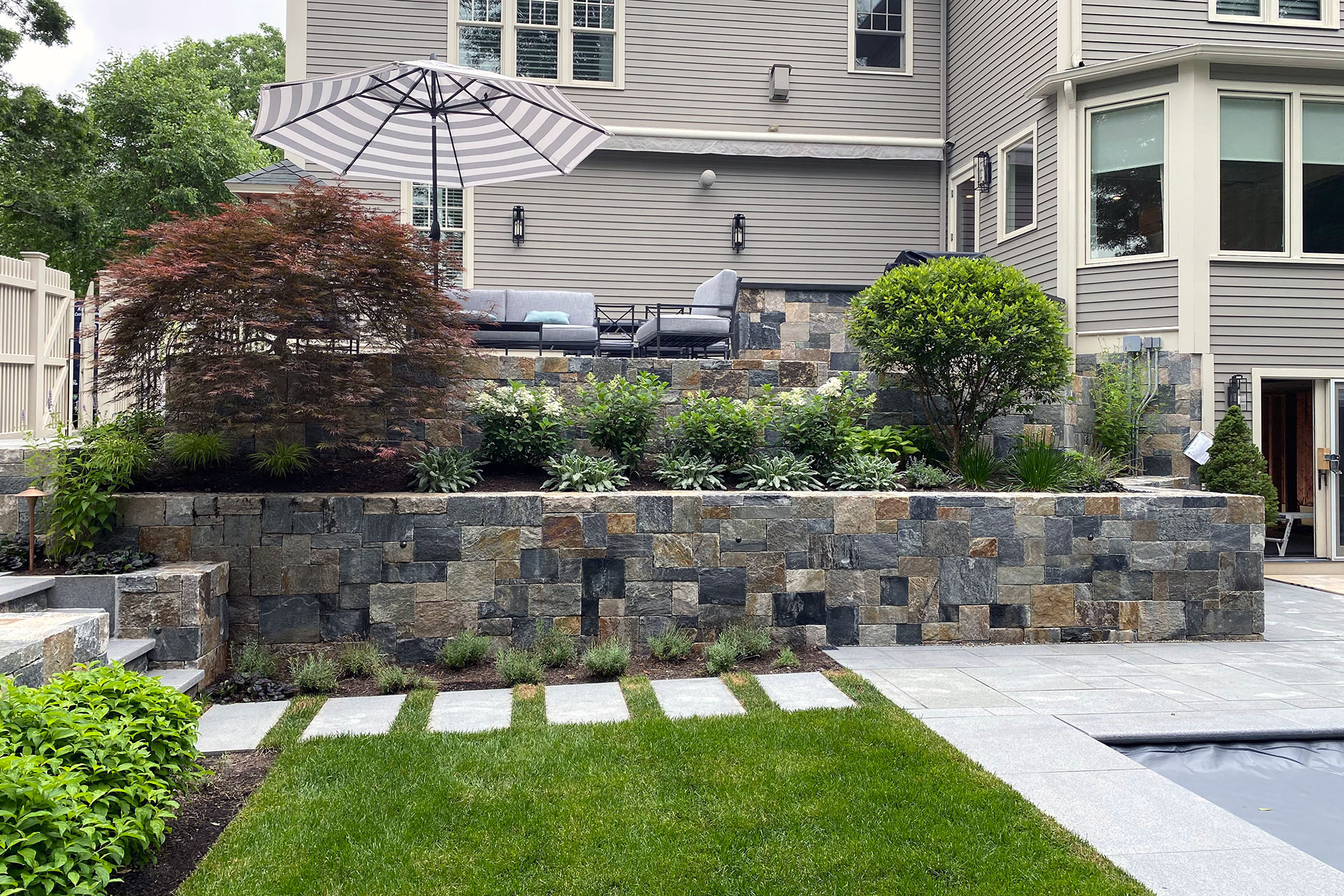
Retaining walls are common throughout Greater Boston, MetroWest, and Cape Cod because many properties were never shaped for the way homeowners use them today. Older homes often sit on uneven grades. Driveways may be narrow or steep. Backyards may slope toward wetlands, wooded edges, neighboring properties, or ledge outcroppings. Urban lots in Cambridge, Belmont, Brookline, and Newton may need to solve circulation, privacy, planting, and drainage in a very limited footprint.
A well-designed retaining wall can help:
- Create usable patios, terraces, lawns, or garden rooms on sloped ground
- Stabilize grade changes near driveways, walkways, pools, steps, and outdoor living areas
- Reduce erosion and soil movement after heavy rain
- Improve circulation between the house, yard, driveway, and garden
- Frame planting beds and create stronger architectural structure
- Protect nearby features from runoff, washout, or grade instability
- Support a larger landscape design plan rather than functioning as an isolated repair
The key is that a retaining wall should not be designed as a stand-alone object. It should be part of a broader site strategy that considers grading, drainage, planting, masonry, lighting, irrigation, and long-term property care.
For homeowners beginning that process, a Blade of Grass offers integrated landscape construction services that connect technical site work with the larger design vision.
When a Retaining Wall Is the Right Solution
Not every slope needs a wall. In some cases, grading, erosion-control planting, lawn reconfiguration, drainage improvements, or a more naturalized slope can solve the issue with less structure. In other situations, a retaining wall is the most durable and visually organized solution.
Sloped Yards That Need Usable Space

A retaining wall is often worth considering when a sloped yard prevents the property from being used comfortably. A hillside may be attractive from a distance, but it can limit where a patio, play lawn, pool terrace, vegetable garden, or outdoor dining area can sit.
On larger properties in Dover, Lincoln, Carlisle, Weston, and Wayland, walls can create a sequence of outdoor rooms that feel settled into the land. On compact lots in Newton, Brookline, Cambridge, and Belmont, a wall may be the difference between an awkward grade and a functional courtyard, terrace, or garden edge.
For related planning ideas, see Landscape Design Ideas for Sloped Yards in Greater Boston.
Driveways, Entries, and Arrival Areas
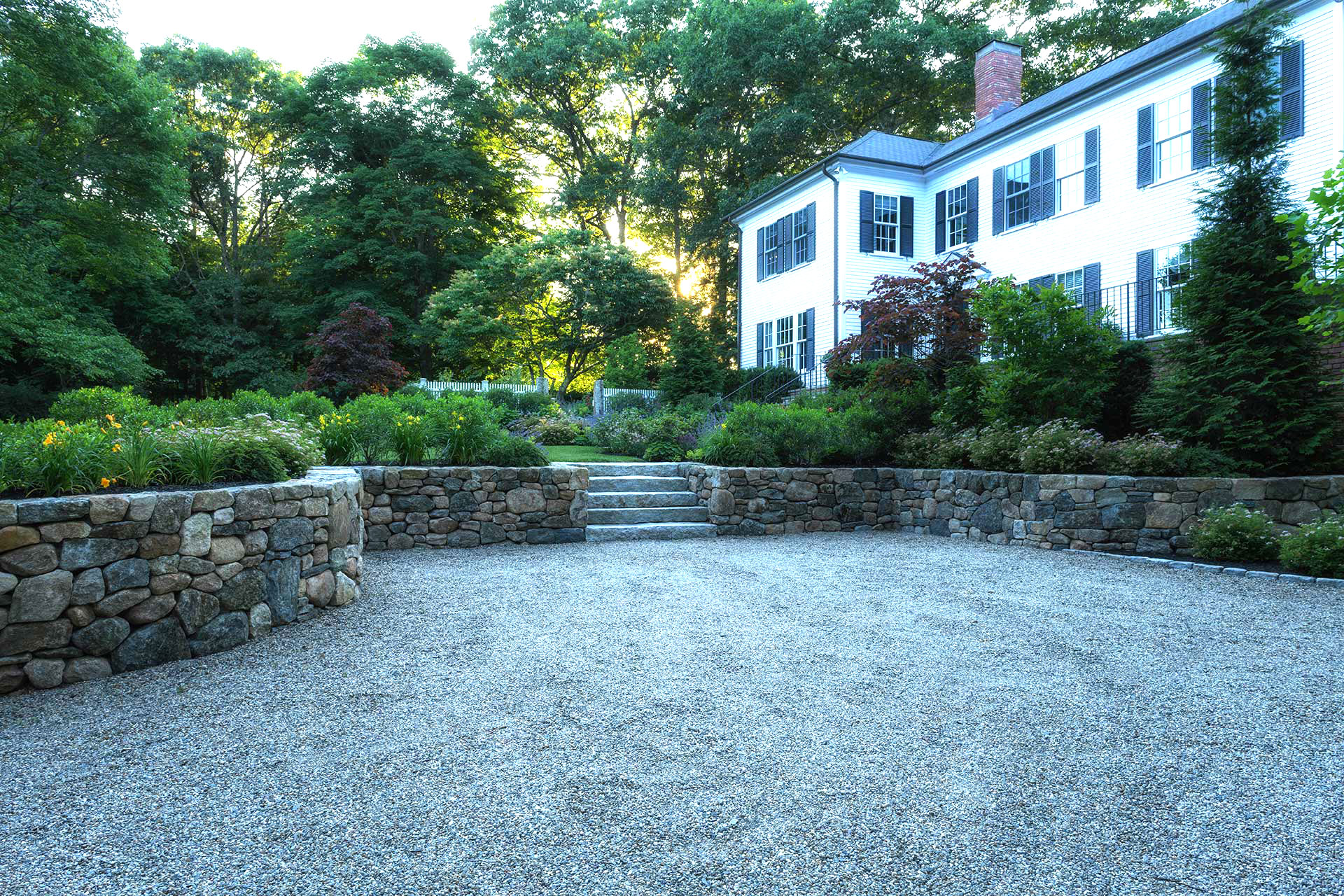
Retaining walls are frequently used near driveways and entries, especially where the home sits above or below the street. These walls do more than hold soil. They shape the arrival sequence.
A properly scaled wall can make a driveway feel more intentional, define guest parking, frame steps, support planting, and prevent exposed slopes from washing onto paved surfaces. Poorly planned walls, by contrast, can make an entry feel heavy, narrow, or disconnected from the architecture.
Drainage and Erosion Problems
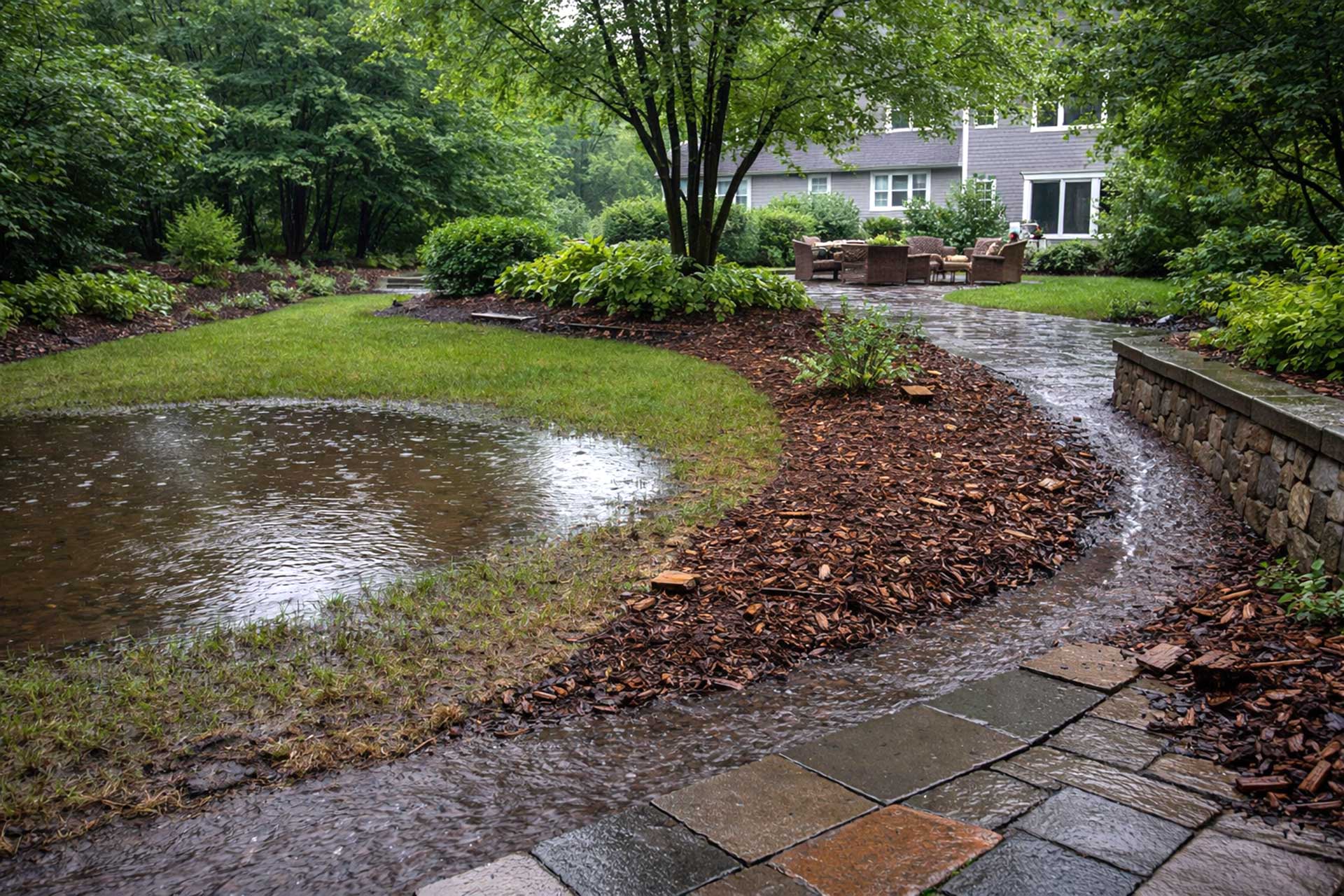
Some retaining walls are built because water has already revealed a problem. Mulch washes downhill after storms. Soil collects at the bottom of a slope. A patio edge stays wet. A lawn remains soft days after rain. A planting bed collapses into a walkway.
In these situations, the wall should be planned alongside drainage, not instead of drainage. Retaining soil without addressing water can simply move the problem behind the wall, where it becomes more expensive to correct later.
Related Blog: Landscape Drainage Solutions for Massachusetts Properties
What Makes Retaining Walls in New England More Complicated?
Retaining walls fail for many reasons, but in New England the most common issues are tied to water, soil, frost, and site complexity.
Freeze-Thaw Cycles
Water expands when it freezes. If moisture becomes trapped behind or beneath a retaining wall, repeated freezing and thawing can push, shift, crack, or destabilize the structure. A wall that looks stable in September may show movement by spring if the base, backfill, and drainage were not designed for winter conditions.
This is one reason construction quality matters so much. The visible stone, block, or veneer is only one part of the wall. The unseen base, drainage aggregate, geotextile fabric, pipe, footing, and backfill often determine whether the wall performs over time.
Heavy Rain and Hydrostatic Pressure
Water trapped behind a retaining wall creates pressure. In technical terms, this is often referred to as hydrostatic pressure. The Federal Highway Administration discusses water, seepage, and drainage design as critical considerations in retaining wall systems in its MSE wall design guidance.
For a homeowner, the takeaway is simple: retaining wall drainage is not a small detail. It is central to the wall’s performance.
A wall without proper drainage may show warning signs such as:
- Bulging or leaning
- Cracking in masonry or mortar joints
- Water staining on the wall face
- Soil washout at the base
- Settling above or below the wall
- Loose capstones or shifting stones
- Wet planting beds that never dry out
Compacted Urban and Suburban Soils
Many Greater Boston properties have compacted soils from construction, past grading, vehicle traffic, old driveways, additions, utility work, or decades of use. UMass Extension notes that soil compaction can create turf and landscape problems by altering soil’s physical properties, including aeration and water movement, in its guide to compaction and cultivation.
Compacted soil can increase runoff, reduce infiltration, stress plantings, and send more water toward walls, steps, patios, and neighboring grades. When planning retaining walls in New England, soil conditions should be assessed early, not discovered after construction begins.
Mature Trees, Roots, and Existing Landscape Features
High-end residential properties often have mature trees, established shrubs, old stonework, irrigation lines, lighting systems, terraces, and historic features that homeowners want to preserve. Retaining wall construction must respect these elements.
Excavation near mature trees can damage roots. Changing grade around a tree can reduce oxygen to the root zone. A wall that redirects water can stress nearby planting. On older properties, careful coordination between masonry, planting, drainage, and horticultural care is essential.
“At the basic level, a retaining wall is a structure that holds or retains soil behind it,” explains Joe Raboine, vice president of design at Belgard, in Architectural Digest. That simple definition is useful, but on New England properties the best walls also shape movement, manage water, support planting, and contribute to the character of the home.
Ask an Expert: Our Retaining Wall Is Starting to Lean. How Worried Should I Be?
Common Retaining Wall Issues Homeowners Notice
A retaining wall rarely fails overnight. Most problems develop gradually, then become visible after a wet season, harsh winter, or significant storm.
Leaning or Bowing
A wall that leans forward is often under more pressure than it can handle. This can be caused by poor drainage, insufficient base preparation, improper wall design, weak backfill, frost movement, or surcharge loads from driveways, slopes, patios, pools, or structures above the wall.
Leaning should be evaluated promptly. Cosmetic repairs rarely solve the underlying issue.
Cracking, Open Joints, or Loose Stones
Cracks may appear in poured concrete, mortared stone, block walls, or veneer. In natural stone walls, loose stones or capstones can indicate movement, water infiltration, settling, or freeze-thaw stress.
A small crack does not always mean immediate failure, but it should not be ignored. The question is whether the crack is superficial or whether the wall is moving.
Water Stains, Efflorescence, or Wet Areas
Water staining, white mineral deposits, moss, algae, or persistently wet soil may indicate that water is trapped or moving through the wall in unintended ways. In shaded areas, especially near north-facing slopes or dense planting, moisture problems can remain hidden longer.
Soil Washout and Erosion
If soil is washing out at the top, base, or sides of a retaining wall, the site likely needs better grading, drainage, planting, or stabilization. Adding more mulch or stone may hide the issue temporarily, but it does not address the water movement that caused it.
Plant Decline Near the Wall
Plantings around retaining walls can struggle when the soil is too wet, too dry, too compacted, too shallow, or exposed to reflected heat. On Cape Cod properties, salt exposure and sandy soils add another layer of complexity. In deer-heavy areas such as Weston, Dover, Wayland, Lincoln, and Carlisle, plant selection also needs to account for browsing pressure.
Retaining Wall Materials: Pros and Cons for New England Homes
The right wall material depends on the home’s architecture, wall height, site conditions, budget, construction method, and desired character. A historic home in Concord may call for a very different wall than a contemporary property in Brookline or a coastal home in Duxbury.
| Material | Pros | Cons | Best Fit |
|---|---|---|---|
| Natural fieldstone | Timeless New England character, blends well with older homes and woodland settings | Requires skilled masonry and thoughtful drainage; irregular stone can be more labor-intensive | Historic homes, garden walls, woodland edges, traditional properties |
| Granite | Durable, refined, regionally appropriate, strong architectural presence | Can feel formal or heavy if not scaled carefully | Entries, steps, terraces, driveway walls, premium hardscape details |
| Segmental concrete block | Engineered performance, efficient installation, suitable for taller reinforced walls | May not have the same visual character as natural stone unless carefully selected and detailed | Structural walls, larger grade changes, walls requiring geogrid reinforcement |
| Poured concrete | Strong, clean-lined, suitable for modern designs and tight sites | Requires excellent design and finishing to avoid a harsh or utilitarian look | Contemporary homes, urban courtyards, modern terraces |
| Timber | Informal appearance, lower initial cost, useful for temporary or rustic applications | Shorter lifespan, moisture vulnerability, less appropriate for premium long-term landscapes | Limited-use areas, temporary stabilization, informal garden edges |
For many Blade clients, the best retaining wall is not simply the strongest or most expensive option. It is the wall that suits the property’s architecture, solves the grade issue, manages water correctly, and feels natural within the overall landscape.
Examples of walls, steps, and integrated masonry can be found in Blade’s stone walls and steps portfolio.
What Good Retaining Wall Construction Should Include
A retaining wall is only as good as the system behind it. Homeowners do not need to know every construction detail, but they should understand the major components that separate durable work from short-term fixes.
1. Site Evaluation
Before construction begins, the site should be reviewed for slope, soil, drainage, ledge, nearby trees, utilities, structures, access, wetlands, and municipal requirements. On many Massachusetts properties, the question is not just “Where should the wall go?” It is “How will this wall change the movement of water, people, soil, and planting across the property?”
2. Proper Base Preparation
The base supports the entire wall. Poor excavation, inadequate compaction, improper stone base, or building on unstable soil can lead to settling and movement. In freeze-thaw climates, base preparation is especially important.
3. Drainage Behind the Wall
Drainage aggregate, perforated pipe where appropriate, filter fabric, weep holes, outlets, and surface grading all help move water away from the wall. If water is not given a controlled path, it will create its own.
4. Correct Wall Batter and Reinforcement
Many retaining walls need a slight backward lean, known as batter, or reinforcement such as geogrid depending on height, soil, and loads. Taller or more complex walls may require engineering, especially if they support driveways, patios, steep slopes, pools, fences, or other structures.
5. Thoughtful Grading Above and Below
The grade above the wall should not send uncontrolled runoff toward the structure. The grade below should not erode or undermine the base. This is where landscape drainage, planting, lawn design, and hardscape detailing need to work together.
6. Integrated Planting and Finishing
The planting around a retaining wall should soften the structure, stabilize soil, manage seasonal interest, and respect the wall’s function. Plant roots, irrigation patterns, mature size, shade, deer pressure, and maintenance access should all be considered.
Permits, Engineering, and Local Review
Retaining wall requirements vary by municipality, wall height, site conditions, wetlands proximity, zoning, and whether the wall supports additional loads. Some Massachusetts communities note that retaining walls above certain heights, often around four feet, may require permits or additional review. For example, Westford provides permit guidance for retaining walls four feet tall or higher.
Homeowners should not assume that a wall is exempt because it is part of a landscape project. A wall near a wetland buffer, coastal resource area, property line, driveway, pool, or steep slope may require more careful review.
Blade has also written about local landscape project review in Permits and Regulations for Landscaping Projects in the Boston Area.
Maintaining Retaining Walls After Construction
A well-built retaining wall should not need constant attention, but it should be included in seasonal landscape maintenance. This is especially true on mature properties where walls interact with planting, irrigation, drainage, leaf litter, shade, snow, and tree roots.
Seasonal Wall Maintenance Checklist
- Inspect the wall each spring for leaning, cracks, loose stones, or shifted caps
- Check for soil washout at the top, base, and side returns
- Clear leaves and debris from drainage outlets, weep holes, and nearby surface drains
- Review planting beds for mulch buildup against the wall face
- Watch for irrigation overspray that keeps the wall or backfill too wet
- Prune shrubs that trap moisture or block inspection access
- Monitor snow storage areas so plowed snow does not overload or saturate the wall
- Look for new water patterns after storms, especially near driveways and roof leaders
Long-term care is not just about the wall itself. It is about how the surrounding landscape changes. Plants mature. Trees cast more shade. Roots expand. Drainage patterns shift. Walkways settle. Irrigation zones may need adjustment.
That is why retaining walls benefit from professional property care that sees the whole landscape, not just the masonry. Blade’s landscape maintenance services are designed to protect the long-term performance and appearance of residential landscapes across Greater Boston.
Learn More
For homeowners who want to better understand retaining wall planning, drainage, soil, and climate conditions, these resources are helpful starting points:
- EPA: What Climate Change Means for Massachusetts
- FHWA: Design and Construction of Mechanically Stabilized Earth Walls
- UMass Extension: Compaction and Cultivation
- Architectural Digest: Retaining Wall Ideas
Frequently Asked Questions
Q: How do I know if my property needs a retaining wall?
A: A retaining wall may be appropriate if a slope is limiting usable space, soil is eroding, grade changes are affecting a patio or driveway, or planting beds are washing out after storms. The best first step is a site review that considers grading, drainage, access, planting, and long-term maintenance.
Q: What causes retaining walls to fail in New England?
A: The most common causes include poor drainage, inadequate base preparation, freeze-thaw movement, unsuitable backfill, soil pressure, erosion, and loads from driveways, patios, slopes, or structures above the wall. Water behind the wall is one of the most important warning signs to address.
Q: Do retaining walls need drainage?
A: Yes. Drainage is central to retaining wall performance. Depending on the wall type and site conditions, this may include drainage stone, filter fabric, perforated pipe, weep holes, outlet points, and surface grading that directs water away from the wall.
Q: Do I need a permit for a retaining wall in Massachusetts?
A: Permit requirements vary by municipality, wall height, site conditions, wetlands proximity, and whether the wall supports additional loads. Walls around four feet or taller often require closer review, and complex walls may need engineering. Always confirm local requirements before construction.
Q: Can an existing retaining wall be repaired, or does it need to be rebuilt?
A: It depends on the cause and severity of the problem. Loose capstones or minor surface issues may be repairable, but leaning, bulging, major cracking, or drainage failure often requires more substantial reconstruction. A site evaluation can determine whether repair or replacement is the better long-term solution.
Final Thoughts
Retaining walls in New England are both practical and architectural. They can make a sloped yard more usable, frame a driveway, support a terrace, stabilize planting beds, manage erosion, and give the landscape a stronger sense of structure. They can also create costly problems when drainage, soil, frost, materials, or permits are treated casually.
For Boston-area homeowners, the best retaining wall is not just built to hold back soil. It is designed as part of the property.
If your landscape includes a failing wall, a steep slope, an awkward grade change, or an outdoor space that could be more usable, the wall should be considered alongside the larger plan for drainage, planting, hardscape, lighting, irrigation, and long-term care.
If your property is entering a new chapter, the landscape should be part of the plan from the beginning. Contact the Blade team to discuss how thoughtful landscape design, construction, planting, and long-term care can help your outdoor spaces feel connected, durable, and true to the home.