An Expert’s Summary
We deal with standing water on many of our clients’ properties, especially in low areas, compacted lawns, and yards affected by runoff from roofs, driveways, or neighboring grades. A French drain can help in the right situation, but it won’t solve every drainage problem.
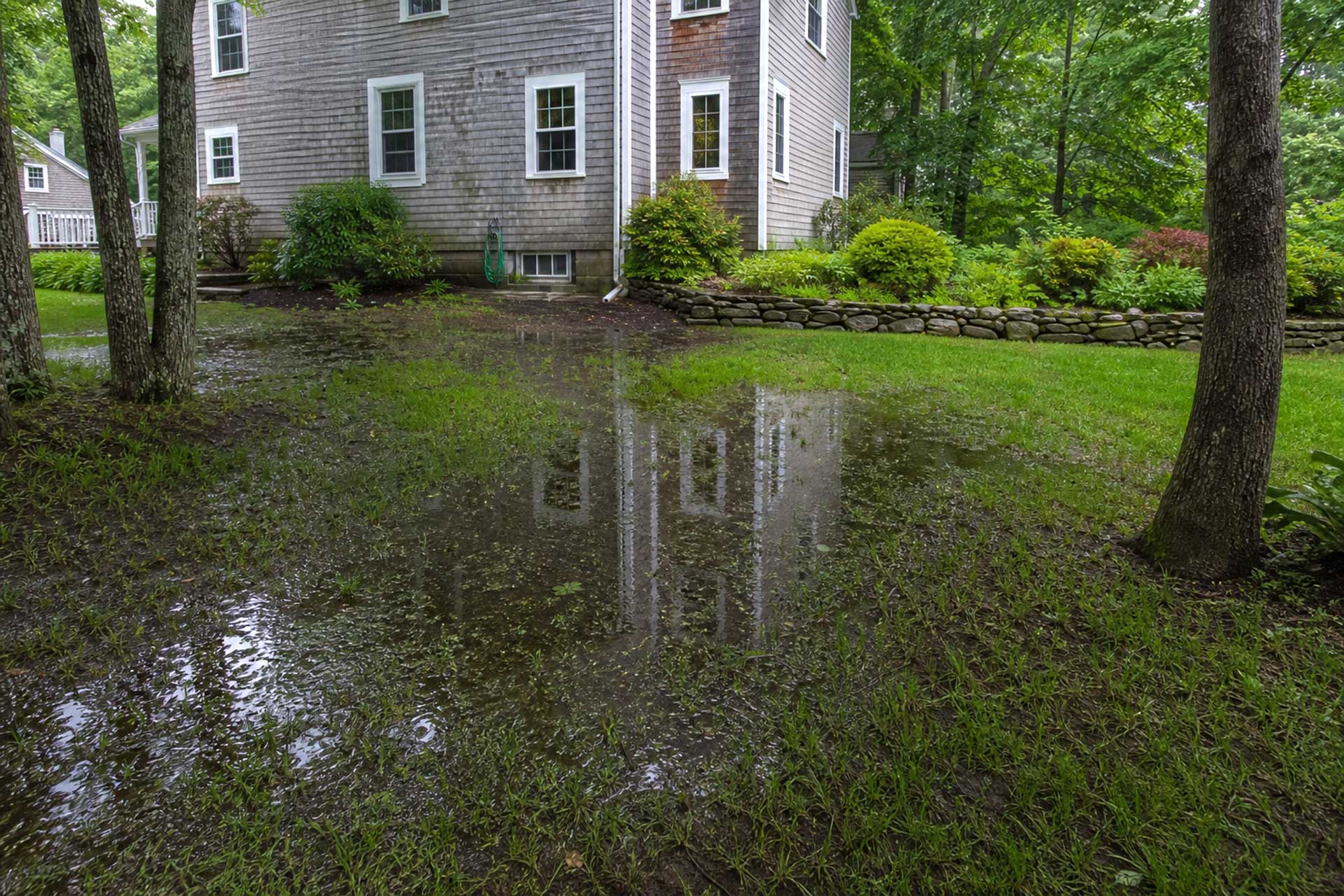
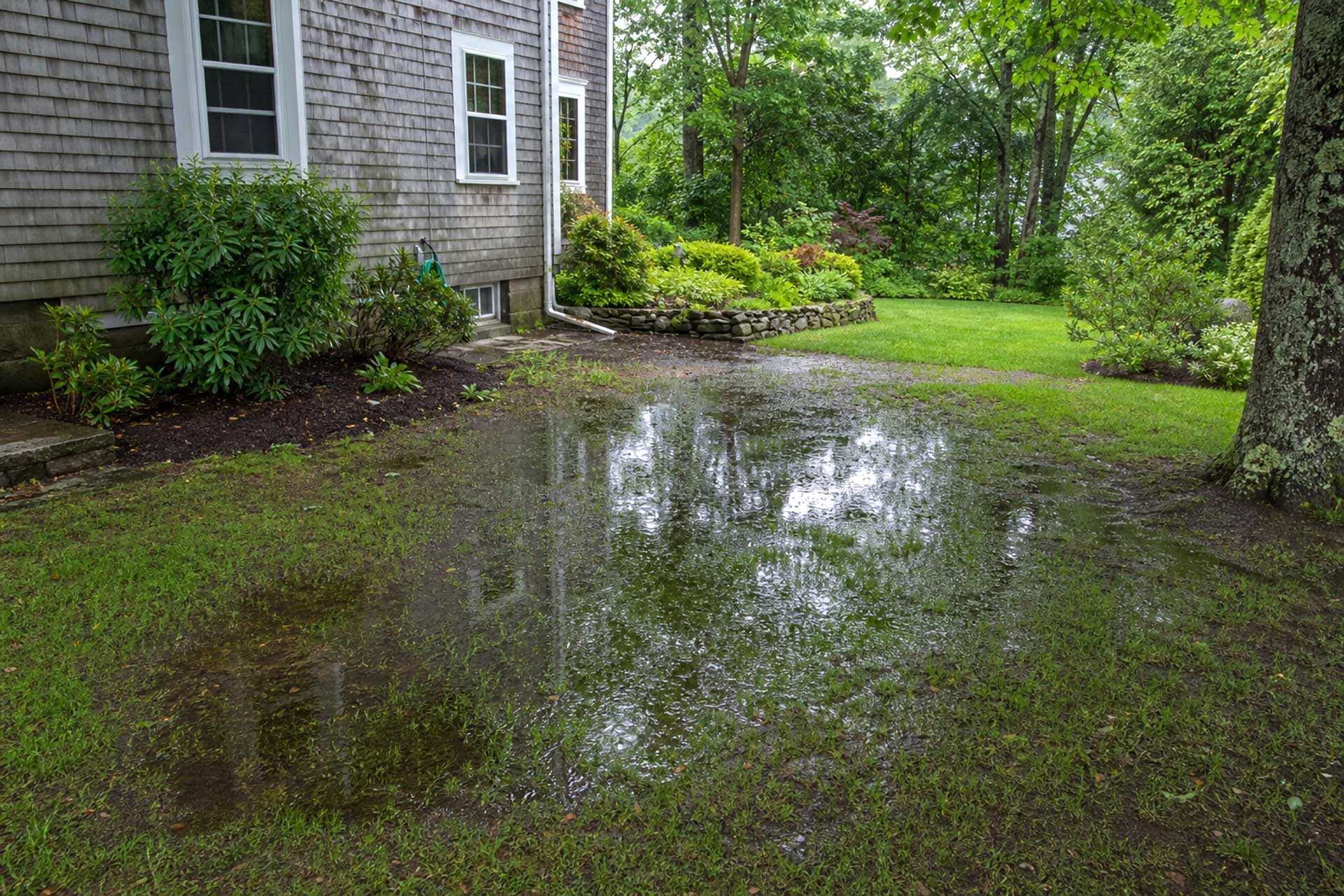
When I evaluate a soggy backyard, I first look at where the water comes from, how it moves across the property, how long it remains, and where it can safely go. In Beth’s photos, the water spreads across a broad, shallow section of lawn near the house rather than collecting in one narrow line. I can also see a nearby downspout, worn and thinning turf, a subtle low area, and mature trees whose roots limit how aggressively we can change the soil. Those clues make surface grading and roof-runoff management the first things I would investigate, not an automatic French drain installation.
The Question
“Every time we get a heavy rain, water collects in the same part of our backyard and sometimes sits there for several days. The lawn gets soggy and muddy, and we’ve noticed the grass starting to thin out. A few people have suggested installing a French drain, but we’re not sure if that would actually solve the problem. How can we tell what’s causing the standing water and what type of drainage fix we really need?”
– Submitted by: Beth D., Sudbury, MA
The Short Answer
Standing water doesn’t automatically mean you need a French drain. Looking at these photos, I wouldn’t make a French drain my first recommendation. The water covers a wide, shallow area of lawn, which looks more like surface water settling in a low spot than a single line of subsurface water that needs to be intercepted.
The downspout near the wet area deserves attention because roof runoff may be adding a concentrated volume of water close to the house. I would also check the lawn elevations and test how quickly the soil absorbs water. The muddy, thinning grass tells us this has happened often enough to affect the turf, but a photo cannot tell us whether compaction, slow soil, or groundwater is contributing below the surface.
My first steps here would be to trace the downspout discharge, document the grades from the foundation through the lawn, and identify a safe outlet. The final plan may combine a downspout extension or solid pipe, modest regrading, a catch basin or swale, and selective soil repair. I would reserve a French drain for evidence of subsurface water that remains after we understand the surface flow. For a closer look at how these options work, I will also plug our recent post regarding landscape drainage solutions for Massachusetts properties.
The Details
Start With the Water, Not the Drain
After decades of working on Greater Boston properties, I’ve learned that the puddle is usually the end of the story, not the beginning.
Water may collect in one corner of the yard, but that doesn’t mean the problem starts there. It may arrive from a roof, driveway, patio, uphill lawn, neighboring property, or underground source. If we install a drain without finding that source, we may move some water while leaving the real problem untouched.
Landscape designer Jan Johnsen offers a simple reminder that applies to every property: “Grading and drainage are critical to any project.” Read her guidance through the American Society of Landscape Architects.
This matters even more in Massachusetts, where our precipitation patterns have become harder on residential landscapes. NOAA reports that precipitation in Massachusetts since 1970 has averaged about 4.7 inches more than it did from 1895 through 1969. Winter and spring precipitation, along with the frequency of extreme rain events, is also projected to increase. See NOAA’s Massachusetts State Climate Summary.
In other words, a backyard that barely managed water twenty years ago may struggle more today.
What the Photos Tell Us About This Yard
The first thing that stands out is the shape of the ponding. The water spreads across a large portion of the lawn in a shallow sheet. It does not appear confined to a narrow trench-like area or one isolated pocket. That pattern often means the lawn has a low, nearly level basin where water arrives faster than the soil can absorb it.
The second clue is the downspout near the house. We cannot tell from the photos whether it empties at the surface, connects to a buried pipe, or has a failed underground connection. We can tell that it sits close enough to the wet area that it needs to be tested. During the next rain, I would watch the outlet and confirm whether roof water travels toward the puddle. A temporary above-ground extension can also help show whether moving roof runoff changes the amount of ponding before the homeowner commits to excavation.
The turf gives us another useful clue. Grass has thinned across the wettest area, and exposed soil appears muddy. That suggests repeat saturation rather than a one-time storm. Replacing the lawn without changing the water conditions would likely lead to the same result.
The mature trees also affect the solution. Their roots may contribute to uneven grades and soil density, but they are valuable landscape features that we should protect. I would not recommend adding a deep layer of fill, trenching casually through the root zone, or aggressively cultivating the entire area. Any grading or drain route needs to work around major roots and preserve the trees’ existing soil level.
Finally, the water sits close enough to the house that I would verify the pitch immediately around the foundation. The photos do not show water entering the home, and we should not assume that it is. Still, keeping runoff away from the foundation takes priority over improving the appearance of the lawn.
Based on the photographs alone, my recommended order of investigation would be:
- Trace the downspout and test its discharge during rain.
- Take spot elevations from the foundation through the flooded lawn and toward any possible outlet.
- Check how long the water remains after the storm ends.
- Test soil infiltration in representative areas outside major tree roots.
- Rule out irrigation leaks, sump discharge, damaged drain lines, and persistent groundwater.
- Choose a surface or subsurface solution only after those checks identify the source.
Other Water Patterns We Check
The photos give us strong surface clues, but we would still walk beyond the puddle. Water may arrive from an uphill grade, appear during otherwise dry weather, or begin after construction elsewhere on the property. Those patterns can change the diagnosis.
Water Collects at the Bottom of a Slope
When a wet area sits below a hill, retaining wall, driveway, or neighboring yard, water may be moving downhill toward it.
That movement can happen across the surface or through the soil. A French drain can sometimes intercept subsurface water along the base of a slope, but surface runoff may require a swale, grading adjustment, catch basin, or another method of guiding water.
The Area Stays Wet During Otherwise Dry Weather
If water appears without recent rain, we look for a leaking irrigation or drainage line, sump-pump discharge, groundwater, or runoff from another property. We need to rule out those sources before beginning landscape work.
The Problem Started After Other Work
A patio, addition, pool, driveway, wall, or landscape renovation can change how water moves. New hard surfaces and grades may concentrate runoff in a lawn that previously stayed dry.
When Does a French Drain Make Sense?
A French drain is a gravel-filled trench that usually contains a perforated pipe. Water enters through the stone and pipe, then moves toward an outlet.
French drains work best when they have a clear job. They may be appropriate when:
- Subsurface water moves through the soil toward a lawn, bed, wall, or patio.
- Water needs to be intercepted along the bottom of a slope.
- A consistently wet edge needs relief.
- Soil conditions allow water to reach the drain.
- The pipe has enough pitch to move water.
- The system has a safe, legal, and dependable outlet.
That last point is the one homeowners often miss. A French drain doesn’t make water disappear. It collects water and moves it somewhere else.
If the pipe has no suitable outlet, the trench may simply become a long underground bathtub. It may fill slowly, drain poorly, or send water to another part of the property.
A well-designed system needs the right depth, pitch, materials, and outlet. Soil, roots, debris, and ice can all interfere with its performance.
When Is a French Drain the Wrong Answer?
I would hesitate to recommend a French drain when the main problem is clearly above ground.
For example, it may not be the best first solution when:
- A downspout empties directly into the wet area.
- The lawn has a visible low spot that grading could correct.
- Water flows across the surface from a driveway or patio.
- The entire yard consists of compacted soil.
- The property has no appropriate drainage outlet.
- High groundwater keeps the whole area saturated.
- A failed pipe or irrigation leak causes the wetness.
- The proposed drain would send water toward a neighbor or protected area.
In these situations, a French drain may address the symptom without correcting the cause. It can also disturb a large portion of the yard and add unnecessary expense. In this particular yard, a trench could also cross mature-tree roots, which gives us another reason to confirm that it is truly necessary before digging.
What Other Drainage Solutions Should We Consider?
There is no single best drainage system for every backyard. Most successful projects use the simplest solution that addresses the actual source of the water.
Regrading the Lawn
Regrading reshapes the ground so water moves away from the house and does not settle in low areas. For this yard, I would explore a modest correction to the broad lawn basin, but only after mapping the foundation elevation, tree roots, and intended outlet. We should not simply add enough soil to bury roots or push the same water toward another part of the property.
Boston’s flood-resilient landscaping guidance recommends sloping soil away from a foundation by at least six inches over the first ten feet where conditions allow. See Boston’s flood-resilient landscaping recommendations.
Redirecting Roof Runoff
When roof water causes the problem, we may extend a downspout, connect it to an underground solid pipe, or move the discharge point. Because Beth’s photos show a nearby downspout, I would test this option early. Unlike a French drain, a solid conveyance pipe carries concentrated roof water without releasing it along the route. The discharge still needs an appropriate destination. We don’t want to solve one wet area by creating another.
Adding a Catch Basin or Area Drain
A catch basin collects water at a known low point and directs it into a solid drainage pipe. Because the photographs show broad surface ponding, a basin at the verified low point may work better than a French drain if the site has a suitable gravity outlet. The surrounding grade must lead water toward the basin, and the outlet must remain accessible. Catch basins also need occasional cleaning because leaves, soil, and debris can block them.
Building a Swale
A swale is a shallow, gently shaped channel that guides water across the landscape. If the elevation survey identifies a gentle route around the mature trees, a swale could move surface water more naturally and with less root disturbance than a deep trench. We can integrate it into lawn or planting so the yard does not feel heavily engineered.
A swale still needs an appropriate destination and enough slope to move water without causing erosion.
Creating a Rain Garden
A rain garden is a planted depression designed to receive runoff and allow it to soak into the soil gradually. It can be both practical and attractive when the site has suitable soils, space, and drainage. I would not place one automatically in the existing puddle. First, we would need to confirm that the soil can drain between storms and locate the garden far enough from the foundation and major tree roots.
The EPA explains that rain gardens collect water from surfaces such as roofs and driveways, then allow it to soak into the ground. Learn more about rain gardens from the EPA.
A rain garden isn’t the right answer for water against a foundation, severe erosion, contaminated runoff, or a location that never drains.
Improving Compacted Soil
If compaction contributes to the problem, soil improvement may help water infiltrate more effectively. Depending on the site, that may include aeration, organic matter, soil replacement, deep cultivation during renovation, or rebuilding the planting profile. Simply spreading a thin layer of topsoil over compacted ground rarely fixes the underlying issue.
We need to take particular care around mature trees. Adding soil over established roots or aggressively cultivating the root zone can harm the tree.
Using Plants That Tolerate Moisture
Sometimes the wetness is seasonal and reflects the natural character of the site. If this area drains reasonably between storms after we correct the incoming runoff, moisture-tolerant planting could replace some of the lawn that repeatedly thins. A layered bed could also create a more graceful transition around the existing trees and fieldstone edge.
Plants can help slow runoff, hold soil, and improve a damp area, but they cannot correct a low grade, stop concentrated roof runoff, or protect the foundation on their own.
Our guide to the best plants for wet areas in Massachusetts yards explains how plant selection changes depending on whether soil stays evenly moist, becomes seasonally saturated, or holds standing water.
What Can You Check Before Calling a Professional?
You don’t need to diagnose the property yourself, but these observations can make the first conversation much more useful:
- Take photos while the water is present.
- Note when the rain stopped.
- Check the area again after 12, 24, and 48 hours.
- Watch where water enters the wet spot.
- Look at every nearby downspout.
- Note whether the lawn is soft beyond the visible puddle.
- Check for washout or recent work that may have changed the grade.
- Look for blocked drain outlets.
Photograph the yard during an ordinary rain, too. Moving water often reveals its source more clearly than the puddle left behind.
Avoid digging exploratory trenches until you know where utilities, irrigation lines, lighting wire, and drainage pipes run.
What Does a Professional Drainage Evaluation Include?
A proper evaluation looks at the whole property, including grades, downspouts, hardscape, soil, irrigation, sump discharge, mature trees, neighboring elevations, regulations, and potential outlets. We also ask how the homeowner wants to use the area. A family lawn, garden, woodland edge, and pool terrace may call for different solutions.
This is where experience matters. The most technically elaborate option is not always the best one. A small grading correction or downspout adjustment may solve the problem with less disruption. On another property, a coordinated system of grading, drains, and planting may provide the only reliable long-term answer.
Can We Send the Water Toward the Street or a Neighbor?
Not without checking the rules and the effect on surrounding properties. Drainage work should not create a new problem downhill. Municipal requirements vary, and connections to stormwater systems may require approval. Work near wetlands, streams, ponds, floodplains, and protected buffer zones may also require Conservation Commission review.
Our guide to Massachusetts wetlands laws and landscape projects explains why even routine grading or drainage work can require additional planning. When in doubt, confirm local requirements before excavation begins.
How Do We Keep the Problem From Coming Back?
Even a well-designed drainage system needs occasional attention. A sensible maintenance routine may include:
- Cleaning catch basins and drain grates
- Removing leaves from swales and outlets
- Checking downspout connections
- Watching for erosion after major storms
- Keeping soil and mulch away from drain openings
- Adjusting irrigation so it does not add unnecessary water
- Repairing settled lawn areas before they become larger basins
- Reviewing the system after construction elsewhere on the property
Trees grow, soil settles, gardens mature, and weather patterns change. Drainage should remain part of long-term property care rather than something everyone forgets after installation.
The Bottom Line
Standing water tells us that the yard is receiving more water than it can absorb or move away. A French drain may be part of the answer, but it should never be the automatic answer.
For this Sudbury property, I would start with the nearby downspout and a simple elevation survey of the broad lawn basin. If roof runoff and a shallow low spot explain the ponding, a combination of solid downspout conveyance, careful regrading, and possibly a catch basin or swale may solve the problem with less disruption than a French drain. If field observations reveal subsurface seepage, then a French drain may become part of the plan.
Whatever the final solution, it should protect the house, avoid damaging the mature trees, restore a usable lawn or planting area, and move water to a safe outlet without affecting neighboring land.
If water remains in your backyard for days, damages the lawn, affects planting beds, or creates mud and ice, the Blade team can help. We’ll look at how water moves through the entire property and recommend a solution that fits the landscape, rather than simply installing a drain and hoping for the best.
Helpful Resources
Rain Gardens: A Way to Improve Water Quality – UMass Amherst Extension
Soak Up the Rain: Rain Gardens – U.S. Environmental Protection Agency
Flood-Resilient Landscaping – City of Boston
Rain Barrels and Rain Gardens for Managing Household Stormwater – Penn State Extension