An Expert’s Summary
Brown boxwoods don’t automatically mean boxwood blight.
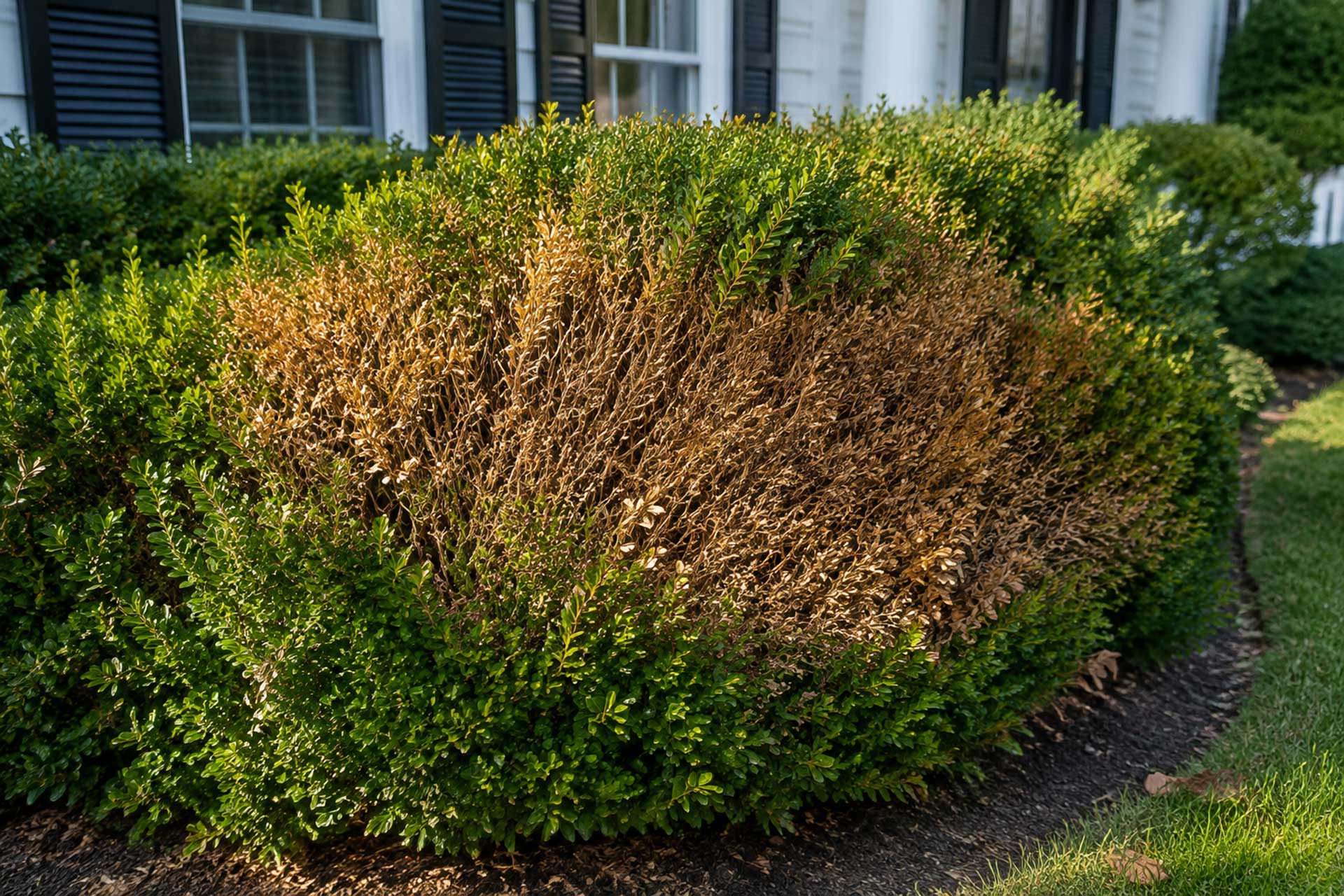
In fact, when I see boxwoods with bronze or brown foliage in early spring, winter injury is one of the first possibilities I consider. Boxwoods are particularly vulnerable to drying winter winds, winter sun, frozen soil, and drought stress going into winter. UMass Extension notes that winter injury commonly appears as bronze, tan, or brown foliage, often on the south or southwest side of exposed shrubs.
But timing and pattern matter. If I see rapid leaf drop, distinct brown leaf lesions, and dark streaks developing on green stems, I’m much more concerned about boxwood blight. If I find straw-colored leaves that remain attached and salmon-colored fungal structures, I start thinking about Volutella. If the foliage has actually been eaten and I find webbing and caterpillars inside the plant, box tree moth moves quickly up the list.
When I’m evaluating brown boxwoods, there are five things I look at first:
- When did the browning appear? Damage that becomes obvious at the end of winter tells me something different from rapid decline during warm, humid weather.
- Where is the damage? One exposed side of a hedge suggests something very different from symptoms spreading randomly from plant to plant.
- Are the brown leaves staying on the plant or dropping? That distinction can be surprisingly useful.
- What do the leaves and stems look like up close? Spots, stem lesions, webbing, chewing, blistering, and fungal structures can point us in very different directions.
- What’s happening around the boxwoods? Drainage, irrigation, road salt, reflected sun, pruning, soil conditions, and recent construction can all contribute to decline.
The important thing is not to decide on a treatment before we’ve decided what we’re treating. I’ve seen homeowners become convinced they have boxwood blight when their plants were suffering from winter damage. I’ve also seen struggling boxwoods where the visible disease wasn’t really the beginning of the problem at all. The plant had been stressed for years, and disease was simply the final thing we noticed.
Remember that brown is just a symptom. It isn’t a diagnosis.
The Question
“We have several mature boxwoods along the front of our house that have always been healthy. This year parts of them have turned brown, and one plant seems worse than the others. My neighbor says it’s boxwood blight and I’m worried that’s what we’re seeing. How can we tell if it’s blight, and if it is, can the boxwoods be saved?”
– Submitted by: Catherine M., Wellesley, MA
The Long Answer
The first thing I’d tell Catherine is not to assume it’s boxwood blight just because the foliage is brown. If we were standing in front of those boxwoods together, I’d probably spend the first few minutes asking questions rather than giving her an answer.
When did she first notice it? Did the boxwoods look healthy last fall? Which direction does the front of the house face? Does the browning occur mostly on the side facing the driveway or walkway? Is it concentrated on the south or southwest side? Does that area get a lot of winter wind?
Then I’d get closer. I’d separate some branches and look into the center of the plant, turn over a few leaves, and look carefully at the stems. I’d see whether the brown leaves are still firmly attached or whether there’s a layer of fallen foliage underneath the shrubs.
I’d also look at the ground around them. Is the soil wet? Is there a downspout nearby? Has the grade changed? Is there a sprinkler hitting the foliage every evening? Are these shrubs sitting beside a walkway that gets heavily salted? Was there construction nearby that might have affected drainage or roots?
Those details matter because boxwoods can arrive at the same brown appearance by very different routes. A row of boxwoods along the southwest side of a house in Concord that turns bronze in February is telling me one story. A hedge that begins dropping leaves rapidly during warm, wet weather is telling me another. And a boxwood on Cape Cod with chewed leaves, webbing, and caterpillars inside the canopy is telling me something else entirely.
That’s why I pay so much attention to the pattern. It’s often where the diagnosis starts.
Start With Where the Damage Is, Not Just What Color It Is
One of the easiest mistakes to make with boxwoods is standing ten feet away and deciding that brown equals disease. I want to walk around the plant. If most of the browning is on the south or southwest side, particularly after winter, I’m immediately interested in exposure.
Boxwoods are broadleaf evergreens. Their leaves continue to lose moisture during winter, especially on sunny and windy days, while frozen soil can prevent the roots from replacing that moisture. UMass Extension describes winter injury on boxwood as bronze, tan, or brown foliage that often becomes noticeable in winter or early spring, particularly on exposed south or southwest sides. Drought stress during the previous fall can make that damage worse.
That pattern is very familiar in New England. I remember looking at a mature boxwood planting in Concord one March that looked pretty alarming when we first came up the driveway. Several feet of the hedge had turned brown, and the homeowner was already thinking about replacing it.
Once we walked around it, though, the story changed. The protected side was green, the interior growth was largely healthy, and the worst damage was concentrated on the exposed southwest face. The leaves weren’t dropping unusually, and we weren’t seeing the stem symptoms I’d expect with boxwood blight.
That doesn’t make winter injury harmless. Some branches may still be lost. But it changes the conversation from “We have to remove this hedge” to “Let’s see how much viable growth we actually have.” That’s a very different decision.
Winter Damage Is More Common Than Many Homeowners Realize
Spring is when we get a lot of questions about boxwoods, and that makes sense. Plants that looked perfectly respectable in November can look awful by March.
Boxwoods aren’t always especially forgiving of a New England winter. Strong winds and bright winter sun increase moisture loss from the leaves, while frozen soil limits the plant’s ability to replace that water. A boxwood that went into winter already drought-stressed is even more vulnerable.
Then there are all the little site conditions that make one planting behave differently from another. A stone wall can create an exposed pocket. A south-facing foundation can produce a surprising amount of reflected winter sun. A driveway can introduce salt. Snow pushed into the same planting bed winter after winter can bring salt, weight, and prolonged moisture. Two boxwoods separated by twenty feet can have very different winters.
That’s why I wouldn’t rush to prune heavily or remove an established boxwood the moment I see brown foliage in March. UMass points out that branches with damaged foliage may still produce new leaves if the buds survived. Waiting until spring growth begins can make the distinction between living and dead wood much clearer.
Sometimes the right thing to do is give the plant a little time before deciding what comes next.
There Are Signs That Make Me Much More Suspicious of Boxwood Blight
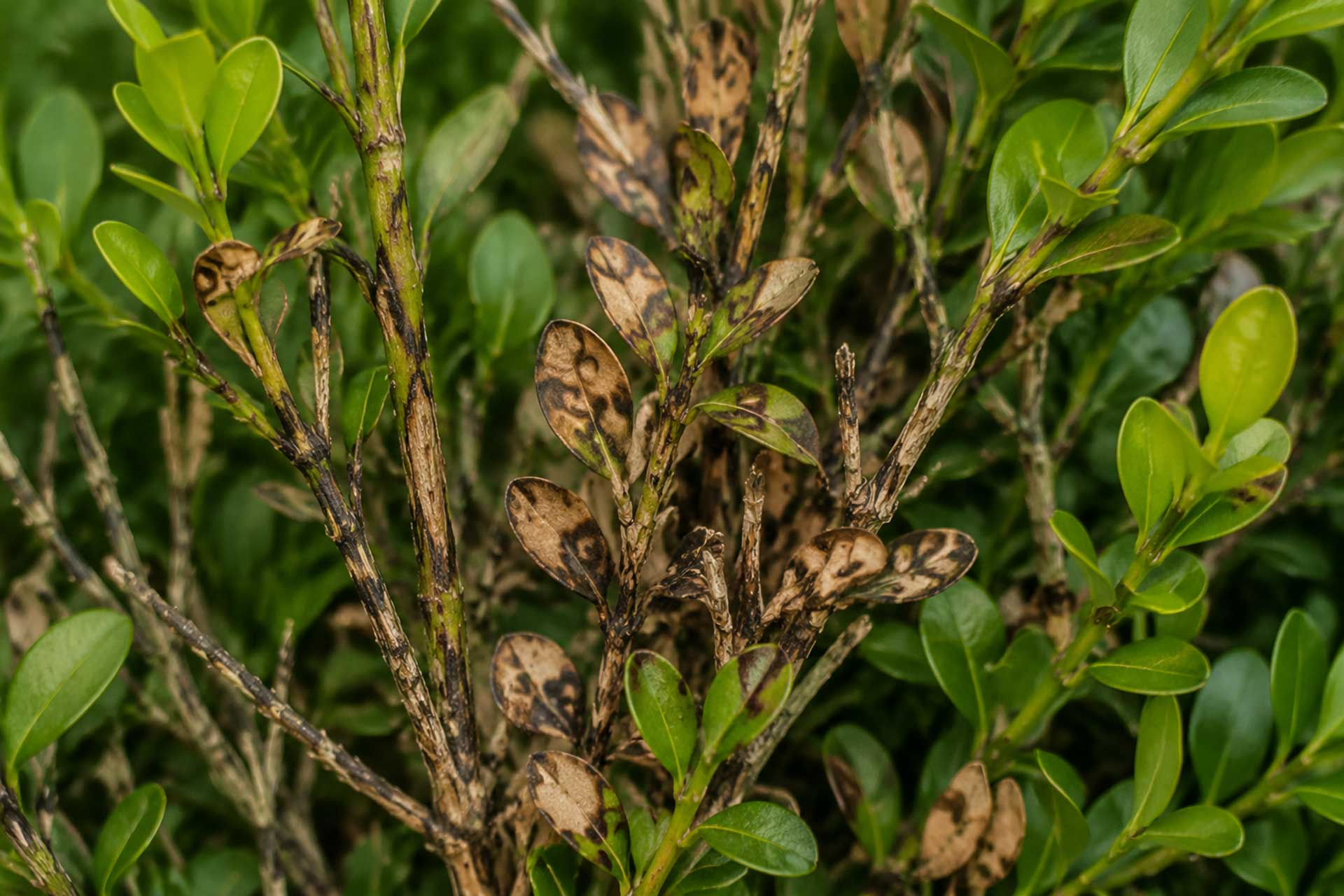
Boxwood blight looks different once you know what combination of symptoms you’re looking for. The disease is caused by the fungus Calonectria pseudonaviculata, and UMass describes typical symptoms as tan or brown leaf lesions with darker borders, rapid defoliation, dark lesions or streaking on stems, and eventual twig dieback. The disease is favored by humid conditions and temperatures between about 64°F and 80°F.
For me, three things really get my attention:
- Distinct leaf spotting
- Dark brown or black streaking on green stems
- Unusually rapid leaf drop
The leaf drop is important. With winter injury, brown foliage often stays on the shrub. With Volutella, dead foliage may also remain attached for weeks or months. Boxwood blight is much more likely to produce conspicuous defoliation.
If I’m seeing those symptoms together, particularly if the problem appears to be moving through neighboring boxwoods, I take it seriously. I also don’t want people casually pruning suspicious plants and then carrying the same shears through every boxwood on the property.
Boxwood blight can spread through infected plant material, splashing water, tools, equipment, and other activity around the plants. If blight is suspected, sanitation becomes part of the response. And if we really suspect blight, I want a proper diagnosis. This is one of those situations where guessing can create a much larger landscape problem.
Sometimes It’s Volutella, and Sometimes Volutella Isn’t Really the Beginning of the Problem
Volutella is another name homeowners may hear when their boxwoods begin to decline. Symptoms can include brown or straw-colored foliage and scattered branch dieback. During moist conditions, you may also find salmon-colored fungal structures on affected leaves and shoots. Unlike boxwood blight, the dead leaves tend to remain on the plant much longer.
But there’s something about Volutella that’s more useful to me than simply recognizing the fungus. I often think of it as a clue.
UMass describes Volutella as an “opportunistic pathogen” that commonly attacks boxwoods already weakened by stress. Drought, insect feeding, soil compaction, root problems, aggressive pruning, and shearing can all help set the stage.
That’s much closer to how we actually experience plant problems in a landscape. The disease may be what finally catches your eye, but the plant may have been telling us something for a while.
Maybe the irrigation hasn’t been reaching that bed properly. Maybe the boxwoods have been sheared into increasingly dense shells with very little air moving through the interior. Maybe water from a downspout has changed the soil conditions. Maybe roots were disturbed when a walk was rebuilt.
That’s why treating the visible disease without addressing the stress behind it often isn’t enough. I’ve seen boxwoods where winter injury, leafminer, and Volutella were all present on the same plant. Nature doesn’t always give us one problem at a time.
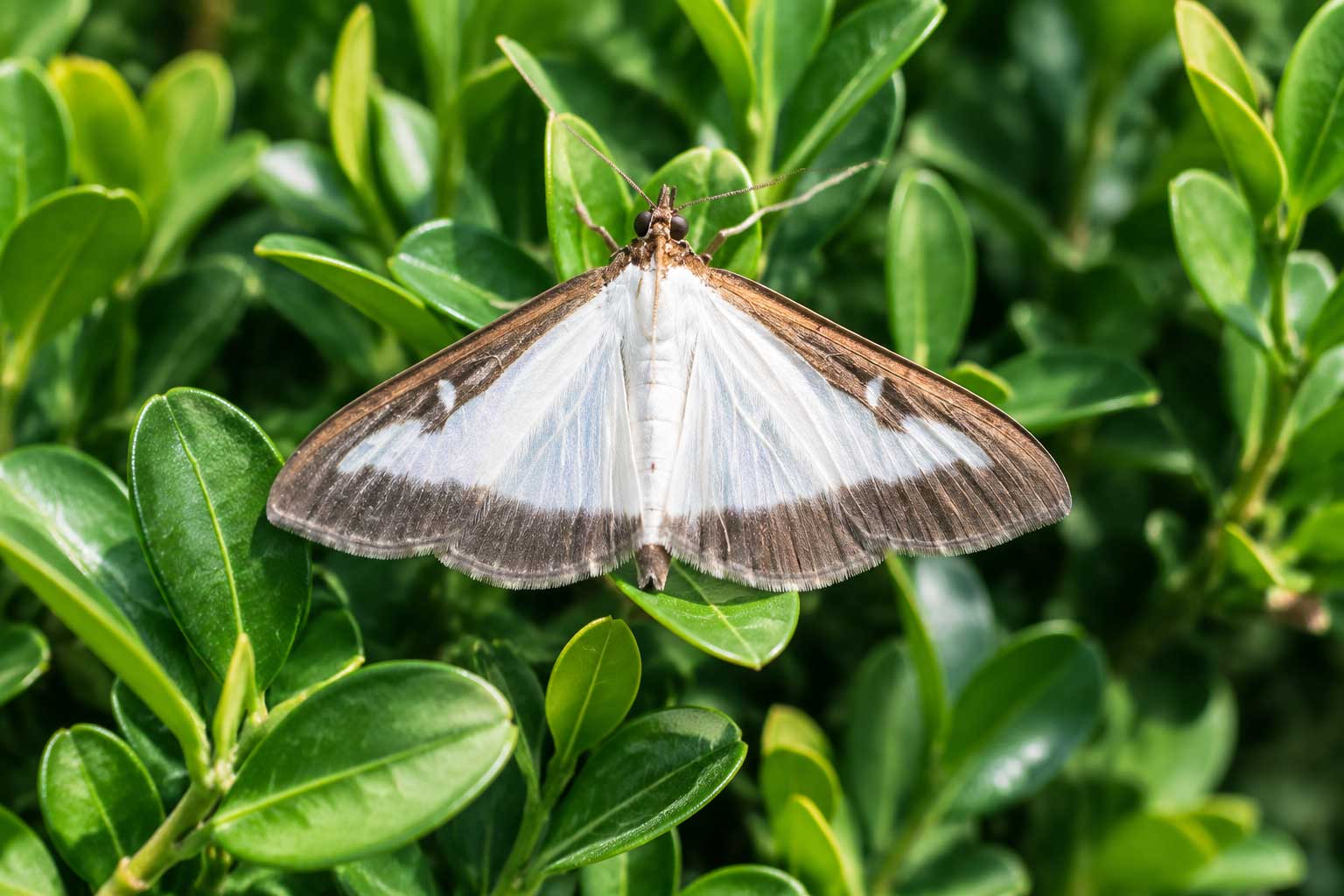
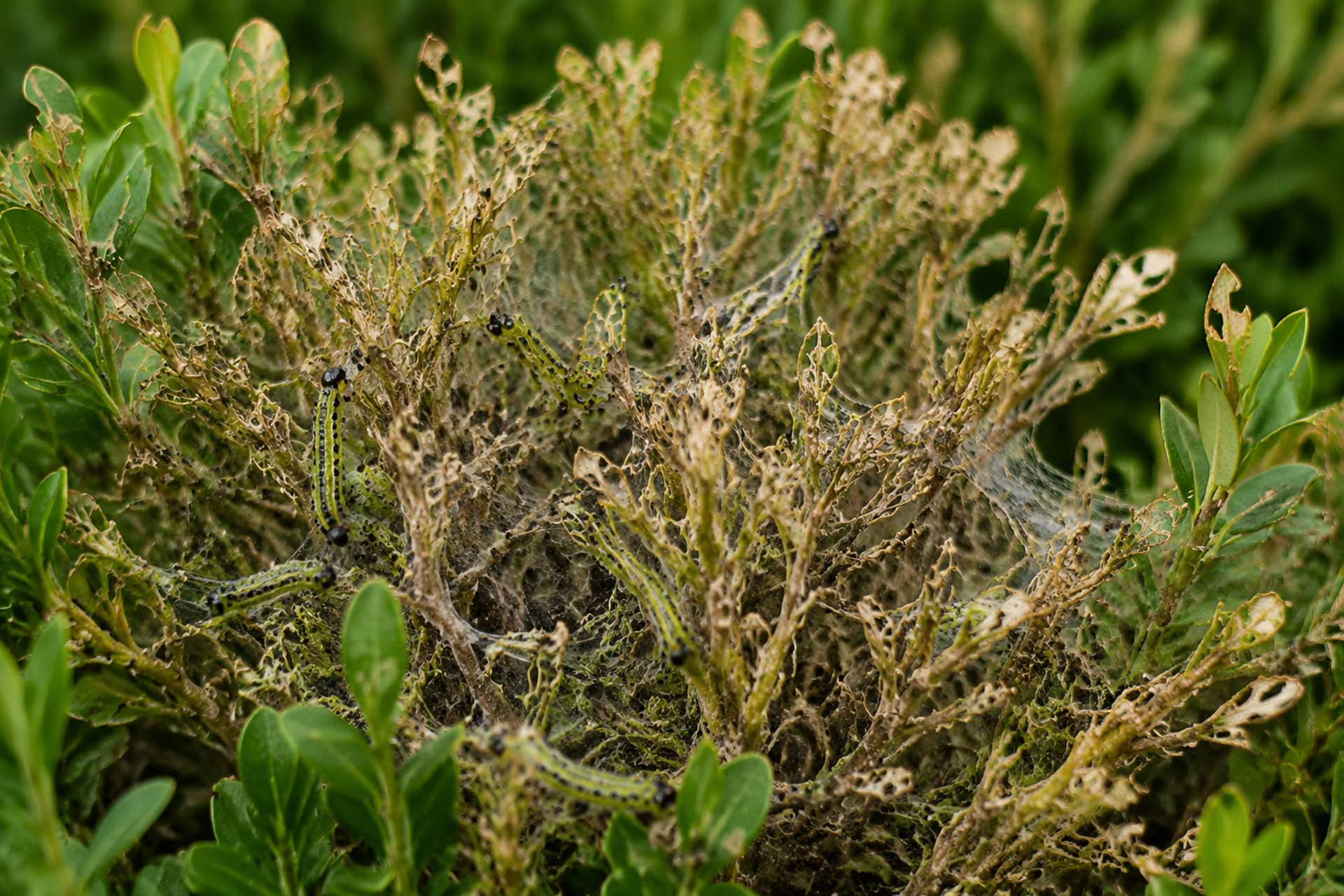
There’s Another Boxwood Problem We Have to Watch for in Massachusetts Now
This is something I would have spent much less time discussing with a Massachusetts homeowner several years ago. Today, I wouldn’t overlook it.
Box tree moth has arrived in Massachusetts. The Massachusetts Department of Agricultural Resources reports that it was first found in several Barnstable County communities in 2023, followed by Plymouth in 2024 and Brookline in 2025. The caterpillars feed directly on boxwood foliage and can kill plants if heavy infestations aren’t controlled. USDA APHIS has since placed the entire Commonwealth within the federal box tree moth quarantine area.
That’s a significant change for anyone caring for boxwoods here, but the good news is that box tree moth damage doesn’t look exactly like winter burn once you get close. I look for foliage that’s actually been eaten.
You may see chewed or skeletonized leaves, silk webbing inside the shrub, green caterpillars with distinctive black and white markings, and frass collecting within the canopy. Sometimes you have to open the plant up to find it.
I’ve looked at shrubs where the outside initially just appeared brown and thin. Once you put your hands into the foliage and separate the branches, though, you realize the leaves aren’t scorched at all. They’re being eaten. There’s webbing inside the plant, and suddenly we’re having a completely different conversation.
For Cape Cod properties, this deserves particular attention because that’s where the Massachusetts detections began. But with a confirmed detection in Brookline, I wouldn’t consider this solely a Cape problem anymore. If you suspect box tree moth, I’d use the current Massachusetts Department of Agricultural Resources guidance for identification and reporting rather than relying on older information.
Don’t Forget About What’s Happening Underground
There’s another part of this conversation that’s easy to overlook because we can’t see it: the roots.
When I see one boxwood declining while its neighbors look reasonably good, I’m interested in what’s different about that particular spot. Boxwoods have relatively shallow root systems, and they don’t appreciate extremes. Soil that stays saturated can create root problems, but so can drought. Compacted soil can reduce root function. Planting too deeply can create long-term stress. Changes in grading or drainage can affect an established plant years after it was installed.
I’ve been on properties where everyone was focused on finding an insect or disease, but the more important clue was standing twenty feet away. A downspout had been redirected and water was now collecting in the bed. The boxwood closest to that area was declining first.
That’s why landscape diagnosis has to include the landscape. We can’t look at the plant as though it exists independently from the property around it.
Several Problems Can Be Happening at the Same Time
This may be the most important thing I’d want a homeowner to understand because landscapes rarely behave as neatly as diagnostic charts.
Imagine a boxwood goes through a dry summer and enters autumn stressed. It isn’t watered adequately before the ground freezes, then winter is windy and the exposed foliage suffers winter injury. Those weakened branches become more susceptible to Volutella. Meanwhile, years of tight shearing have created a dense exterior canopy with poor air circulation, and summer irrigation repeatedly wets the foliage.
By June, the homeowner is looking at a brown boxwood and asking, “What disease does it have?” There may not be one answer.
This is why experienced property care is less about reacting to isolated symptoms and more about watching how plants change over time. Color changes matter. Unusual leaf drop matters. Drainage changes matter. Insect activity matters. How a plant came through the previous winter matters.
The earlier we notice those things, the more choices we usually have.
Should We Treat the Boxwood or Replace It?
This is where I stop thinking like a diagnostician for a moment and start thinking like a landscape designer, because whether a boxwood can be saved isn’t always the same as whether it should be saved.
If damage is limited, the underlying cause can be corrected, and there’s healthy wood remaining, preserving an established boxwood often makes sense. I’m especially inclined to do that when the plant has an important role in the landscape.
A mature boxwood hedge along the entry of an older home in Weston isn’t just a collection of shrubs. It may be providing the geometry that organizes the entire front garden, something we think about carefully when we’re developing a foundation planting design around an established home.It might soften the foundation, define the walk, frame the front door, and give the property winter structure. Twenty years of growth has value, and I don’t throw that away casually.
But preservation shouldn’t become an automatic response either. If a plant is severely compromised, if confirmed disease threatens neighboring boxwoods, if the root conditions can’t reasonably be corrected, or if we’re repeatedly treating the same declining planting without addressing the underlying problem, replacement may be the more responsible choice.
Sometimes the landscape is telling us that a plant no longer belongs in that particular spot. Good stewardship includes knowing when to listen.
If We Replace Boxwoods, Should We Plant Boxwoods Again?
Sometimes. I don’t think every boxwood problem means we should stop using boxwood.
There are boxwood cultivars with improved resistance to blight, and UMass identifies blight-tolerant selections from the NewGen and Better Boxwood collections as options to consider. But before I replace a boxwood with another boxwood, I want to understand why the first planting failed.
If the bed stays wet, putting another boxwood in the same hole doesn’t solve anything. If overhead irrigation is keeping foliage wet, we should correct the irrigation. If the shrubs have been planted too tightly and repeatedly sheared into dense masses, we should rethink spacing and pruning. This is the same principle we use when designing a lower-maintenance landscape: choose plants that actually want the conditions the property is giving them.
Sometimes I’d choose another plant entirely. Compact varieties of inkberry holly, for example, can provide evergreen structure where site conditions suit them, although I don’t think of inkberry as a simple one-for-one replacement for boxwood.
But I wouldn’t simply ask, “What looks most like boxwood?” I’d ask the following questions:
- What was the boxwood doing for the design?
- Was it defining the front walk or creating a low evergreen edge?
- Was it holding the foundation planting together through winter?
- Was it being used as part of a hedge or privacy planting?
- Was it providing a quiet backdrop for hydrangeas and perennials?
- Was it providing a quiet backdrop for hydrangeas and perennials?
- Was it giving an older property some formality without making the garden feel overly formal?
Once I know what job the boxwood was doing, I can choose the right plant for that job. That’s a much better way to think about replacement.
The Best Time to Notice a Boxwood Problem Is Before It Becomes a Crisis
When we care for established landscapes, we’re constantly making small observations. That’s one reason seasonal landscape maintenance matters so much in New England. We’re seeing the same plants through winter injury, spring growth, summer heat, drought, pruning, and fall preparation rather than looking at them only after something has gone wrong. Maybe that boxwood is a little thinner than it was last year. This side of the hedge is getting more winter burn. Water is sitting in this bed longer than it used to. We’re seeing more leafminer damage. That shrub isn’t recovering as quickly after pruning.
None of those observations sounds particularly dramatic, and that’s the point. Good landscape care is usually quiet. It’s noticing small changes early enough that we still have choices.
Sometimes the answer is better irrigation. Sometimes it’s selective pruning. Sometimes we improve drainage or change how a plant is maintained. Sometimes we simply monitor it for another season. And sometimes we decide a plant has reached the end of its useful life and replace it.
The goal isn’t to keep every shrub forever. It’s to understand what’s worth preserving, what the landscape is telling us, and what decision will leave the property healthier five or ten years from now.
So when I look at a brown boxwood, I’m not really asking, “How do we make this green again?” I’m asking, “Why is this plant struggling here, and what decision gives this part of the landscape the best future?”
That’s usually the more useful question.
Suggested Reading
- UMass Extension: Boxwood Blight – Massachusetts-specific information on symptoms, disease development, sanitation, treatment, and replacement options.
- UMass Extension: Boxwood, Common Health Issues in the Landscape – A useful overview of winter injury, Volutella, boxwood blight, leafminer, mites, and other problems affecting boxwood in southern New England.
- Massachusetts Department of Agricultural Resources: Box Tree Moth – Current Massachusetts information about identification, distribution, reporting, and management.
- USDA APHIS: Box Tree Moth – Federal information about box tree moth, quarantine areas, identification, and management.
Ask a Landscape Expert
If your boxwoods are turning brown, I wouldn’t begin with a treatment. I’d begin with a closer look.
Sometimes the answer is fairly reassuring. A boxwood that looks terrible after a difficult New England winter may still have healthy stems and buds and recover well with appropriate care. Other times, the pattern tells us something more serious is happening. Either way, knowing the difference matters.
If you’re seeing unexplained browning, leaf drop, dieback, or insect damage in established boxwoods on your Greater Boston, MetroWest, or Cape Cod property, contact us. We can look at what’s happening within the context of the larger landscape and help determine whether the right approach is treatment, improved growing conditions, selective replacement, or a broader planting change.
And if there’s another question you’ve been wondering about while walking your property, Ask a Landscape Expert. There’s a good chance other New England homeowners are wondering the same thing.