An Expert’s Summary
When a bluestone patio lifts, sinks, or starts rocking after winter, the visible stone usually isn’t the real problem. In most cases, movement begins underneath the patio, where water, freezing temperatures, soil conditions, and the construction of the base all affect how well the surface stays in place.
The good news is that an uneven patio doesn’t automatically need to be completely rebuilt. If the movement is limited to a small area and the surrounding base remains stable, we can often lift the affected stones, correct the material underneath them, and reset the patio. If the movement is widespread, keeps returning, or has changed the patio’s overall pitch, a more substantial repair may be the better long-term answer.
Before recommending either approach, I’d want to determine why the stones moved. Resetting them without correcting the underlying cause may make the patio look better temporarily, but the same problem can return after another wet winter.
The Question
“Our bluestone patio has become uneven, and several stones lift or rock after the winter. Can the affected area be repaired, or does the entire patio need to be rebuilt?”
– Submitted by: Jim C., Belmont, MA
The Short Answer
Yes, the affected area may be repairable, particularly if you have a dry-laid bluestone patio and only a few stones have moved. Individual stones can often be lifted, the bedding and base beneath them corrected, and the stones reset at the proper elevation.
However, I wouldn’t assume that resetting the loose stones is the complete repair. Rocking or raised bluestone can indicate frost movement, poor drainage, settling, erosion, an insufficient base, or inconsistent compaction. If those conditions affect a large portion of the patio, rebuilding part or all of the base may be necessary.
The first step is figuring out whether the movement is isolated or part of a larger pattern.
A Longer Answer
Why Bluestone Patios Move During a New England Winter
Patios in Greater Boston have to handle repeated freezing and thawing, saturated soil, snowmelt, spring rain, and rapid changes in temperature. Bluestone itself performs well in our climate, but even a durable stone depends on what’s beneath it.
Frost heave develops when three conditions come together:
- Freezing temperatures reach the soil.
- The soil or base contains frost-susceptible fine material.
- Enough moisture is available to feed the freezing process.
The Federal Highway Administration’s guidance on frost-susceptible soils identifies those same three conditions. As water migrates through the soil and freezes, it can form layers of ice known as ice lenses. Those lenses can lift the soil and patio base unevenly.
The U.S. Geological Survey also notes that the density of ice decreases by about 9 percent when water freezes. That physical change contributes to movement, but severe frost heave isn’t simply a small amount of trapped water expanding. The larger problem is often the continuing movement of moisture toward the freezing area and the growth of ice within frost-susceptible soil.
When spring arrives, the frozen material thaws. Some raised stones may settle closer to their original position, while others remain tilted, loose, or unsupported. That’s why a patio can look fairly level in the fall and noticeably different by the end of winter.
As the Concrete Masonry & Hardscapes Association puts it, “Heaves are typically caused by frost heave of the underlying soils.” Its pavement maintenance guide discusses concrete pavers rather than natural bluestone, but the underlying principles of soil, drainage, bedding, and base movement are useful for understanding both systems.
Water Is Usually Part of the Story
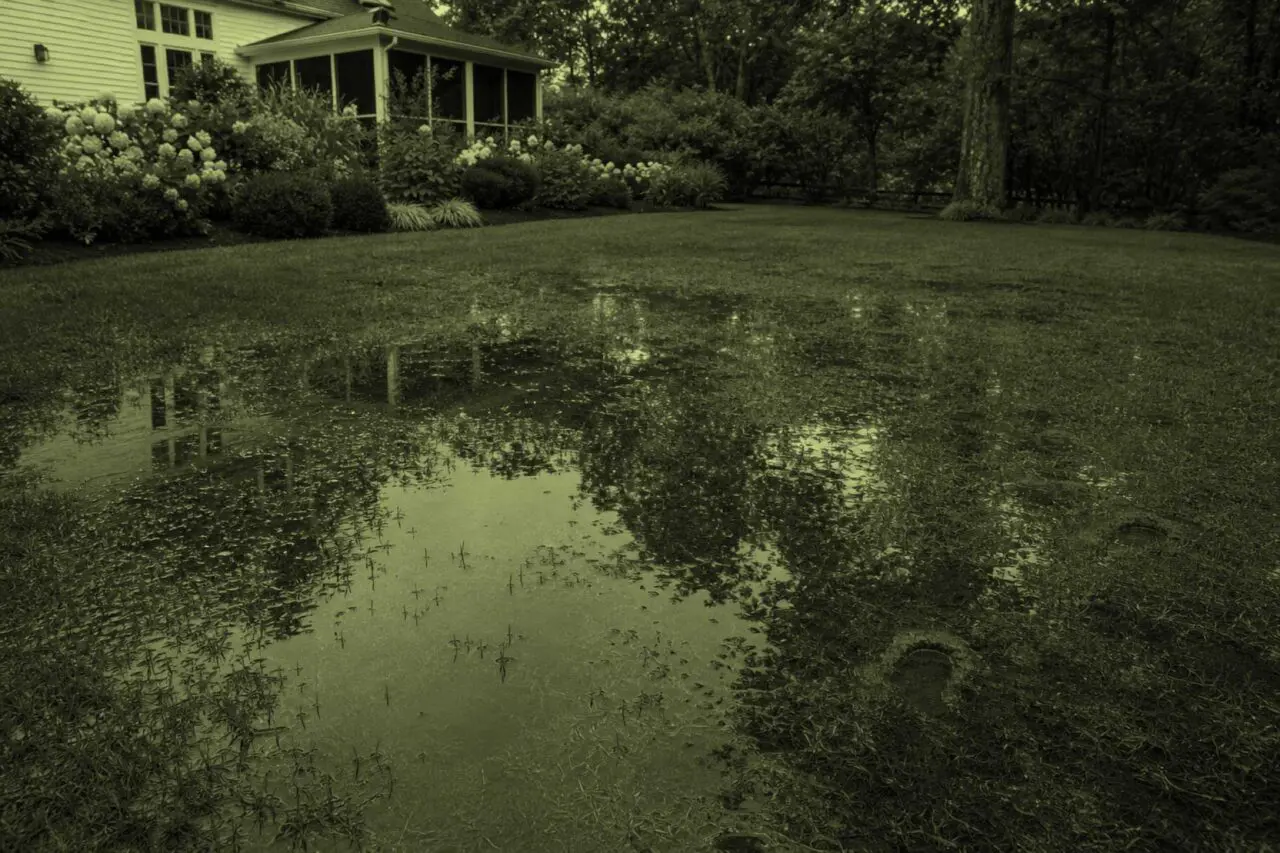
When I look at a patio that has moved, I pay close attention to water. It may be coming from rain and snowmelt, but I also look for a more concentrated source.
Look for these trouble spots:
- A downspout emptying near the patio
- Runoff coming down a slope
- Water collecting at the edge of the stone
- A low area that remains wet after storms
- Patio joints that allow bedding material to wash away
- Irrigation repeatedly soaking the surrounding soil
- A surface pitched toward the house instead of away from it
- Planting beds that have been raised above the patio edge
A patio base performs best when it can remain stable and shed or manage water. If the base becomes saturated before a hard freeze, the chance of movement increases. If flowing water carries away bedding material, stones may sink or rock even without significant frost heave.
This is one reason I don’t like to treat patio repair as a purely masonry issue. The surrounding grade, roof drainage, planting beds, soil, and overall landscape design can all affect the stonework.
For a deeper look at how water moves through a property, I’d suggest our blog post on why professional landscape drainage should be part of every Boston landscape plan.
Could the Patio Base Be the Problem?
Yes. In fact, the base is one of the first things I’d investigate.
A dry-laid bluestone patio typically relies on several layers working together. While the exact assembly depends on the site and installation method, it generally includes prepared subgrade, compacted aggregate, a setting or bedding layer, and the bluestone surface.
Problems can develop when:
- The original excavation wasn’t deep enough for the site conditions.
- The soil wasn’t compacted consistently.
- The aggregate base was installed in lifts that were too thick to compact properly.
- Fine soil migrated into the base.
- Bedding material washed out or shifted.
- Different base materials were used in adjoining areas.
- The patio was installed over recently disturbed soil.
- Drainage wasn’t considered during construction.
Sometimes the evidence appears in a specific pattern. If one small group of stones rocks while the rest of the patio remains solid, the bedding immediately beneath those stones may have settled or washed out. If broad areas rise and fall together, I’d be more concerned about the base or soil below it.
The design of the patio matters as well. Large stones, narrow joints, surrounding walls, steps, door thresholds, and transitions into walks or lawns all affect how much correction is possible without disturbing adjacent work.
Again, I’ll recommend a post form our own blog – a guide to the best stone and hardscape materials for Boston-area landscapes explains why installation, grading, drainage, and edge restraint matter just as much as the surface material.
When Can We Repair Only the Affected Area?
A localized repair may make sense when:
- Only a few stones have moved.
- The rest of the patio feels firm and consistent.
- The overall pitch still directs water appropriately.
- The problem hasn’t returned after previous repairs.
- The surrounding edges, steps, and walls remain stable.
- We can identify and correct a specific source of water or erosion.
- The base beneath the affected area is generally sound.
For a dry-laid patio, the repair usually begins by carefully lifting the affected bluestone. Bluestone can often be reused if it remains intact, which helps preserve the patio’s existing color, weathering, and pattern.
Once the stone is out, we can see more of what’s happening underneath. The repair may involve removing loose material, rebuilding and compacting part of the base, replacing the bedding layer, and resetting the stone at the correct height and pitch. Joints and edges may also need attention.
This work sounds straightforward, but the finished elevation matters. One corrected stone has to relate properly to every stone around it. It also has to work with doors, steps, walls, drains, and nearby lawn or planting beds.
I’d also want to correct the source of the movement. That might mean extending a downspout, changing the adjacent grade, adding drainage, repairing an edge, or preventing soil from washing into the base.
When Does a Larger Rebuild Make More Sense?
A partial or complete rebuild becomes more likely when:
- A large percentage of the patio has moved.
- High and low areas appear throughout the surface.
- Water regularly pools on the patio.
- The patio drains toward the house.
- Previous resetting hasn’t lasted.
- Stones keep rocking in several different areas.
- The base contains unsuitable or poorly compacted material.
- The patio connects poorly with steps, thresholds, or retaining walls.
- Major drainage or grading changes are required.
- The surface has become a significant tripping hazard.
At that point, repeatedly correcting individual stones may cost more over time without solving the underlying problem. Removing the surface gives the masonry team an opportunity to correct the full base, reestablish the pitch, coordinate drainage, and reset reusable stone.
A full rebuild doesn’t always mean replacing the bluestone. If the stones remain in good condition, many may be reusable. Careful removal and documentation of the existing pattern can help maintain the patio’s established appearance.
It’s also a good time to reconsider how the space works. If the patio is too small, poorly connected to the house, or awkwardly divided by old repairs, addressing the base may create an opportunity to improve circulation, furniture placement, planting edges, or the relationship between the patio and the rest of the landscape.
A Quick Note About Mortared Bluestone Patios
The answer changes if the bluestone is mortared over a concrete slab rather than installed as a dry-laid patio.
Loose stones on a mortared patio may result from failed mortar, moisture trapped beneath the stone, cracking in the concrete base, or movement of the slab itself. Resetting one stone may be possible, but we need to understand why the bond failed.
Cracked joints, hollow-sounding stones, widespread mortar deterioration, or movement across the slab may point to a larger issue. A mortared installation should be evaluated as a complete assembly rather than repaired using the same methods we’d use for dry-laid stone.
Some Uneven Patios Aren’t Primarily Frost Problems
Although winter often makes patio movement more noticeable, not every uneven patio has suffered frost heave.
As a side note, I’d also investigate:
- Tree roots: Expanding roots can lift individual stones or an entire patio edge. Root work should be coordinated with an arborist when the health or stability of a valuable tree could be affected.
- Animal activity: Burrowing animals can create voids beneath patios and walks.
- Utility trenches: Soil over a repaired water, electrical, gas, or drainage trench may continue settling if it wasn’t compacted correctly.
- Erosion: Water moving along an edge or through open joints can carry away bedding and leave unsupported stones.
- Failed edge restraint: Patio edges can spread or drop when they aren’t adequately supported.
- Heavy loads: Outdoor kitchens, fireplaces, planters, hot tubs, or vehicles can overload a base that was designed only for ordinary patio use.
- Nearby construction: Additions, pools, walls, drainage work, and excavation can change soil conditions or redirect runoff.
- Ordinary settlement: Newly disturbed soil may consolidate over time, particularly if the patio was installed soon after other construction.
Any if the above can produce symptoms that look similar from the surface. That’s why I’d avoid diagnosing the patio solely from a photograph or assuming winter is responsible because the movement appeared in spring.
Should You Wait to See Whether the Stones Settle?
If the ground is still frozen, I’d usually wait for a complete thaw before making a final repair decision. The patio may move again as the soil thaws and releases moisture.
That doesn’t mean ignoring an immediate safety issue. A raised edge or rocking stone can become a tripping hazard, especially along a frequently used route. Mark the area, move furniture away from unstable stones, and avoid creating a temporary repair that traps more water beneath the surface.
Once the ground has thawed, watch what happens during rain:
- Does water collect in the uneven area?
- Does a downspout discharge nearby?
- Are joints opening or washing out?
- Does the patio pitch away from the house?
- Is the movement limited to one section?
- Are nearby steps, walls, or walkways also moving?
Those observations can help a masonry professional distinguish an isolated repair from a broader drainage or base problem.
My Recommendation
Based on Jim’s description, I wouldn’t assume the entire bluestone patio needs to be rebuilt. Several lifting or rocking stones may be repairable, especially if the patio is dry-laid and the surrounding surface remains stable.
I’d start with an on-site assessment after the ground has fully thawed. I’d check the patio’s pitch, downspouts, surrounding grades, edge conditions, drainage patterns, and the extent of movement. Lifting one or two affected stones may also reveal whether the problem sits in the bedding layer, aggregate base, or soil below.
If the issue is localized, repair the affected base and reset the existing stone. If movement extends across the patio or water has compromised the underlying construction, rebuilding a larger section will usually provide a better and more durable result.
The main point is simple: repair the reason the stone moved, not just the stone’s position.
Key Takeaways
- An uneven bluestone patio doesn’t automatically require a complete rebuild.
- Frost heave needs freezing temperatures, moisture, and susceptible soil or base material.
- Drainage, grading, base construction, and compaction are common underlying culprits.
- A few dry-laid stones can often be lifted and reset if the surrounding base remains sound.
- Widespread or recurring movement may require rebuilding part or all of the patio base.
- Mortared bluestone patios require a different assessment from dry-laid installations.
- Roots, erosion, animals, utility trenches, heavy loads, and ordinary settlement can also make patios uneven.
- Wait until the ground has thawed before making a final diagnosis, but address immediate tripping hazards promptly.
Learn More
For additional information about frost movement, patio construction, and drainage, visit:
- Frost-Susceptible Soils and Frost Action, Federal Highway Administration
- Operation and Maintenance Guide for Interlocking Concrete Pavement, Concrete Masonry & Hardscapes Association
- How to Fix an Uneven Paver Patio, This Old House
- Water Density and What Happens When Water Freezes, U.S. Geological Survey
- Best Stone and Hardscape Materials for Boston-Area Landscapes, a Blade of Grass
- Why Professional Landscape Drainage Should Be Part of Every Boston Landscape Plan, a Blade of Grass
Concerned About an Uneven Stone Patio?
An uneven patio can be a localized masonry repair or a sign that water, grading, or the base needs closer attention. Our team can evaluate how the stonework relates to the rest of your property and recommend a repair that addresses both appearance and long-term performance.
Contact us to start a conversation about your patio or broader landscape.