A New England garden can feel full and layered in June, then surprisingly bare by January. Inkberry holly helps bridge that seasonal gap, bringing a steady green presence without dominating the planting.
Its appeal is understated. It doesn’t produce the dramatic summer flowers of a hydrangea or grow into a towering privacy screen. Its small black berries are quieter than the bright red fruit we associate with many hollies. What it offers instead is evergreen structure without looking heavy.
That makes inkberry useful in Massachusetts landscapes. It can define an edge, give foundation plantings a sense of permanence, and provide a dark green backdrop for flowering plants. In the right conditions, it also brings year-round greenery to places where some familiar evergreens struggle.
Inkberry is native, too, though describing it as a “native alternative to boxwood” only tells part of the story. It has its own growth habit, site preferences, strengths, and limitations. Give it a role that suits those characteristics, and it can be an excellent choice. Expect it to behave exactly like boxwood, and it may disappoint.
So, is inkberry holly right for a Massachusetts landscape? Very often, yes. The more useful question is what job you need it to do.
Inkberry Holly at a Glance
- Botanical name: Ilex glabra
- Plant type: Broadleaf evergreen shrub
- Mature size: Species typically 5–8 feet or larger; compact cultivars may remain around 2–4 feet
- Light: Full sun to part shade; tolerates more shade than many flowering shrubs
- Soil / moisture: Prefers acidic soil and consistent moisture; tolerates periodically wet conditions
- Flowers: Small white flowers in late spring to early summer
- Fruit: Small black berries on pollinated female plants
- Native status: Native to eastern North America, including Massachusetts
- Deer resistance: Generally considered deer resistant, although no plant is completely deer proof
- Best landscape uses: Foundation plantings, mixed borders, low hedges, mass plantings, native gardens, rain gardens and layered screening
Why We Like Inkberry Holly in Massachusetts Landscapes
Inkberry isn’t usually the plant a homeowner points to first. That’s part of what makes it useful.
In a good planting design, not every shrub should be trying to become the focal point. Gardens need quieter plants that hold everything together. They need evergreen mass behind perennials, something dark and simple beside a flowering shrub, or a repeated plant that gives the eye somewhere to rest.
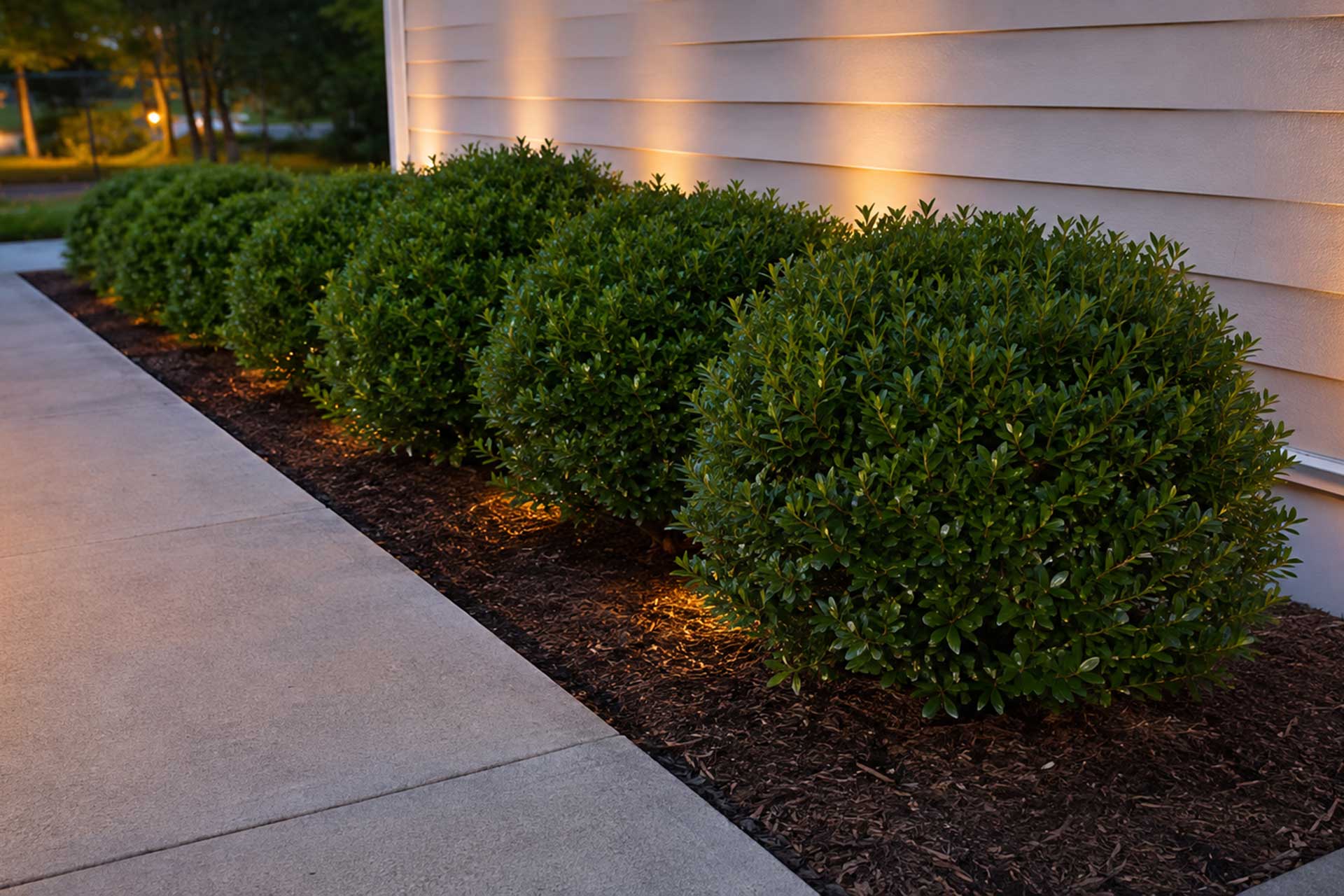
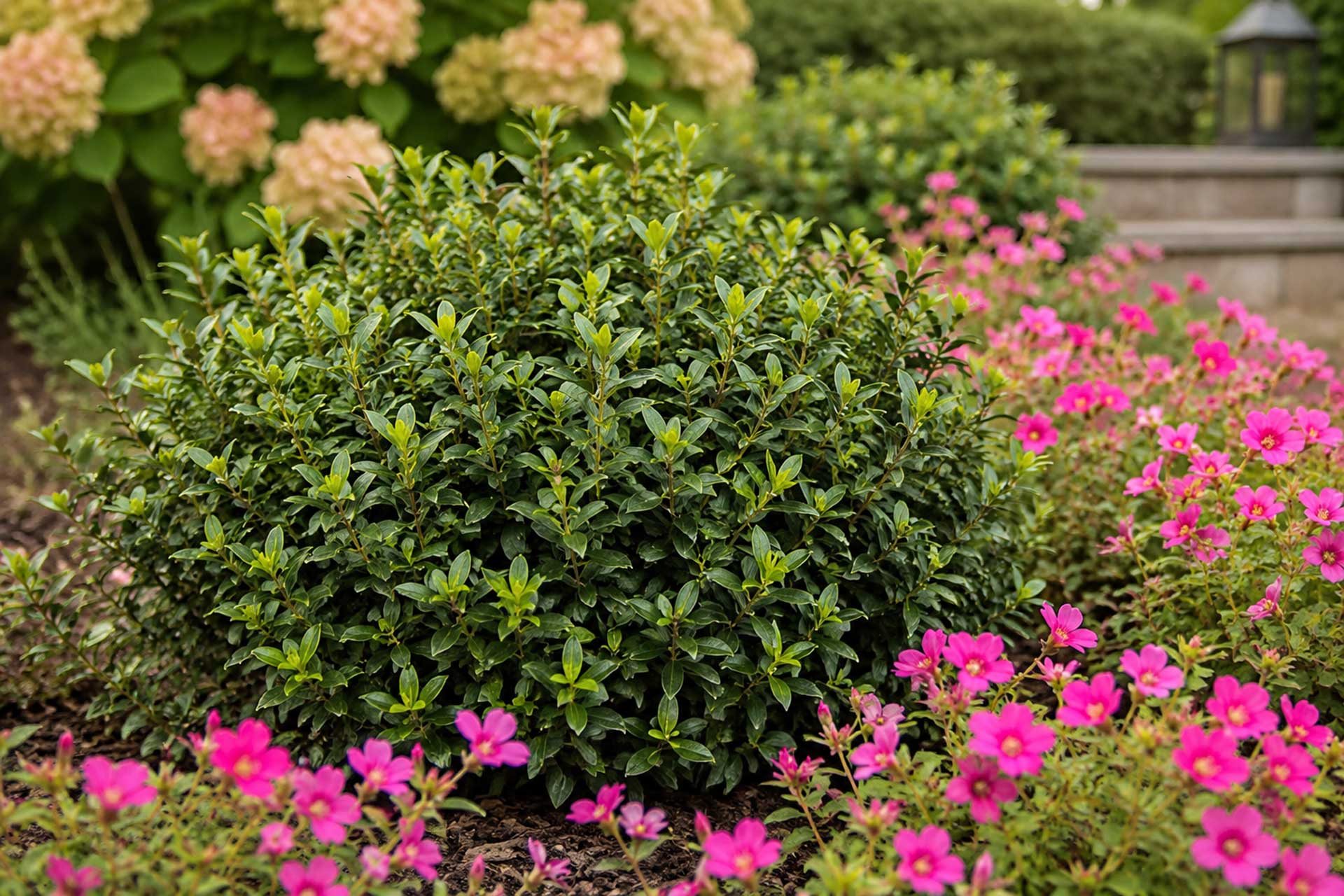
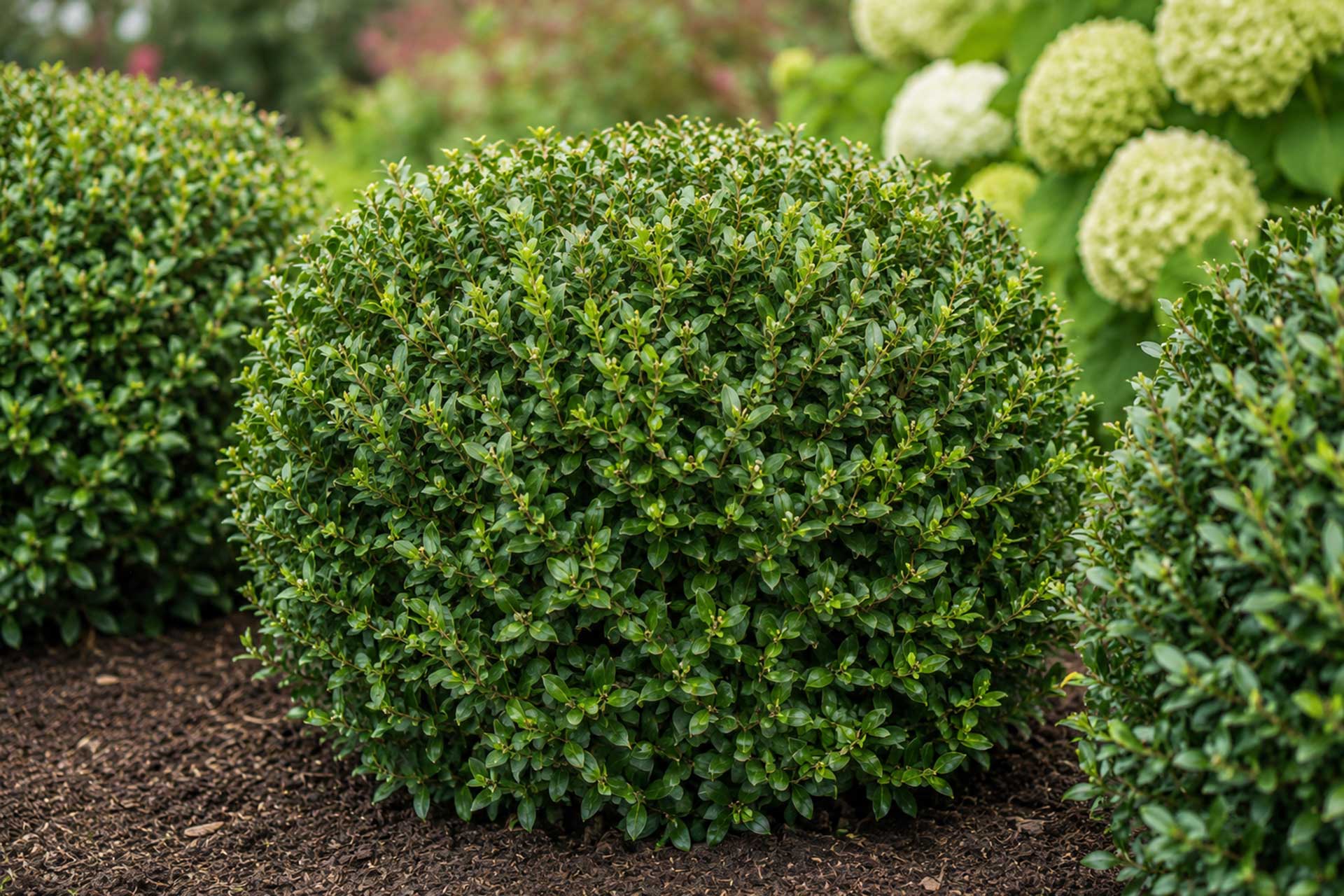
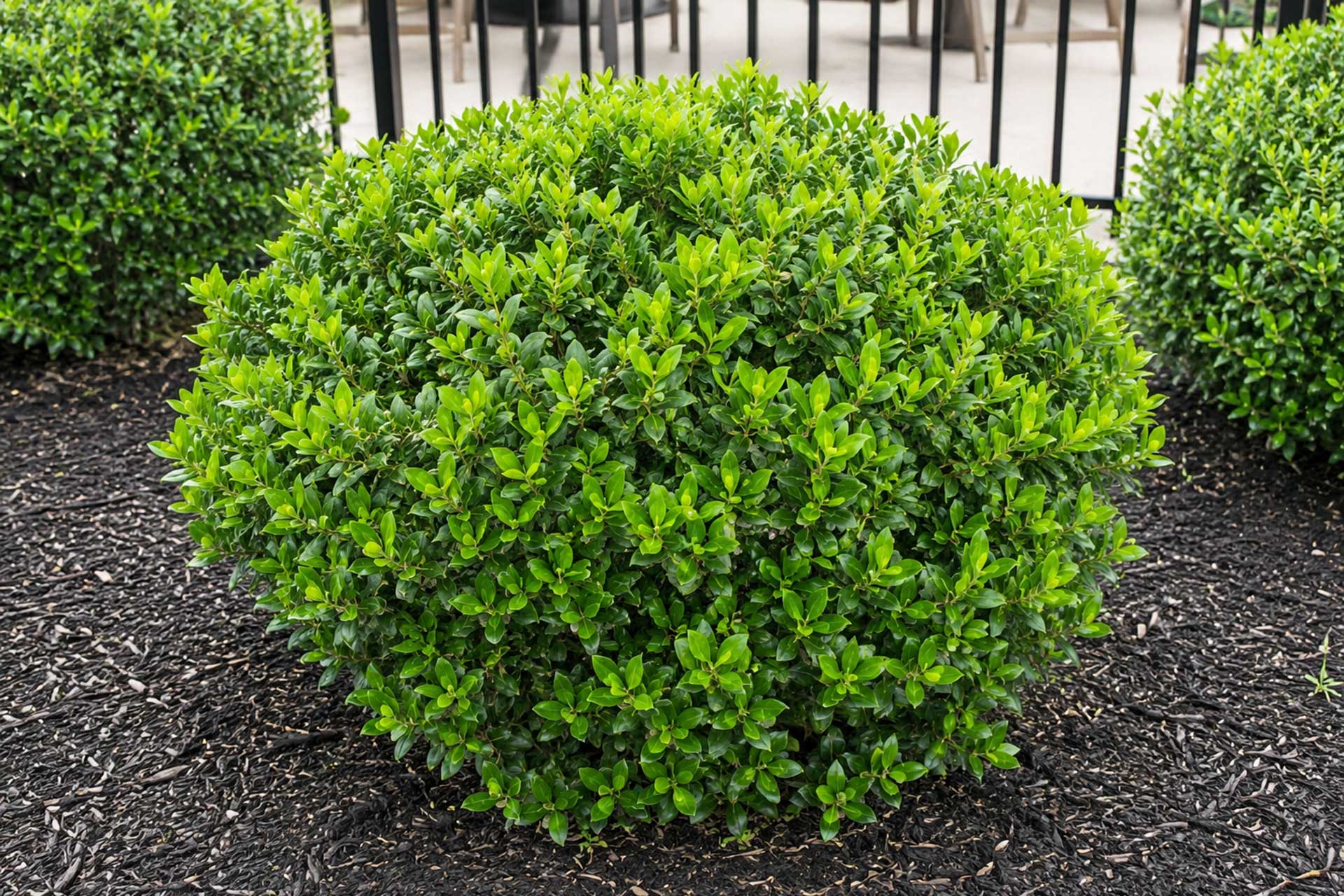
Inkberry can do all of those things. Its leaves are small, smooth and spineless, so the overall texture is finer and softer than many hollies. Depending on the cultivar, the habit may be rounded, mounded or somewhat upright. That makes it easy to combine with both traditional New England planting and more naturalistic landscape design.
We also like having a native evergreen shrub available for sites where the soil isn’t especially dry. That’s an important distinction.
A lot of compact evergreens prefer well-drained conditions. Inkberry naturally occurs around bogs, swamps, wet woods and other moisture-retentive environments. The Commonwealth of Massachusetts includes inkberry in its coastal landscaping guidance and specifically notes its usefulness in wet areas, low spots, rain gardens and stream banks.
That doesn’t mean we would plant it in standing water and forget about it. But on a property with moist, acidic soil, a low area that periodically holds water, or a transition toward woodland or wetland conditions, inkberry gives us options that many conventional evergreens don’t.
What Does Inkberry Holly Look Like Through the Seasons?
Inkberry isn’t a plant with one dramatic season. Its value is more cumulative.
Spring: Fresh Evergreen Growth
Inkberry comes out of winter already green, which matters more than it sounds.
While deciduous shrubs and perennials are still waking up, the inkberry is already holding the shape of the planting. New foliage begins emerging in spring, often a lighter or fresher green before darkening as it matures.
Small white flowers appear in late spring or early summer. They’re not the reason most people plant inkberry, and you may barely notice them from across the garden. Pollinators do.
The flowers provide a nectar and pollen source, which is one of the quieter ecological benefits of incorporating this native shrub into a broader planting.
Summer: Structure Behind the Flowers
Summer is when we particularly appreciate inkberry as a supporting plant.
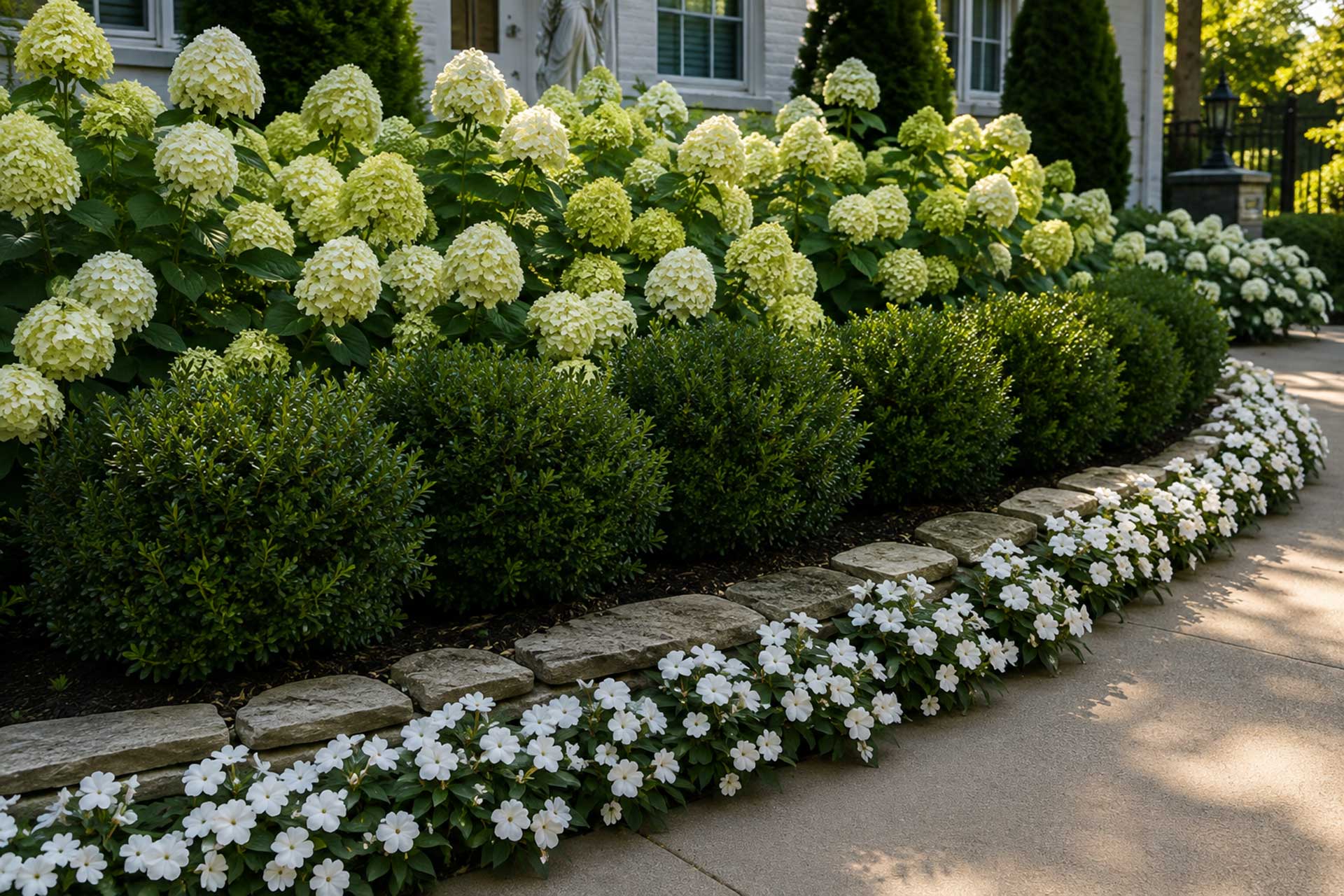
Put it behind hydrangeas, grasses or flowering perennials and its dark foliage gives those plants something to play against. Repeat it through a border and it can provide visual rhythm without making the garden feel rigid.
This is where inkberry and panicle hydrangea can work particularly well together.
The hydrangea brings large flowers, changing color and considerable summer presence. Inkberry provides the finer-textured evergreen structure underneath or behind it. One plant is doing what the other isn’t.
Fall and Winter: This Is Why We Planted It
By November, the landscape tells you whether you used enough structural plants.
Perennials disappear. Ornamental grasses fade. Deciduous shrubs lose their leaves. Hydrangeas turn to dried flowers and stems. Inkberry remains green.
Female plants may also carry small black fruit if they’re growing near a compatible male pollinator. The berries are subtle, especially compared with winterberry, but they provide additional seasonal interest and food for birds and other wildlife.
The University of Maryland Extension notes that inkberry berries are eaten by songbirds and small mammals and that the plant also serves as a host for several moth species.
For us, though, winter is when the design value becomes most obvious. A group of inkberries can keep a foundation bed from disappearing. A low hedge can still define a path. An evergreen mass can anchor a planting that otherwise becomes branches, stone and dormant groundcover.
That’s not flashy. It’s good landscape structure.
Where Does Inkberry Holly Grow Best in Massachusetts?
Inkberry is adaptable, but there are a few conditions we pay particularly close attention to.
Sun and Shade
Inkberry can grow from sunny conditions into fairly substantial shade. That flexibility is useful on established Massachusetts properties, where mature oaks, maples and other trees can create changing light conditions throughout the day.
But shade tolerance doesn’t mean every inkberry will look identical in every exposure. Plants receiving more sun often develop denser growth, assuming they have adequate moisture. In heavier shade, the habit may become looser. As always, we’d rather work with the actual conditions than rely only on a plant tag.
Morning sun beneath high tree canopies is different from a dark north-facing corner between buildings. Likewise, six hours of sun beside a reflective stone wall is very different from six hours in an open garden with moist soil.
Soil and Moisture
This is where inkberry becomes particularly interesting. Inkberry prefers acidic soil with regular moisture. According to University of Maryland Extension, it grows across a range of soil textures and can tolerate conditions ranging from relatively dry to periodically wet. The species commonly occurs naturally at swamp and bog edges and in sandy woodlands.
For Massachusetts homeowners, that makes inkberry worth considering in situations where other shrubs may struggle with periodic moisture. It’s one of the reasons it pairs naturally with our guide to the best plants for wet areas in Massachusetts landscapes.
There’s an important distinction, though. A plant that tolerates wet soil isn’t a substitute for solving a drainage problem.
If water is collecting against the foundation, flooding a patio, washing soil down a slope or remaining stagnant for long periods, we want to understand why. Plant selection may be part of the solution, but it doesn’t replace appropriate grading and landscape drainage planning.
Soil pH Matters
Inkberry is an acid-loving plant. That’s often a good match for naturally acidic New England soils, but we still don’t assume.
Properties can have imported fill, construction debris, heavily amended foundation beds or previous applications of lime that change soil chemistry considerably from one part of the landscape to another.
If plants repeatedly struggle in a particular bed, a professional soil test before planting can tell us much more than guessing based on appearance.
Choosing the Right Inkberry Holly
This is where inkberry has changed considerably from the plant many homeowners may remember.
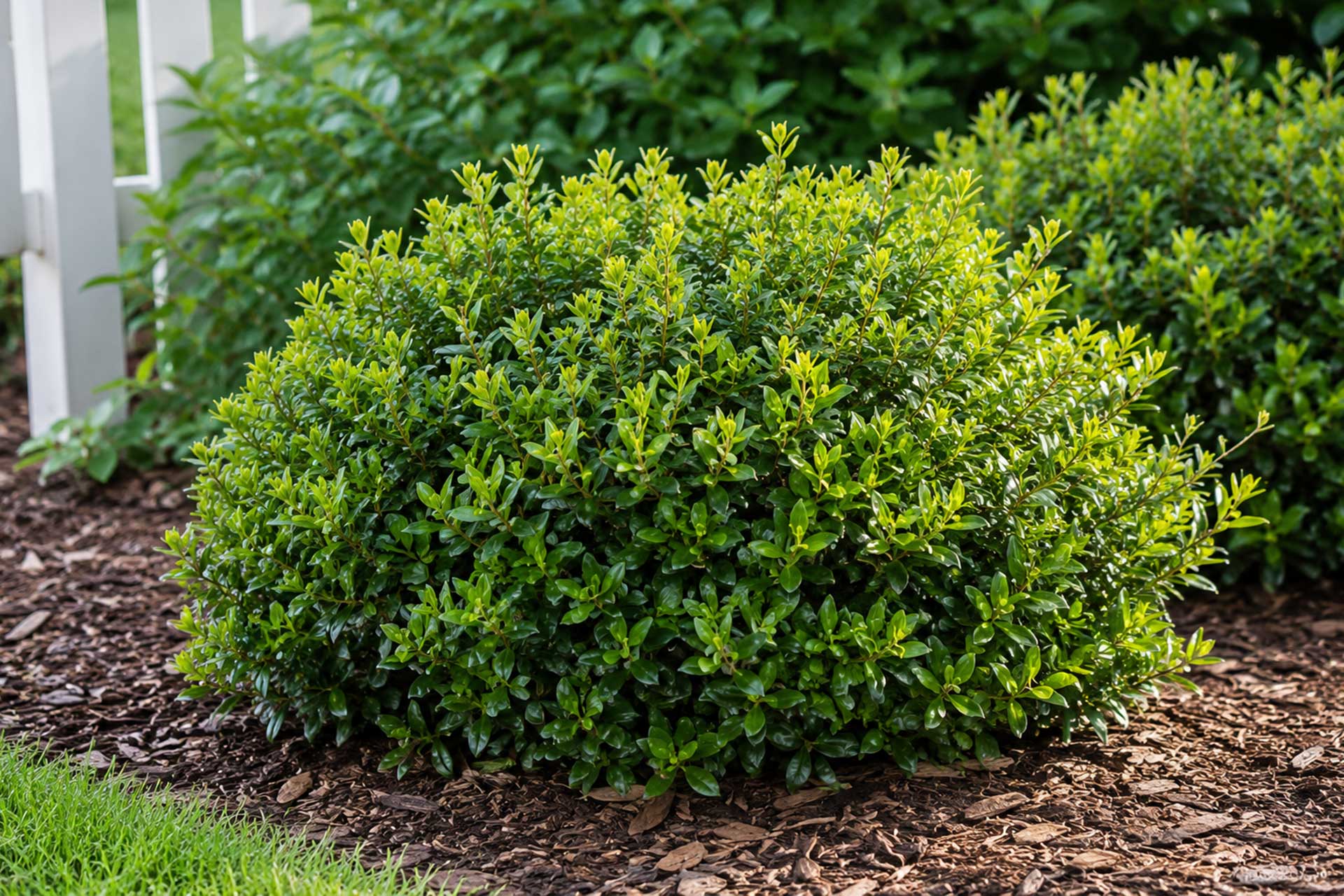
Older landscape inkberries could become fairly large, loose and somewhat bare around the lower stems as they aged. That habit is perfectly natural for the species, but it isn’t always what you want beside a front walk or beneath a window.
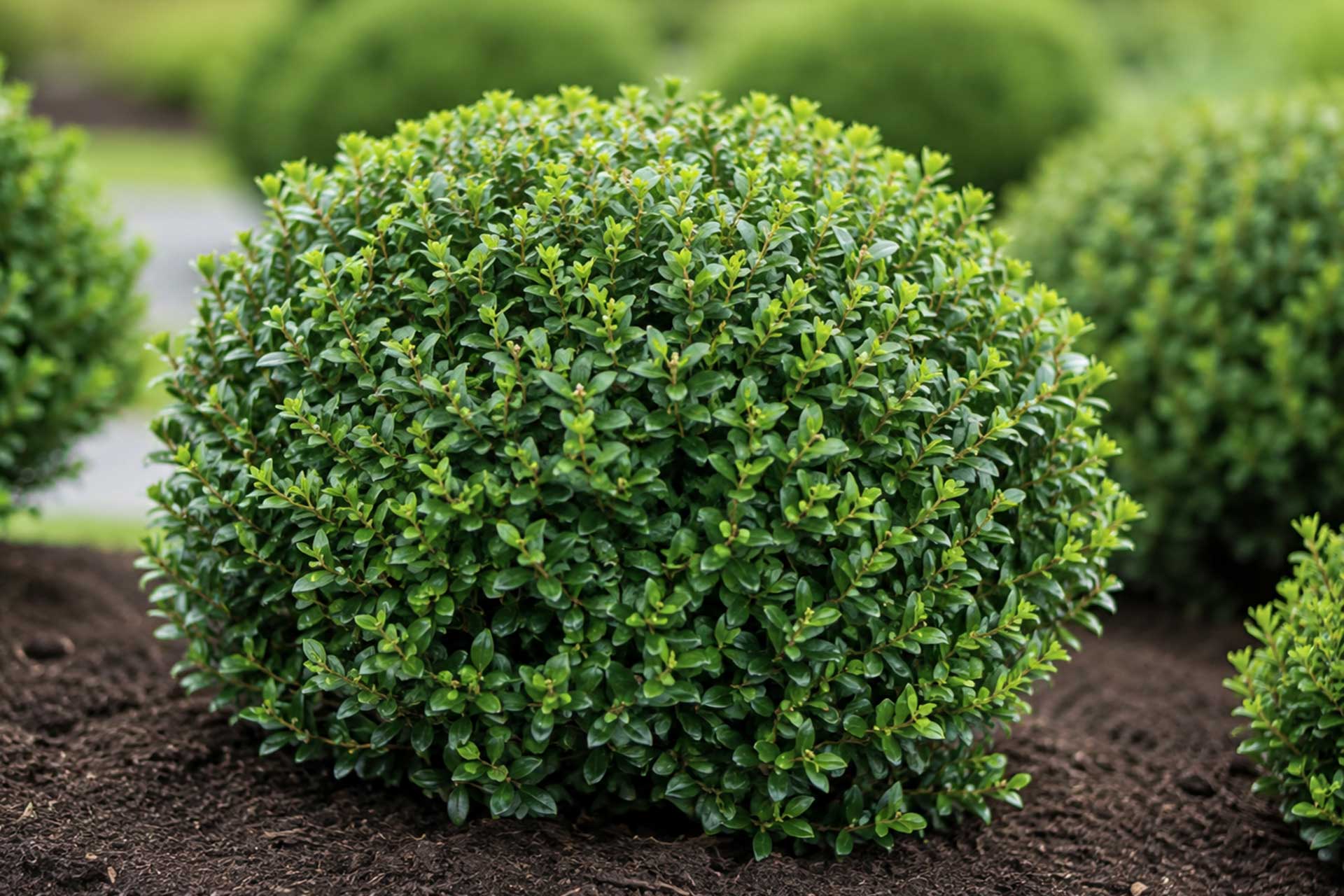
Modern cultivars give us much better control over size and shape.
| Cultivar | Typical Mature Size | General Character and Use |
|---|---|---|
| Gem Box® | About 2–3′ × 2–3′ | Dense, rounded dwarf form; useful for low edging, foundation planting and smaller formal compositions |
| Strongbox® | About 2–3′ × 2–3′ | Broad, mounded form with foliage held close to the ground; useful where a boxwood-like mass is desired |
| Shamrock | About 3–4′ × 3–4′ | Compact but somewhat more natural in character; useful in mixed borders, massing and informal hedges |
| Compacta | About 3–4′ | Older compact selection; useful where a medium evergreen shrub is appropriate |
| Squeeze Box® | About 4–6′ tall × 2–3′ wide | Upright male cultivar; provides a narrower vertical form and can pollinate compatible female cultivars |
These differences aren’t minor. A two-and-a-half-foot mounding plant and a six-foot upright plant can perform completely different jobs even though both labels say Ilex glabra.
That’s why we make plant selections by cultivar rather than simply writing “inkberry” on a plan and deciding later. The plant should fit the space when it’s mature.
What About the Black Berries?
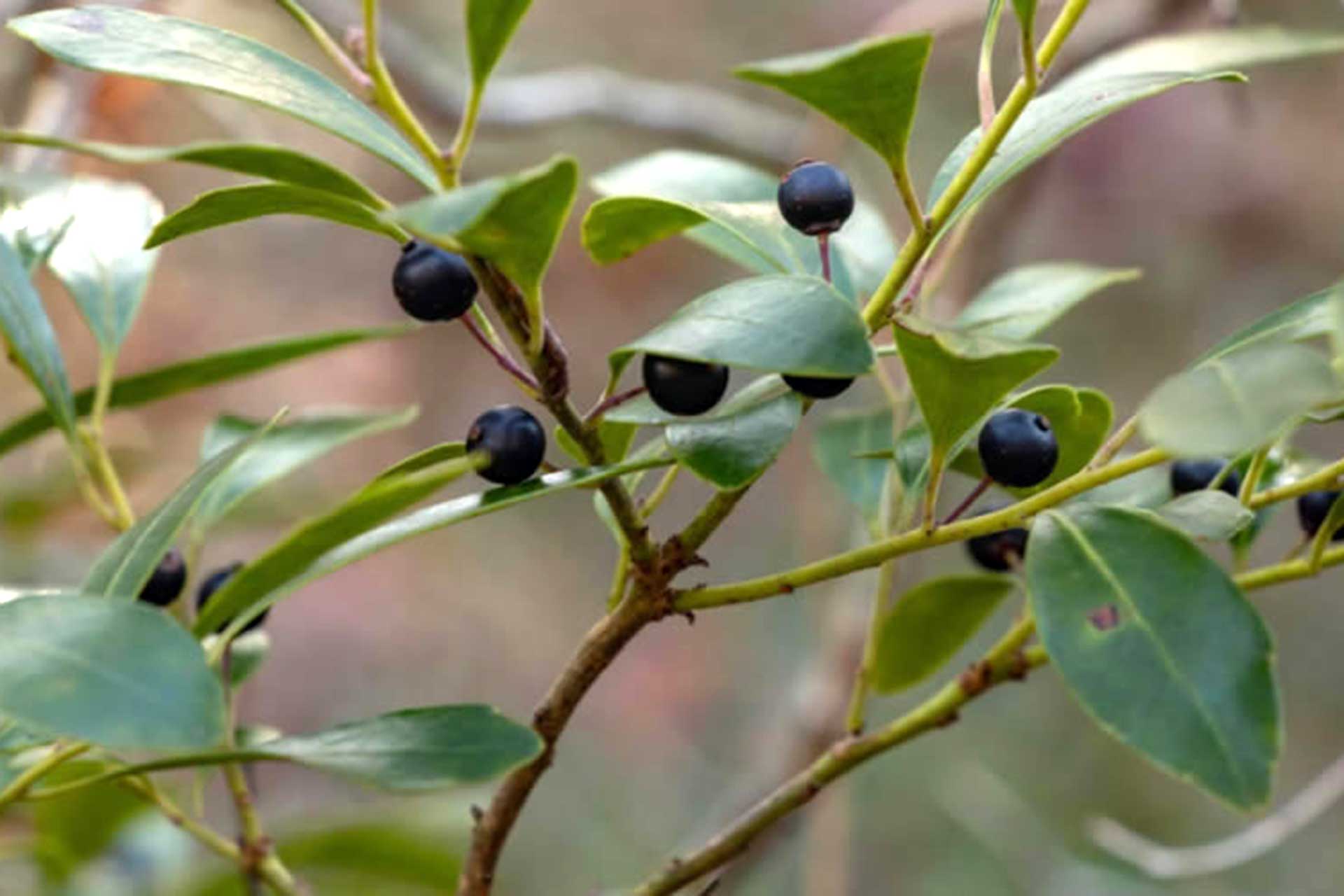
Inkberry is a holly, and like many hollies it is dioecious. In plain English, male and female flowers occur on separate plants.
Female inkberries can produce the small black fruits that give the plant its common name, but they generally need pollen from a compatible male holly nearby.
That distinction matters if berries are one of the reasons you’re choosing the plant.
For example, Gem Box® and Strongbox® are female cultivars. Their breeder recommends the male Squeeze Box® as a pollinator and notes that it can pollinate compatible plants within roughly 50 feet. Proven Winners lists Squeeze Box® at approximately 4–6 feet tall and 2–3 feet wide, making it quite different in form from the compact female varieties.
If fruit isn’t important, this isn’t something we’d build an entire planting around. If berries and wildlife value are important, then we plan for pollination rather than hoping it happens by accident.
Where Inkberry Works Best in a Landscape
The strongest uses aren’t necessarily the most obvious ones.
Foundation Plantings
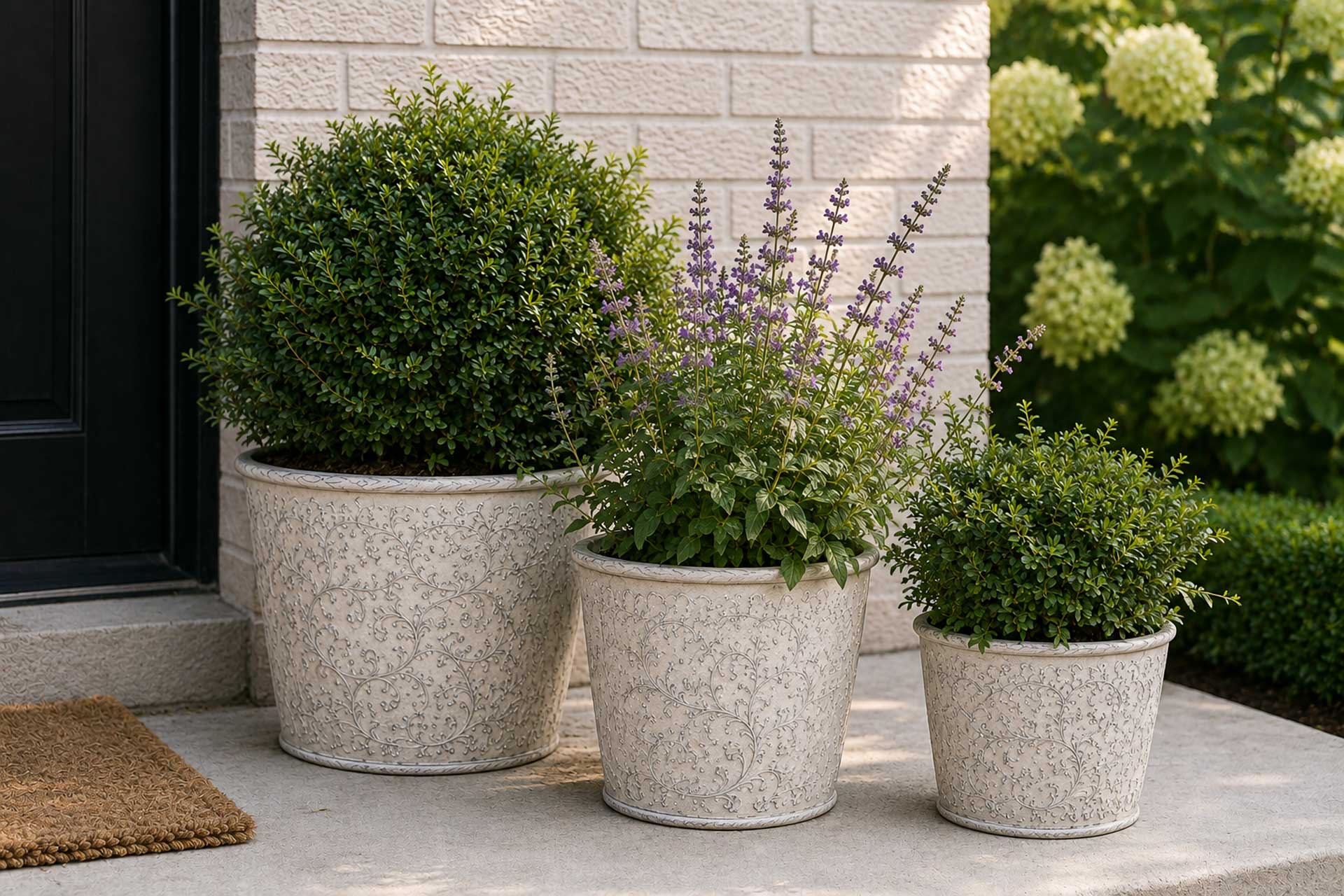
Inkberry can be excellent near a house because it provides evergreen mass without the stiffness of some conifers.
Compact cultivars work particularly well beneath windows, beside entries and at transitions between architecture and larger planting beds.
As we discuss in our guide to foundation landscaping for Boston homes, the objective isn’t to create a row of shrubs hiding the foundation. It’s to use plants to connect the architecture to the surrounding landscape.
Inkberry can be one of those connecting plants.
Mixed Shrub and Perennial Borders
This may be our favorite role for inkberry. A planting composed entirely of flowering shrubs can become visually busy in summer and almost disappear in winter. Inkberry gives that planting a backbone.
We might combine it with flowering shrubs, native perennials, ornamental grasses, ferns, sedges and groundcovers so the garden isn’t dependent on a single season.
Inkberry isn’t the star. Rather, it makes the stars look better.
Low Hedges and Repeated Evergreen Masses
Compact varieties can define the edge of a path, organize a front garden or provide repeated evergreen forms through a larger planting. The key is deciding how formal the planting actually needs to be.
We generally prefer allowing inkberry to retain some of its natural character rather than clipping it into an unnaturally tight box. Newer compact varieties make this easier because their natural forms are already relatively tidy.
Wet-Area and Rain-Garden Planting
Inkberry can also move away from the architecture entirely. Massachusetts includes Ilex glabra among its recommended native plants for rain gardens.
On the right property, that means inkberry can form the evergreen component of a planting designed around seasonal moisture, runoff or low-lying conditions. We might combine it with moisture-adapted perennials, grasses and other native shrubs rather than treating the area as a conventional ornamental bed.
Layered Privacy Planting
Inkberry can contribute to privacy, but we want to be clear about scale. A three-foot inkberry isn’t going to screen a second-story window.
What it can do is create the lower evergreen layer beneath larger trees and shrubs. That often makes a privacy planting feel much more complete.
We discuss this approach in Creating Privacy With Trees and Hedges in Residential Landscapes. The strongest screens usually aren’t a single row of identical plants. They’re layered compositions where different plants handle different heights, seasons and sightlines.
Is Inkberry Holly Really a Good Boxwood Alternative?
Yes. And no. This is probably the comparison inkberry gets most often, and it’s worth being precise.
Compact varieties such as Gem Box® and Strongbox® can fill many of the design roles traditionally assigned to boxwood. They’re evergreen, small-leaved, relatively compact and capable of creating repeated green forms or low hedges.
But they’re not boxwood.
As University of Maryland Extension puts it:
“Inkberry does not grow as densely as other hollies or boxwoods.”
– University of Maryland Extension
That difference matters.
Some inkberries naturally grow looser and can become bare at the bottom as they mature. They also prefer acidic, moisture-retentive soils rather than dry alkaline conditions.
Newer selections have improved lower branching substantially, which makes the comparison more useful than it once was.
Still, we don’t choose inkberry because we’re trying to disguise it as boxwood.
We choose it when its native status, evergreen foliage, moisture tolerance, softer texture and natural character make sense for the site.
| Characteristic | Inkberry Holly | Boxwood |
|---|---|---|
| Native to eastern North America | Yes | No |
| Evergreen | Yes | Yes |
| Wet-soil tolerance | Good; tolerates periodically wet conditions | Generally prefers well-drained soil |
| Formal clipping | Possible, but often best with a somewhat natural form | Excellent |
| Wildlife value | Flowers support pollinators; female plants can produce berries for wildlife | More limited |
| Growth habit | Varies considerably by cultivar; older forms may open at the base | Typically dense and compact |
| Best fit | Native, mixed, moist-site and moderately structured plantings | Very formal edging, hedges and highly controlled evergreen structure |
Where We Wouldn’t Use Inkberry Holly
We like inkberry, but we don’t think it belongs everywhere.
We’d hesitate to use it:
- in extremely dry, exposed soil without reliable irrigation
- where a very rigid formal hedge is the primary design goal
- where the available space doesn’t match the mature size of the cultivar
- where tall, immediate privacy is required
- in alkaline soil without understanding why the pH is high
- where road salt, wind or other exposure exceeds what the specific site and cultivar can reasonably tolerate
- where an older, larger form would eventually become too loose for the intended composition
We also wouldn’t automatically replace every boxwood with inkberry simply because inkberry is native. That’s not how we think about native planting.
The right question isn’t, “Can this native plant technically replace that non-native plant?” It’s, “What does this part of the landscape need, and which plant can do that job well here?”
What Should You Plant With Inkberry Holly?
Inkberry is especially easy to combine with other plants because its foliage is relatively quiet. We think about companions by contrast and season.
Panicle Hydrangeas
This is a very natural pairing. Inkberry provides year-round evergreen structure while panicle hydrangeas provide the summer flowers and larger-scale seasonal presence.
In winter, when the hydrangeas become stems and dried blooms, the inkberry keeps the composition grounded.
Ornamental Grasses and Sedges
Inkberry is visually dense. Grasses bring movement.
In sunny conditions, larger ornamental grasses can create a beautiful contrast between the dark evergreen foliage and finer moving blades or seed heads. In shaded or woodland conditions, native sedges can serve a similar role at a lower scale.
Our guide to ornamental grasses for Boston suburban landscapes looks at how we use these plants for texture and movement.
Native Perennials and Groundcovers
Inkberry also makes sense as part of a more layered native garden.
Ferns, asters, woodland groundcovers, sedges and other regionally appropriate plants can soften the shrub’s base and make the planting feel less like a collection of individual specimens.
If you’re working beneath mature trees, our guide to low-care native plants for woodland gardens offers useful companion ideas.
Flowering and Fruiting Native Shrubs
Inkberry can be paired with plants that provide more visible seasonal change.
Winterberry, viburnum, summersweet and other native or regionally appropriate shrubs can add flowers, fragrance, berries or fall color while the inkberry contributes the evergreen framework.
The goal isn’t to make every plant evergreen. It’s to use enough evergreen structure that the deciduous plants have room to be seasonal.

How Much Maintenance Does Inkberry Holly Need?
Inkberry is relatively manageable when it’s planted where it belongs. That qualifier matters.
An inkberry in appropriate acidic, moisture-retentive soil may need little more than establishment watering, mulching, occasional selective pruning and routine monitoring.
The same plant in dry, compacted soil may require constant intervention and still never look particularly good. That’s why we often say plant selection is part of landscape maintenance.
The easier landscape to maintain isn’t necessarily the one with fewer plants. It’s the one where the plants actually fit their conditions.
Should Inkberry Be Sheared?
Usually, we prefer not to treat inkberry like a tightly clipped boxwood. Older inkberries have a natural tendency to become somewhat open at the base. Repeated shearing of the outer foliage doesn’t necessarily correct that.
University of Maryland Extension recommends selective thinning in early spring when rejuvenation near the base is needed and specifically notes that shearing isn’t recommended for the species.
Newer compact cultivars can require less intervention because their natural growth is already denser. If we’re constantly forcing a plant into a shape it doesn’t want to hold, that’s usually a design problem before it’s a pruning problem.
Are Inkberry Hollies Deer Resistant?
Generally, yes. University of Maryland Extension describes inkberry as deer resistant, and several commercial cultivars are also promoted for good deer resistance.
But we’d still use the word resistant, not deer proof.
Anyone gardening in parts of Weston, Dover, Concord, Lincoln or other deer-heavy Greater Boston communities knows that browsing pressure varies enormously. Deer will sometimes eat plants they’re supposedly not interested in, particularly during difficult winters or when populations are high.
Inkberry can be a very useful component of a deer-conscious planting plan, but we wouldn’t build the entire strategy around one species.
For a broader approach, see our guide to deer-resistant plants and landscape design strategies for Boston-area gardens.
Is Inkberry Holly Native to Massachusetts?
Yes. And in this case, the native status is more than an interesting label.
Inkberry’s natural adaptations help explain why it can be so useful in New England landscapes. It evolved in eastern North American environments that include acidic soils, woodland edges, bog margins and periodically wet conditions.
Massachusetts state guidance includes inkberry in recommendations for both rain gardens and coastal landscapes. It also gives us something we don’t have in enormous abundance: a useful native broadleaf evergreen shrub.
Native plants don’t have to mean a meadow or a deliberately wild-looking landscape.Inkberry can be used in a very composed planting beside stone terraces, traditional architecture, clipped lawn edges or formal paths. The design determines the character.
That’s something we think is particularly important on established Greater Boston properties. Native and refined aren’t opposites.
Inkberry Holly vs. Other Evergreen Shrubs
There isn’t one universally best evergreen shrub. Different plants solve different problems.
| Plant | General Character | Where It Often Works Best |
|---|---|---|
| Inkberry Holly Ilex glabra |
Native, broadleaf evergreen, soft texture, moisture tolerant | Foundation plantings, native gardens, mixed borders, moist sites and low hedges |
| Boxwood Buxus spp. |
Dense, very formal, highly shapeable evergreen | Formal hedges, edging, topiary and strongly architectural plantings |
| Japanese Holly Ilex crenata |
Fine-textured evergreen with a boxwood-like appearance | Formal and semi-formal hedging and foundation planting |
| Arborvitae Thuja spp. |
Coniferous evergreen with considerably more height | Taller screening, property boundaries and evergreen backdrops |
| Winterberry Holly Ilex verticillata |
Native deciduous holly with conspicuous winter fruit | Wet areas, native planting, seasonal interest and wildlife gardens |
That last comparison is especially useful because homeowners sometimes assume all hollies behave similarly. Inkberry and winterberry can both tolerate moisture and both are native, but visually they’re very different plants.
Winterberry drops its foliage and becomes a display of bare stems and bright berries. Inkberry stays green.
On the right property, we may use both.
So, Is Inkberry Holly a Good Choice for a Massachusetts Landscape?
Yes, when the site and the job make sense. Inkberry is one of those plants we appreciate more as the entire landscape matures. It doesn’t have to dominate a planting. In fact, it usually works better when it doesn’t.
It can sit behind a flowering perennial. Repeat quietly along a path. Hold a foundation planting together through winter. Fill the lower layer beneath a privacy screen. Bring evergreen structure into a rain garden. Or give a native planting enough order that it feels completely at home beside a beautifully detailed house.
And that’s really the point. A useful landscape plant isn’t always the one with the biggest flower or the brightest fall color. Sometimes it’s the plant that keeps showing up, season after season, doing exactly what the design needs it to do.
Inkberry can be that plant.
Frequently Asked Questions About Inkberry Holly
Q: How big does inkberry holly get?
A: The straight species can grow roughly 5–8 feet tall and sometimes larger, while modern compact cultivars may remain only 2–4 feet tall. Always choose according to the mature dimensions of the specific cultivar.
Q: Is inkberry holly evergreen in Massachusetts?
A: Yes. Inkberry is a broadleaf evergreen and retains its foliage through winter, making it useful for year-round structure in Massachusetts landscapes.
Q: Can inkberry grow in shade?
A: Yes. Inkberry tolerates partial shade and can grow in fairly shaded conditions, although growth may be denser with more available light. Soil moisture and the specific microclimate are also important.
Q: Does inkberry holly like wet soil?
A: Inkberry prefers consistent moisture and tolerates periodically wet conditions. It naturally occurs around bogs, swamps and wet woodland environments, and Massachusetts includes it among recommended rain-garden plants.
Q: Is inkberry holly deer resistant?
A: Generally, yes. Inkberry is considered deer resistant, although browsing varies by location and no shrub should be assumed completely deer proof.
Q: Does inkberry holly produce berries?
A: Female plants can produce small black berries when pollinated by an appropriate male holly. If fruit is important, choose compatible male and female cultivars and plan their placement accordingly.
Q: Is inkberry holly a good substitute for boxwood?
A: It can be, particularly compact cultivars such as Gem Box® and Strongbox®. But inkberry has different soil preferences and a somewhat different growth habit, so we prefer to choose it because it fits the site rather than treating it as an exact boxwood copy.
Q: Is inkberry holly native to Massachusetts?
A: Yes. Ilex glabra is native to eastern North America and occurs in Massachusetts. It can be an especially useful native evergreen for moist, acidic landscapes.
Choosing Plants as Part of the Larger Landscape
Plant selection works best when every plant has a reason for being there.
Inkberry might be the right evergreen beside a front walk, the lower layer of a mixed privacy planting or the plant that finally makes sense in a moist bed where other shrubs have struggled.
Twenty feet away, something completely different may be better. That’s why we look at more than whether a plant is hardy in Massachusetts. We consider soil, water, sunlight, mature size, architecture, neighboring plants, views, maintenance and how the entire property changes through the seasons.
At a Blade of Grass, our landscape designers bring those pieces together into planting plans designed for the way Greater Boston properties actually grow and mature.
If you’re planning a new garden, reconsidering an existing planting or looking for a more thoughtful mix of native and ornamental plants, contact us to start a conversation about your property.
Sources and Further Reading
- University of Maryland Extension: Inkberry Holly
- Massachusetts Office of Coastal Zone Management: Coastal Landscaping Shrubs, Groundcovers and Vines
- Massachusetts: Stormwater Solutions for Homeowners, Rain Gardens
- NC State Extension Plant Toolbox: Ilex glabra
- Missouri Botanical Garden Plant Finder: Ilex glabra
- Proven Winners: Gem Box® Inkberry Holly
- Proven Winners: Strongbox® Inkberry Holly
- Proven Winners: Squeeze Box® Inkberry Holly