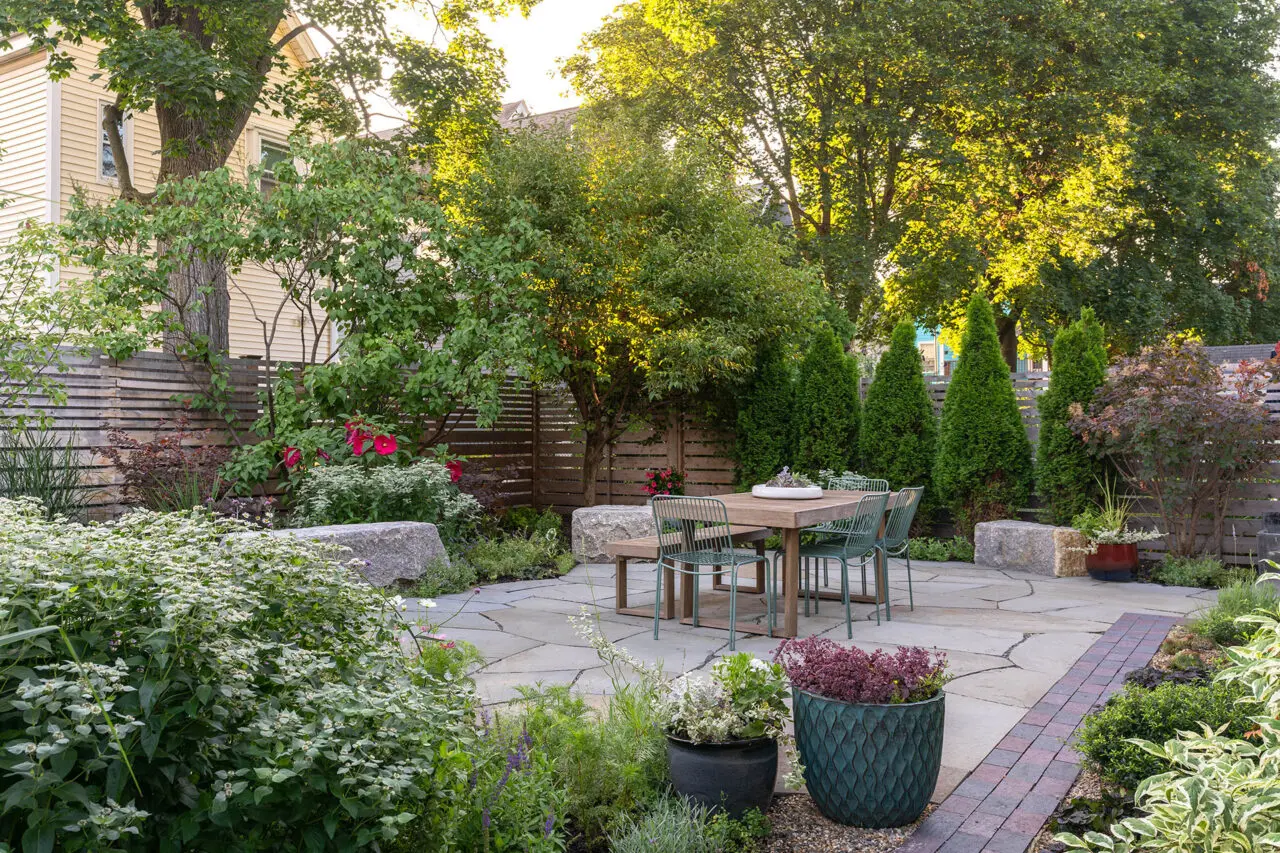
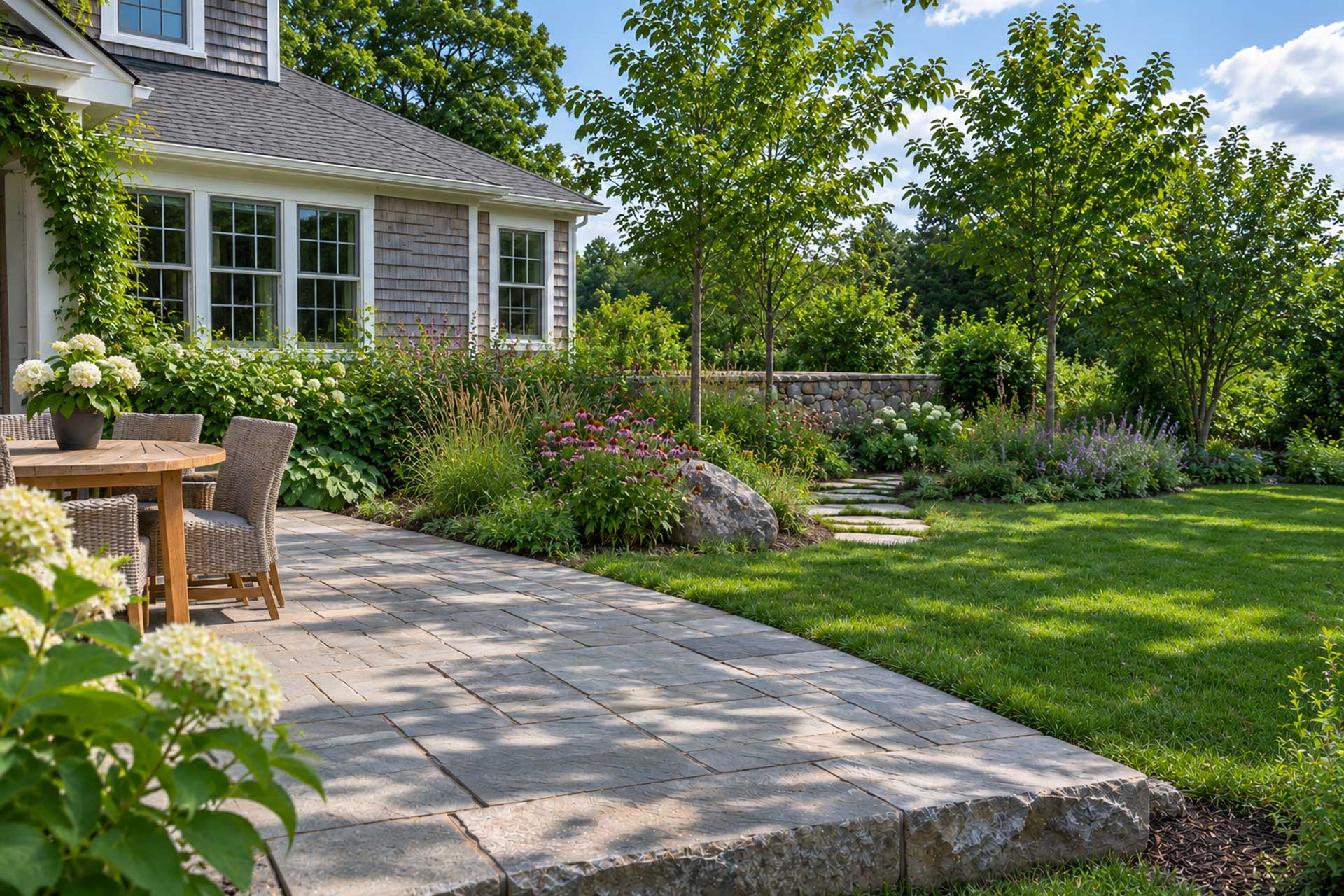
A finished landscape can make construction look remarkably simple. A stone terrace connects naturally to the house. Garden beds frame the view. New walkways, trees, lighting, and lawn areas appear to belong exactly where they are.
Getting there is another story.
Landscape construction often begins with equipment, excavation, exposed soil, and a yard that looks considerably less finished than it did before work started. For homeowners, that can be surprising, especially when much of the early work seems unrelated to the features they are looking forward to enjoying.
But those less visible phases are often the ones that determine how well the finished landscape performs.
Understanding what happens during landscape construction, how the work progresses, and what can affect the schedule makes the experience easier to navigate. It also helps homeowners recognize the difference between normal construction challenges and issues that deserve closer attention.
Key Takeaways
- Landscape construction and installation overlap, but construction often involves more extensive site preparation and structural work.
- Grading, drainage, foundations, and other hidden work are essential to long-term performance.
- Project timelines depend on scope, site conditions, materials, weather, and scheduling.
- Disruptions and unexpected challenges are normal. Clear communication and management matter.
- Newly installed landscapes require ongoing care as plants become established.
Landscape Construction vs. Landscape Installation: What’s the Difference?
The terms landscape construction and landscape installation are often used interchangeably, but there is a useful distinction.
Landscape construction generally refers to the physical work required to create or substantially modify an outdoor environment. That can include excavation, grading, drainage, retaining walls, patios, walkways, steps, and other structural improvements.
Landscape installation often describes the process of putting a landscape design into place, particularly when it involves trees, shrubs, perennial gardens, lawns, irrigation, lighting, and finishing details.
In practice, most substantial residential projects involve both.
A new backyard terrace, for example, may require excavation, drainage adjustments, and a carefully prepared foundation before the finished stone can be installed. The surrounding planting, lawn restoration, and lighting complete the design.
The distinction matters less than understanding the full scope of the project. A landscape that looks simple when completed may involve considerable preparation beneath the surface.
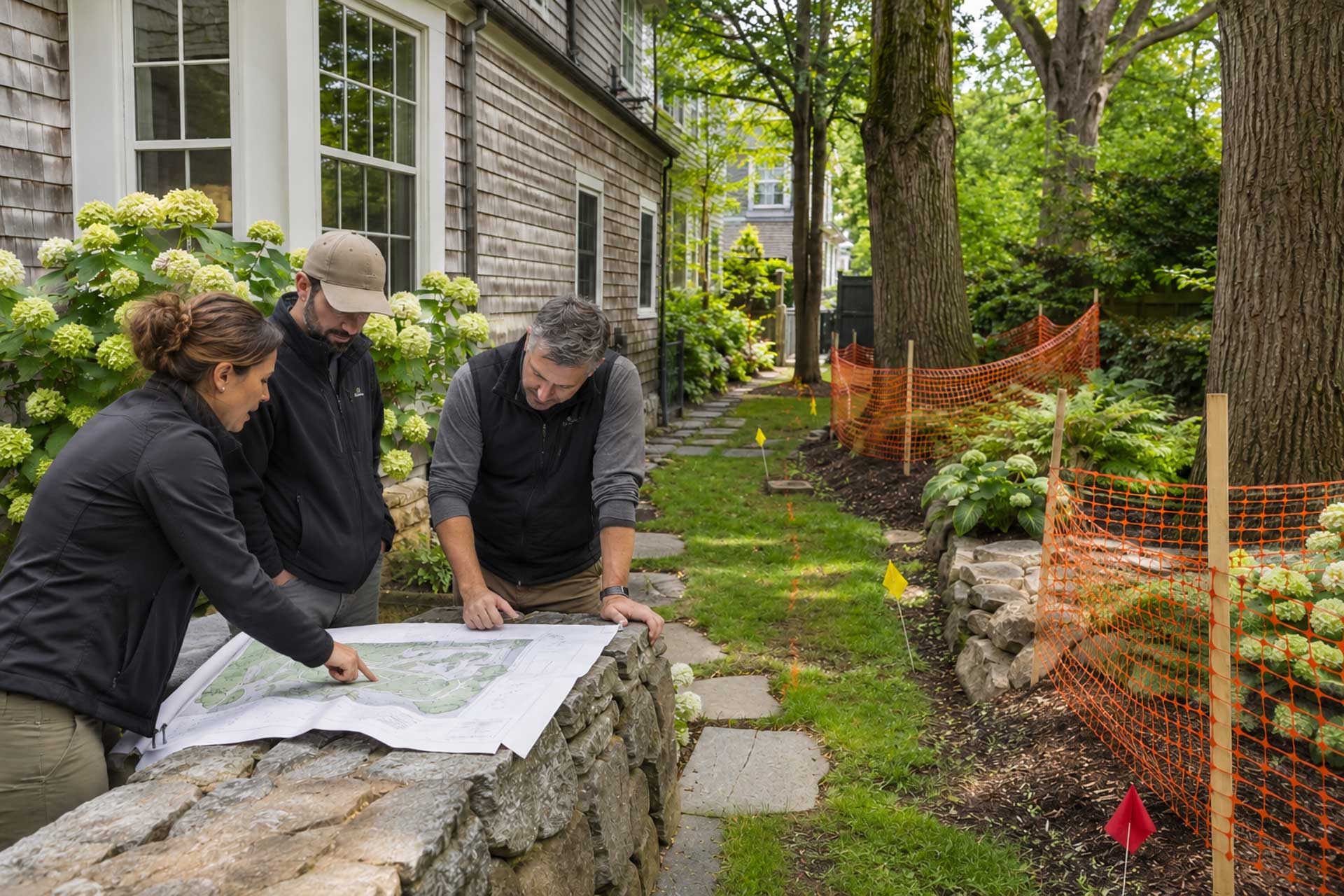
Before Construction Begins: The Work That Happens Behind the Scenes
One of the first surprises for homeowners is that construction may not begin immediately after the landscape design is approved.
There can be a substantial amount of coordination between having a finished plan and having equipment arrive at the property.
Material selections need to be confirmed. Construction drawings and specifications may require final adjustments. Permits or approvals may be necessary, particularly for projects involving retaining walls, significant grading, drainage, or protected environmental areas.
The property itself also needs to be considered.
Where will materials be delivered? Can equipment reach the backyard without damaging an existing walkway or valuable tree? Will a driveway need to remain accessible? Are there portions of the garden that should be protected throughout construction?
On established Greater Boston properties, access can be a significant consideration. A narrow side yard, mature trees, stone walls, or neighboring structures may limit the size of equipment that can be used and influence how materials move through the site.
Before excavation, underground utilities must also be addressed. Massachusetts requires excavation notification through Dig Safe, and utility markings help identify the locations of participating utilities before work begins. Private lines may require additional investigation.
These details may not be the most interesting parts of a landscape project, but resolving them early can prevent unnecessary disruption later.
For homeowners still deciding how different improvements should fit together, our guide to planning a backyard transformation explores the decisions worth making before construction begins.
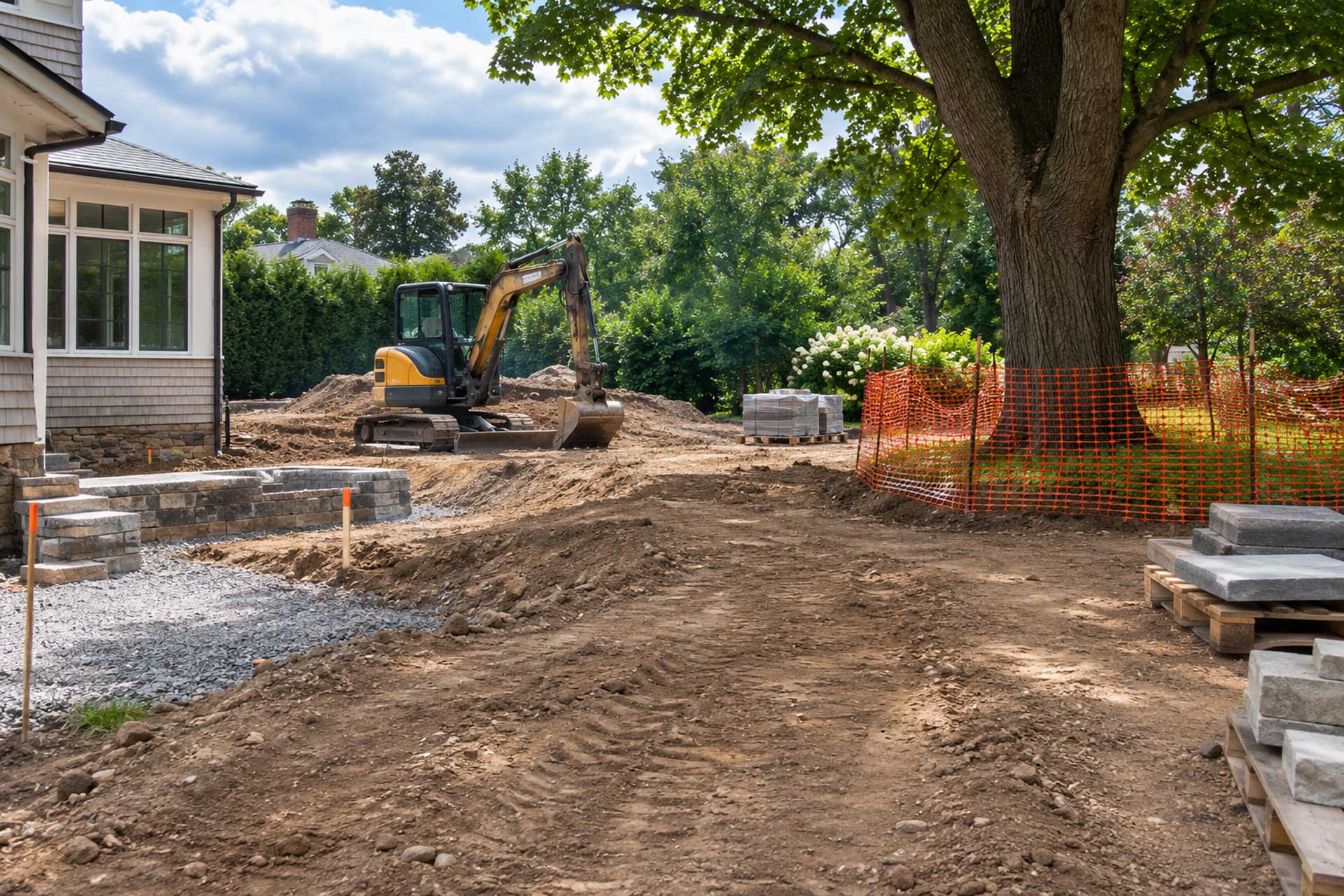
Site Preparation: Why Your Yard May Look Worse Before It Looks Better
The first days of active construction can be the most unsettling.
Existing plants may be removed or relocated. Sections of lawn disappear. Soil is excavated, equipment moves across the property, and materials begin accumulating in designated work areas.
It can be difficult to reconcile that activity with the finished landscape shown on the plans.
Site preparation is also where some of the most important construction decisions become visible.
Grading and Drainage Come First
The elevations of a property influence where rainwater travels, how surfaces connect, and whether certain areas remain dry and usable.
Before installing a patio or walkway, the construction team may need to adjust grades, remove unsuitable material, or install drainage infrastructure.
Even relatively modest elevation changes can matter. A terrace that slopes in the wrong direction may send runoff toward the house. A low area that collects water can create problems for a lawn or nearby planting beds.
On Massachusetts properties, those issues can become more noticeable during heavy rainfall and winter freeze-thaw cycles.
This is why drainage should be considered before finished surfaces and planting are installed, rather than treated as a problem to solve afterward.
Our article on landscape drainage solutions for Massachusetts properties examines those considerations in more detail.
Protecting What Should Remain
Construction does not always involve starting with a completely blank property.
Mature trees, established gardens, existing stonework, and other landscape features may be important parts of the finished design.
Protecting those elements requires planning. Equipment routes, excavation limits, material storage, and temporary barriers can all affect how much disturbance occurs.
Tree roots deserve particular attention. They may extend well beyond the visible canopy, and excavation or repeated equipment traffic can damage roots or compact the surrounding soil.
A homeowner may wonder why a particular area has been fenced off or why equipment takes a less direct route across the property. Those precautions may be intended to protect features that would be difficult or impossible to replace.
The International Society of Arboriculture offers guidance on protecting trees during construction, including precautions to limit damage to roots and surrounding soil.
What Excavation Can Reveal
Not every site condition is apparent during the design process.
Once excavation begins, crews may encounter buried construction debris, unexpected rock or ledge, unsuitable soils, old drainage systems, or foundations from earlier improvements.
Some discoveries require relatively minor adjustments. Others may affect how a portion of the landscape can be built.
The important distinction is between a condition that could not reasonably have been confirmed in advance and a problem that results from inadequate preparation.
When unexpected conditions arise, homeowners should understand what was discovered, why it matters, what options are available, and whether the proposed solution changes the project scope or cost.
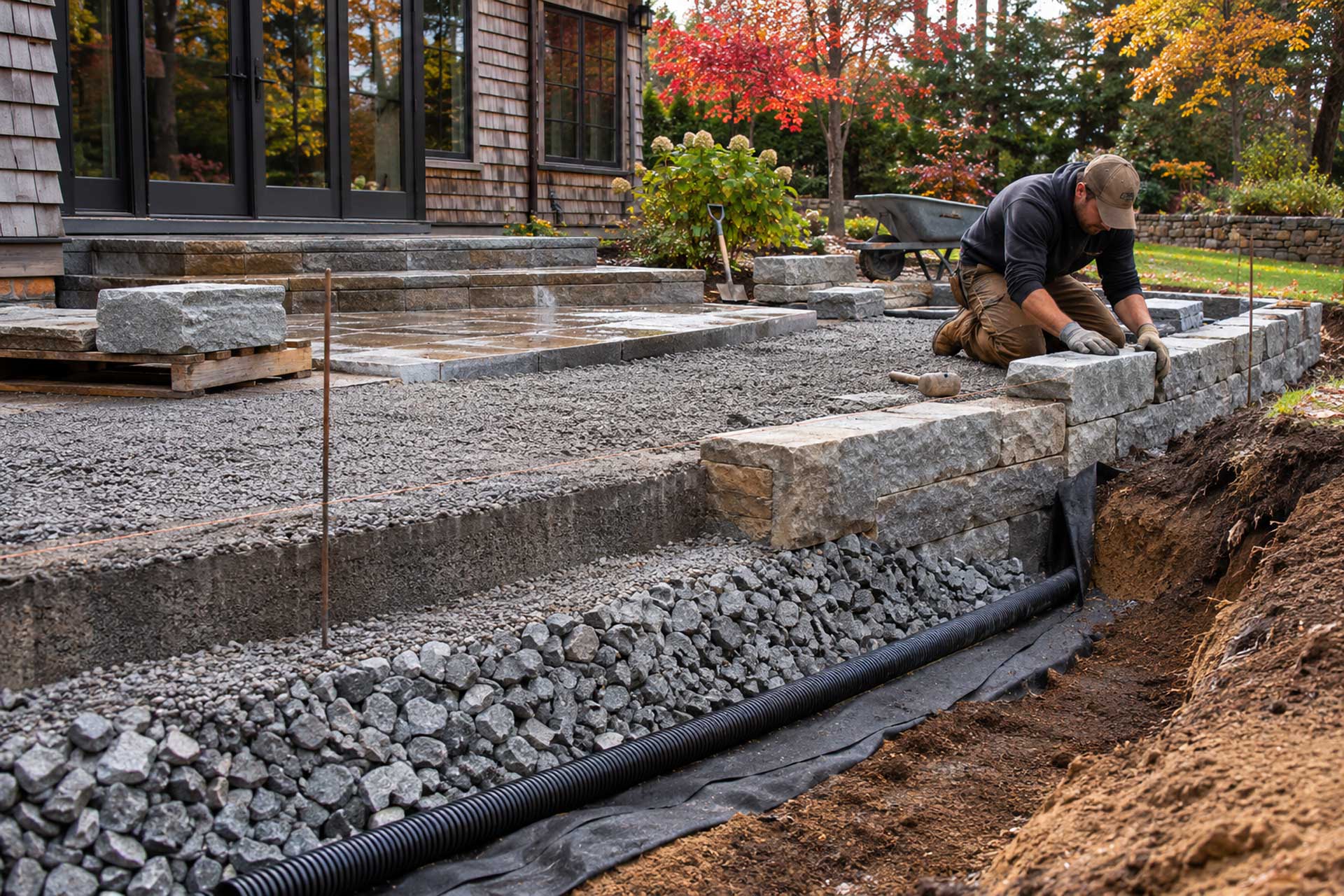
Building the Foundation: Why Hardscaping Takes Time
A patio can appear straightforward in a landscape drawing. There is a defined shape, a selected stone, and a finished elevation.
What the drawing does not necessarily communicate is how much work may be required beneath the finished surface.
Depending on the design and site conditions, construction can involve excavation, preparing and compacting supporting materials, establishing appropriate drainage, and carefully setting the finished stone.
That preparation is especially important in New England, where water and repeated freezing and thawing can place considerable stress on outdoor surfaces.
The same principle applies to steps, retaining walls, and other built elements. Their long-term performance depends on appropriate foundations, drainage, materials, and construction methods suited to the conditions.
A substantial amount of time may pass before the most visible materials are installed. That does not necessarily mean progress has stalled.
As This Old House illustrates in its bluestone patio guide, much of the work involved in building a durable stone surface happens before the finished material is installed.
Why Underground Infrastructure Must Be Coordinated
A finished landscape may include irrigation, lighting, drainage systems, electrical connections, and other features that depend on underground infrastructure.
Those systems need to be considered alongside the construction of patios, paths, walls, and planting areas.
For example, it is generally preferable to plan necessary conduits or irrigation crossings before completing a stone walkway rather than disturbing the finished surface later.
The exact sequence varies by project, but the underlying principle remains the same: construction is a coordinated process, not simply a series of unrelated installations.
Good sequencing helps protect finished work and reduces the likelihood that one trade will need to undo what another has already completed.
When the Landscape Finally Begins Taking Shape
After the structural work and major site preparation are complete, the property often begins changing more quickly.
Stone surfaces are finished. Garden beds take shape. Trees and shrubs arrive, and areas that previously looked like construction zones begin to resemble the original design.
For many homeowners, this is the most satisfying part of the process.
It is also a phase where important horticultural decisions still need to be made.
Soil Preparation Matters as Much as Plant Selection
New plants cannot succeed on appearance alone.
Soil conditions, drainage, available rooting space, planting depth, and moisture all influence how well trees, shrubs, and perennials become established.
Areas disturbed by construction may require soil preparation before planting. In particular, soil compacted by equipment can limit the movement of water and air through the root zone.
As Fine Gardening explains, construction activity can leave soil compacted and disturbed, making proper preparation especially important before new planting begins.
These details are not immediately apparent once mulch has been spread and the beds look finished, but they can influence plant health for years.
Why Newly Planted Gardens May Look Sparse
A newly installed landscape will not always look like a mature garden.
Shrubs may be intentionally spaced apart. Perennials may occupy only part of the bed. Young trees may provide less shade or privacy than they eventually will.
That is not necessarily an indication that something is missing.
Planting design should account for how plants grow and relate to one another over time. Filling every available space on installation day can create crowding and additional maintenance as the garden develops.
The goal is not simply to produce an attractive first impression. It is to establish a landscape that can mature successfully.
How Long Does Landscape Construction Take?
There is no universal timeline for residential landscape construction.
A relatively straightforward planting installation may be completed much more quickly than a project involving extensive excavation, multiple stone terraces, retaining walls, irrigation, lighting, and substantial changes in elevation.
Even projects of similar size can have different schedules because the properties themselves present different challenges.
Several factors influence the overall timeline:
- Project scope: The number and complexity of improvements affect the amount of construction and coordination required.
- Site access: Limited equipment access can increase the time needed to move materials and complete work.
- Permits and approvals: Some work requires municipal or conservation review before construction can proceed.
- Materials: Custom stone, fabricated elements, and specialty products may have longer lead times.
- Weather and site conditions: Heavy rain, saturated soil, frozen ground, or extreme temperatures can affect different construction activities.
- Coordination: Certain phases need to be completed before other crews or specialists can begin.
It also helps to distinguish the overall project schedule from the number of days crews are actively working on the property.
A project may include periods when materials are being prepared off-site, inspections are pending, or work is paused because conditions are unsuitable.
That does not automatically indicate poor management. However, homeowners should have a reasonable understanding of the schedule, major milestones, and how changes will be communicated.
How New England’s Seasons Affect Construction
Spring is a popular time to begin landscape work, but wet soils and unpredictable weather can complicate excavation and site preparation.
Summer often provides longer working days and favorable conditions for many construction activities, although heat and drought may require additional attention to newly installed plants.
Fall can be an excellent period for certain planting projects and continued hardscape work, provided conditions remain appropriate.
Some construction activities can continue during winter, depending on the work, materials, soil conditions, and temperatures. Others may need to wait.
For homeowners hoping to enjoy a new landscape by a particular season, the most productive approach is to begin planning early and discuss the desired completion date before construction is scheduled.
Living With Landscape Construction: What Should You Expect?
Even a well-organized project changes how a property functions while work is underway.
Equipment may arrive early in the day. Materials may be delivered in stages. Portions of the driveway, lawn, or backyard may be unavailable for a period of time.
Noise, dust, mud, and temporary changes in access are often part of construction.
The amount of disruption depends on the project, but there are practical questions worth discussing before crews arrive:
- Will the driveway or main entrance remain accessible?
- Where will materials and equipment be stored?
- Which areas of the property will be closed off during construction?
- How should children and pets be kept safely away from work areas?
- Will there be periods when outdoor utilities or irrigation systems are unavailable?
- Who should homeowners contact when questions arise?
A backyard renovation may have little effect on daily activities inside the home, while improvements involving the front entrance, driveway, or primary walkways may require temporary arrangements.
The goal is not to eliminate every inconvenience. That is rarely realistic.
It is to understand the likely disruptions in advance and maintain clear communication as the work progresses.
When Something Unexpected Happens: Normal Challenges vs. Red Flags
Few construction projects unfold exactly as imagined.
Rain may interrupt excavation. A material delivery may be delayed. An underground condition may require a modification to the original plan.
Those situations are not necessarily evidence that something has gone wrong.
What deserves attention is how the issue is handled.
If excavation reveals an unexpected drainage problem, for example, there may be a legitimate reason to reconsider part of the construction approach. A responsible response should explain the condition, the proposed solution, the consequences of different options, and any effect on cost or timing.
Homeowners should be able to understand the reasoning without needing to become construction experts themselves.
Changes That Deserve a Closer Look
Certain situations warrant additional questions:
- Significant changes to the scope or price without a clear explanation or written approval.
- Substitutions of materials or plants that differ from the approved specifications without discussion.
- Repeated scheduling changes without meaningful updates.
- Work that departs from the agreed design without an understandable reason.
- Damage to areas that were supposed to be protected, without a plan for addressing it.
- Important preparation or inspection steps appearing to be omitted without explanation.
A single delay or design adjustment does not automatically signal a larger problem. Patterns of poor communication, undocumented changes, or unresolved concerns are more meaningful.
It is reasonable to ask questions during construction, particularly when something looks different from the plans or an unexpected condition has been discovered.
In our experience, the most productive conversations happen when concerns are raised while decisions can still be evaluated, rather than after the affected work has been completed.
The Final Walkthrough: When Is a Landscape Project Really Finished?
The final stages of construction often involve smaller adjustments that are easy to overlook while the larger improvements are taking shape.
Edges are refined. Disturbed areas are restored. Remaining debris is removed. Irrigation and lighting systems are checked, where applicable, and the completed work is reviewed against the agreed scope.
A final walkthrough gives homeowners an opportunity to ask questions and identify anything that requires follow-up.
It is useful to understand:
- Whether any adjustments or punch-list items remain.
- How new irrigation, lighting, or other installed systems operate.
- What maintenance responsibilities begin immediately after installation.
- Whether specific materials or plants have special care requirements.
- What warranties or follow-up arrangements apply to the completed work.
Not every item needs to be fully resolved during the walkthrough, but remaining responsibilities should be clear.
Construction Completion Is Not Landscape Maturity
A new stone terrace may be ready to use as soon as its installation and required finishing work are complete. Trees, shrubs, and perennials follow a different timetable.
They need time to establish roots, adapt to their new surroundings, and begin growing into the intended design.
That process may extend through multiple growing seasons, depending on plant size, species, site conditions, and care.
Watering is especially important during establishment. Newly planted trees and shrubs may need attention even when surrounding established plants appear healthy.
Our guide to proper watering after a new landscape installation explains how establishment needs differ from routine landscape watering.
There is also a visual adjustment for homeowners. The garden that looks open and newly planted in its first year may become fuller and more layered over time.
A successful landscape is designed for both moments: how it looks when construction ends and how it performs as the property evolves.
Frequently Asked Questions
Q: Can We Stay in Our Home During Landscape Construction?
A: In most residential projects, homeowners can continue living in their homes while construction is underway. However, access to portions of the property may be restricted, and projects involving primary entrances, driveways, or extensive excavation may require temporary arrangements. Discuss these conditions before work begins.
Q: Can Landscape Construction Be Completed in Phases?
A: Yes. Phased construction can be a practical approach when homeowners want to spread improvements over time. However, grading, drainage, underground utilities, and access should be considered as part of the larger plan so future phases do not require unnecessary reconstruction of completed areas.
Q: When Should We Start Planning a Spring Landscape Installation?
A: Ideally, begin discussions well before the desired installation season. Design development, material selections, permitting, and contractor scheduling can require considerable lead time. Winter can be a productive planning period for spring and summer projects, even when certain types of physical construction are limited.
Q: What Should We Ask Before Hiring a Landscape Construction Company?
A: Ask who will manage the project, how the scope and schedule will be documented, what site preparation is included, how existing property features will be protected, and how unexpected conditions or changes will be handled. It is also important to understand the final walkthrough, warranty terms, and responsibilities for care after installation.
Understanding the Process Makes the Experience Better
A finished landscape rarely reveals how much work went into creating it.
The grading beneath a lawn, the foundation below a stone terrace, the drainage behind a retaining wall, and the soil surrounding a newly planted tree may never attract much attention. Yet these details often determine how well the landscape functions long after construction is complete.
For homeowners, understanding that process can make the experience more predictable. It helps explain why certain phases take time, why disruption is sometimes unavoidable, and why careful decisions made early can prevent problems later.
The goal is not simply to reach the final planting or the last piece of stonework. It is to create a landscape that looks appropriate to the property, works the way it should, and continues to improve with time.
Planning a Landscape Construction Project?
At a Blade of Grass, our landscape design and construction teams work with homeowners throughout Greater Boston, MetroWest, and Cape Cod to plan and build outdoor environments that respond to each property’s conditions and priorities.
If you’re considering a new landscape or improvements to an existing property, explore our landscape construction services or contact us to discuss your plans.