Water problems rarely start with a dramatic flood. More often, they begin quietly: a lawn that stays soft for days after rain, mulch that keeps washing into the driveway, a patio edge that turns slick in winter, or a planting bed that never seems to dry out. On Massachusetts properties, those small issues can add up quickly.
That is especially true in Greater Boston and MetroWest, where many homes contend with older site layouts, compacted or clay-heavy soils, freeze-thaw cycles, spring saturation, and runoff from roofs, driveways, or neighboring grades. Massachusetts has also become wetter over time. Since 1970, precipitation in the state has averaged about 4.7 inches more than during 1895–1969, and the state climate summary notes a record-setting number of extreme precipitation events during 2005–2014.
That is why drainage should be approached as part of the landscape itself, not as a patch after problems appear. As landscape architect Kongjian Yu put it, “We need to accept and embrace flooding as a natural phenomenon.” In residential terms, that means understanding where water wants to go, then shaping the property so it can move, infiltrate, and drain in controlled ways that protect the home and landscape.
Key Takeaways
- Standing water is a symptom, not a diagnosis.
- The right drainage solution depends on where the water is coming from.
- French drains can be effective, but they are not the answer to every drainage problem.
- Massachusetts conditions make drainage more complex than many homeowners expect.
- Drainage work should protect lawns, planting beds, hardscape, foundations, and long-term property value.
Why Drainage Problems Are So Common on Massachusetts Properties
Massachusetts landscapes are shaped by a combination of climate, soil, topography, and development patterns. Winter and spring precipitation are projected to increase, and extreme precipitation events are expected to become more frequent. That matters for residential sites because many were not originally designed for the water volumes they now experience.
At the same time, roofs, driveways, walks, terraces, and other impervious surfaces push water outward instead of allowing it to soak into the ground. EPA explains that stormwater runoff is generated when rain and snowmelt flow over land or impervious surfaces and do not infiltrate into soil. That runoff can carry sediment and other pollutants, but even before water-quality concerns enter the picture, it can also create practical property problems: pooling, erosion, icing, and oversaturated planting areas.
For residential properties, the consequences are often broader than a wet lawn. Poor drainage can shorten the life of hardscape, weaken turf, stress ornamental plantings, undermine slopes, complicate maintenance, and diminish the usability of outdoor spaces that were meant to feel refined and effortless. That is one reason water management should be treated as foundational planning, not a minor add-on.
Signs Your Property May Have a Drainage Problem
Some drainage failures are obvious. Others are easy to normalize until they have been repeating for years.
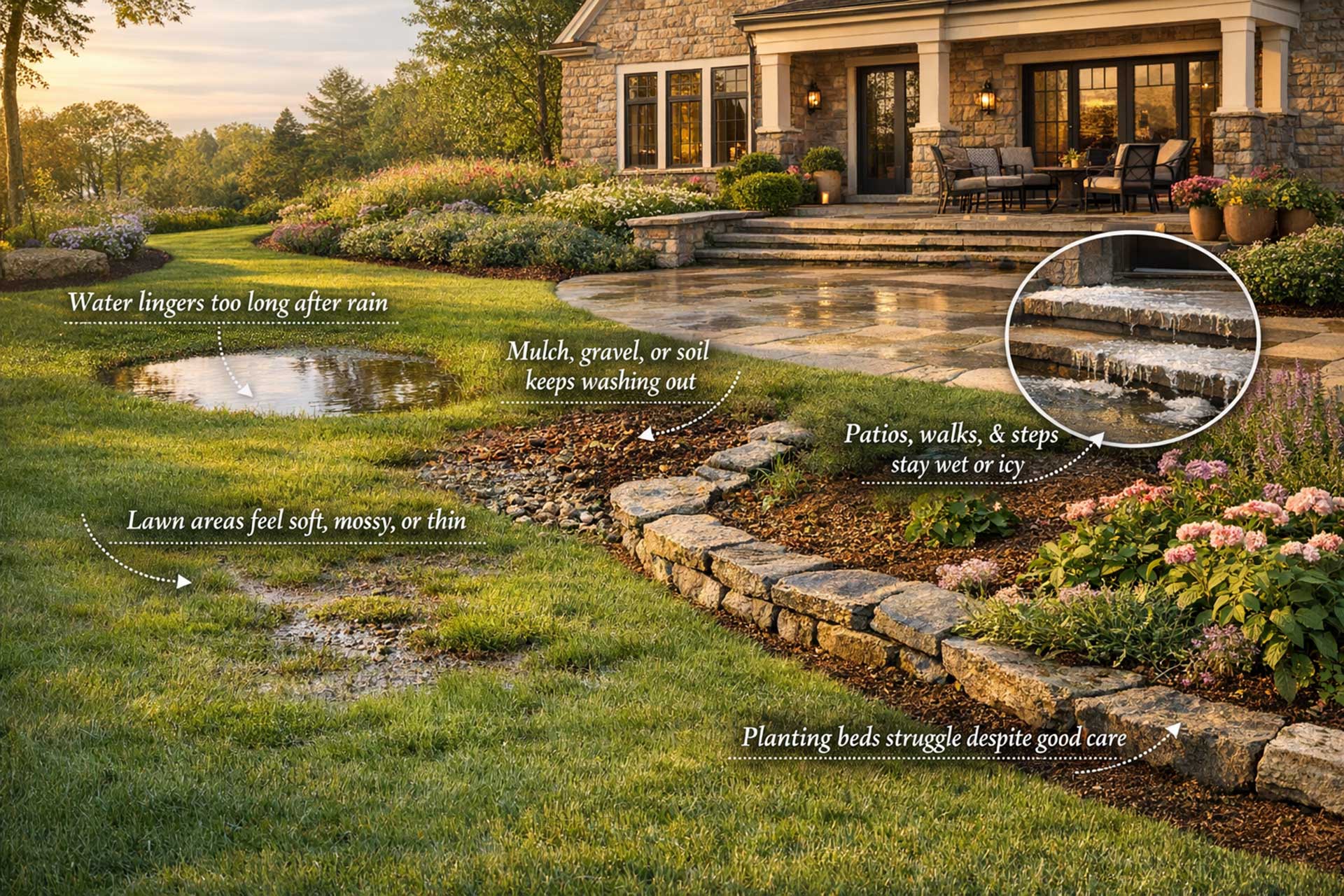
1) Water lingers too long after rain
A puddle after an intense storm is not automatically cause for concern. A low area that stays wet for days, however, usually indicates a problem with grading, soil infiltration, subsurface drainage, or concentrated runoff.
2) Mulch, gravel, or soil keeps washing out
When decorative stone migrates, mulch collects at bed edges, or bare soil appears after storms, the property is often shedding water too quickly across the surface rather than absorbing or redirecting it properly.
3) Lawn areas feel soft, mossy, or thin
Persistent wetness can lead to turf decline, compaction, moss pressure, and areas that become difficult to mow or use comfortably.
4) Patios, walks, and steps stay wet or icy
In Massachusetts, drainage issues often become just as noticeable in winter as they are in spring. Water that does not move off the property properly can refreeze when temperatures drop, turning walkways, steps, and patio edges into slippery problem areas. What looks like a simple wet spot in one season can quickly become a safety concern and a recurring maintenance issue in another.
5) Planting beds struggle despite good care
Some shrubs and perennials decline not because they need more water, but because their roots remain too wet. Poor drainage can look like weak growth, stress, dieback, or repeated replacement.
Related Blog: The Complete Landscape Maintenance Calendar for Boston & New England Homeowners
What Usually Causes the Problem
Before choosing a drainage solution, the first step is to understand the source of the water.
1) Poor grading and hidden low spots
Sometimes the issue is not dramatic. A subtle pitch toward a patio, a shallow basin in the lawn, or a slight settlement near the home can be enough to hold water repeatedly. Grading and site engineering are an important part of long-term landscape performance planning.
2) Compacted or slow-draining soils
Dense soils absorb water slowly. That can be especially frustrating on older properties or sites disturbed by previous construction. When infiltration is limited, even moderate rain can produce soggy surface conditions.
3) Downspouts discharging in the wrong place
A roof can move a surprising amount of water. If downspouts empty near foundations, bed edges, walkways, or lawn depressions, a localized issue can become chronic very quickly.
4) Runoff from higher parts of the property
On estate lots, sloped sites, or homes with multiple grade changes, water may be arriving from uphill lawn panels, driveways, terraces, or neighboring properties. In those cases, the wet area is often only the endpoint, not the source.
5) Older hardscape or site alterations
Past additions such as patios, pool decks, walls, or driveway changes can interrupt historic drainage paths and create new low points. That is one reason drainage should be coordinated with landscape construction rather than treated as a separate afterthought.
Related Blog: Why Professional Landscape Drainage Should Be Part of Every Boston Landscape Plan
Landscape Drainage Solutions and When They Make Sense
Homeowners are often presented with one favorite fix, usually a French drain, even though different problems call for different responses. A better approach is to match the solution to the symptom and the water source.
1) Regrading and land contouring
Regrading is often the most important solution because it addresses how water moves across the site before it becomes trapped. It may involve reshaping a lawn panel, creating a shallow swale, adjusting bed elevations, or refining the pitch around a patio or walk. When the problem is fundamentally about slope, regrading can do more than any buried pipe.
- Best for: broad surface pooling, runoff crossing lawns, water moving toward terraces or the home.
- Less effective alone when: a site also has slow soils, concentrated roof runoff, or an unavoidable collection point.
2) French drains
French drains can be highly effective, but they are not magic. They are most useful when subsurface water needs to be intercepted and moved away from a specific area. On the right site, they help relieve saturation and redirect water discreetly. On the wrong site, they become an expensive answer to the wrong question.
- Best for: persistent wet zones, edge drainage near hardscape, subsurface interception.
- Less effective alone when: the real issue is poor grading, overflowing downspouts, or large volumes of surface runoff.
3) Catch basins and area drains
These are designed to collect surface water at known low points and move it into a managed drainage system. They are often appropriate near paved areas where sheet flow collects quickly.
- Best for: patios, driveways, courtyards, stair landings, and low hardscape zones.
- Less effective alone when: the surrounding grades still direct too much water to the same point.
4) Downspout drainage and underground conveyance
When roof water is the primary cause, capturing it early is often the cleanest fix. Extending and relocating discharge can dramatically reduce saturation around foundations, beds, and turf.
- Best for: water near foundations, wet beds at roof edges, recurring puddles below leader pipes.
Less effective alone when: roof runoff is only one part of a broader site issue.
5) Dry wells and subsurface storage
Dry wells can help manage concentrated water when soils and site conditions allow for infiltration or controlled dispersal. They are often part of a broader strategy rather than a standalone cure.
- Best for: collecting roof runoff or drained surface water where subsurface conditions are appropriate.
- Less effective alone when: soils are consistently slow-draining or the site is constrained by regulation.
6) Swales and drainage-friendly contouring
A swale can be a subtle, elegant way to guide water across a property without making the landscape feel engineered. On larger Massachusetts properties, this can be one of the most natural-looking solutions.
- Best for: sloped lawns, estate sites, naturalistic areas, and long runoff paths.
- Less effective alone when: the problem is localized near a structure or hardscape feature.
7) Erosion control with planting and stabilization
When runoff is stripping soil from a bank or slope, drainage work may need to be paired with planting, edging, stone placement, or other stabilization measures. This is where design and horticulture matter. The goal is not merely to stop washout but to make the repair feel intentional and lasting.
- Best for: slopes, eroding bed edges, exposed soil, and banks with recurring washout.
- Less effective alone when: runoff is too concentrated or grading issues are sending too much water into the area.
8) Permeable surfaces and drainage-aware hardscape
Permeable paving and thoughtful hardscape detailing can reduce runoff and improve site performance, especially when replacing or expanding outdoor living areas. They are not right for every setting, but they can be valuable tools on properties with recurring runoff from paved surfaces.
- Best for: patios, walkways, driveways, and paved areas with recurring surface runoff.
- Less effective alone when: the site also has grading problems, roof runoff issues, or persistent subsurface saturation.
Why French Drains Are Not Always the Answer
This deserves its own section because it is one of the most common points of confusion.
A French drain can be excellent when the problem involves subsurface saturation or water moving laterally through soil. It is far less helpful when the real issue is that large volumes of surface water are being sent to the wrong place in the first place. If a patio is pitched incorrectly, a lawn swale is missing, or downspouts are overwhelming one area, a buried drain may relieve symptoms without solving the core problem.
That is the difference between a drainage installation and a drainage strategy. For premium properties, strategy matters more. The best results usually come from combining grading, collection, conveyance, infiltration, and planting in ways that support the broader design of the landscape.
Special Considerations for Massachusetts Properties
Massachusetts adds another layer of complexity because some drainage work intersects with wetlands, conservation review, or local permitting. In Massachusetts, grading, drainage improvements, patios, trenching, and other seemingly routine work may require review if they fall within protected resource areas or buffer zones.
That does not mean homeowners should avoid solving drainage problems. It means the solution should be shaped with the property’s legal and environmental context in mind. On many Greater Boston and MetroWest sites, the best drainage plan is one that resolves water problems while also respecting wetlands rules, runoff patterns, and neighboring conditions.
Related Blog: Massachusetts Wetlands Laws and Landscape Projects: A Practical Guide for Property Owners
When a Drainage Problem Is Also a Design Problem
Some wet-yard articles treat drainage like a hidden utility job. On a high-end residential property, it rarely is.
Drainage affects how a lawn reads from the house, how a terrace performs after rain, how well a planting palette establishes, how comfortable paths feel in winter, and how much ongoing maintenance a property requires.
What a Professional Drainage Evaluation Should Look At
A thorough drainage evaluation should look beyond the puddle.
It should consider the overall grading of the site, roof runoff, the location of downspouts, hardscape elevations, soil behavior, seasonal icing, signs of settlement or erosion, adjacent grades, and how maintenance patterns may be contributing to the issue. It should also ask what the property is supposed to do. A formal garden, a family lawn, a pool terrace, and a wooded slope will not all call for the same drainage response.
That broader lens is often what separates a temporary fix from a property-level improvement.
Frequently Asked Questions
Q: What is the best drainage solution for a wet yard in Massachusetts?
A: There is no universal best fix. The right answer depends on whether the water is coming from poor grading, roof runoff, compacted soil, subsurface movement, or runoff from higher elevations. Many properties need a combination of solutions rather than a single installation.
Q: Are French drains worth it?
A: Yes, when they are matched to the right condition. They can be very effective for intercepting and redirecting water, but they are not a cure-all for every drainage problem.
Q: Can drainage problems damage patios and walkways?
A: Yes. Persistent water can contribute to settlement, edge deterioration, erosion around hardscape, and winter icing. On Massachusetts properties, freeze-thaw cycles can make that worse over time.
Q: Do drainage improvements ever require permits in Massachusetts?
A: They can. If work involves grading or occurs near wetlands, riverfront areas, or protected buffers, local Conservation Commission review may be required.
Q: Can planting alone solve drainage issues?
A: Usually not. Planting can support erosion control, stabilization, and water uptake, but it is rarely enough when grading, runoff capture, or drainage infrastructure is the real need.
Learn More About Protecting Your Property from Water Problems
The most effective drainage work rarely feels like a patch. It should look integrated, perform quietly, and support the long-term health of the entire landscape. For Massachusetts homeowners, that means solving current water issues while also protecting hardscape, preserving planting health, reducing maintenance headaches, and planning for the kinds of weather the region increasingly experiences.
If your property struggles with recurring puddling, runoff, erosion, or persistently wet areas, it may be time to take a closer look at how water is moving through the landscape. At a Blade of Grass, we approach drainage and water mitigation as part of the larger health and performance of the property, with solutions designed to protect outdoor living spaces, planting areas, hardscape, and long-term usability. Contact our team to schedule a free consultation and learn more about our drainage and water mitigation services for Massachusetts properties.