Every fall, mature properties throughout Greater Boston and MetroWest can disappear beneath a layer of maple, oak, beech, birch, and ornamental tree leaves. For many homeowners, the automatic response is to rake, blow, collect, and remove every leaf as quickly as possible.
Complete removal is not always necessary. When conditions are right, mulching leaves into the lawn can return organic material to the soil, reduce the amount of debris leaving the property, and simplify portions of the fall cleanup process.
The important phrase is “when conditions are right.”
A light layer of dry leaves can often be chopped finely and recycled into healthy turf. A dense, wet layer left in place can block light, trap moisture, restrict airflow, and weaken the lawn before winter. On properties with large tree canopies, shaded turf, drainage concerns, or formal garden beds, the best solution is usually a selective combination of mulching, collection, composting, and removal.
Understanding that balance helps care for the lawn without treating every fallen leaf as waste.
Key Takeaways
- Finely chopped leaves can return organic matter and nutrients to an established lawn.
- Leaf mulching works best with dry leaves, moderate accumulation, and regular mowing.
- Grass should remain visible after mowing.
- Wet, matted, excessive, or disease-affected leaves may need to be collected instead.
- Mature properties often require both leaf mulching and leaf removal.
- Fall leaf management should also protect garden beds, drainage, and walkways.

What Does It Mean to Mulch Leaves Into a Lawn?
Leaf mulching is the process of using a mower to cut fallen leaves into small fragments that settle between the grass blades. Instead of remaining on top of the lawn as a continuous layer, the pieces move into the turf canopy and gradually decompose.
A mulching mower is designed to circulate material beneath the mower deck and cut it several times before returning it to the lawn. A conventional mower can also work when leaf accumulation is light, although it may require more than one pass.
The goal is not to leave visible piles of shredded leaves. The finished lawn should still look like a lawn. Grass blades should remain upright and visible, with small leaf particles distributed evenly beneath them.
UMass Extension notes that, when leaf accumulation is moderate, a mower can be used to recycle leaves directly into turf. Its guidance also cites research showing that mulched maple leaves did not harm turf or soil, increase thatch, promote disease, or negatively change soil pH and nutrient availability. You can review the full guidance in Yard Waste Management in Massachusetts.
“When there is only a moderate amount of leaves on the ground, a mower can be used to mulch them into the turf.”
– UMass Extension
Why Mulch Leaves Instead of Raking and Removing Them?
Leaves are part of the natural nutrient cycle. In forests and woodland margins, they fall, break down, and contribute organic material to the soil. Residential landscapes often interrupt that process by removing nearly all leaves each autumn.
A maintained lawn is not a forest floor, so it cannot absorb unlimited material. It can, however, benefit from a controlled amount of finely chopped leaves.
Leaf Mulching Returns Organic Material to the Soil
As small leaf fragments decompose, they contribute organic matter to the upper soil layer. Organic matter can support soil organisms and improve soil structure over time.
This does not mean leaf mulching will immediately correct poor soil, severe compaction, improper pH, or drainage problems. Those conditions may require testing and a broader soil-management plan. Homeowners renovating a lawn or planting area may benefit from reading our guide to soil testing before planting.
For an established lawn in reasonable condition, however, recycling a manageable quantity of leaves is a useful addition to seasonal maintenance.
Mulched Leaves Return Some Nutrients
Fallen leaves contain nutrients that can be returned to the soil as they decompose. The University of Minnesota Extension explains that mulched leaves return nutrients including nitrogen, phosphorus, and potassium, although not in the same quantities as recycled grass clippings.
Leaf mulching should not be presented as a complete replacement for a soil-based fertilization program. Lawn nutrient needs depend on turf species, soil conditions, irrigation, use, shade, and maintenance expectations. Still, recycling leaves can reduce the amount of useful organic material removed from the property.
Learn more from the University of Minnesota Extension’s guide to fall leaf mulching.
It Reduces the Volume of Seasonal Yard Debris
The amount of landscape material generated nationally is considerable. According to the U.S. Environmental Protection Agency’s material-specific data, yard trimmings accounted for an estimated 35.4 million tons, or 12.1 percent of municipal solid waste generation, in 2018.
Not all collected leaves go to landfills. Many Massachusetts municipalities compost or otherwise process yard waste. Even so, managing some leaves directly on the property can reduce collection, hauling, and processing requirements.
The EPA provides additional context in its yard trimmings data.
It Can Simplify Part of the Fall Cleanup Process
On the right property, mowing light leaf accumulation is more efficient than repeatedly gathering and moving every leaf. The benefit is most noticeable early in the season, when leaves are falling gradually and the lawn is still growing.
Leaf mulching does not necessarily eliminate the need for a final cleanup. Mature properties in Concord, Sudbury, Weston, Lincoln, Carlisle, and similar wooded communities can produce far more leaves than the lawn can absorb. In those settings, mulching may reduce the total volume without replacing collection entirely.
Related Blog: Pruning, Deadheading, and Mulching Matter More Than You Think
When Mulching Leaves Into the Lawn Works Best
Successful leaf mulching depends more on timing and conditions than on a particular calendar date. In a typical Massachusetts fall, the process may begin in September or October and continue through November, depending on the property’s tree species, weather, and lawn growth.
The best candidates generally have:
- An established lawn in reasonably good health
- A light or moderate layer of leaves
- Leaves that are dry enough to chop cleanly
- Grass that is still actively growing
- A mower with sharp, properly maintained blades
- Enough mowing frequency to prevent heavy accumulation
Properties with a mixed canopy may require several passes over many weeks. Maples may begin dropping before some oaks have finished. Wind can also move leaves from neighboring properties, woodland edges, or streets into concentrated areas of the lawn.
Waiting for every tree to become bare usually creates more work and poorer mulching conditions.
How Much Leaf Cover Is Too Much?
There is no universal depth that works for every lawn, mower, and leaf type. Some university research has tested substantial leaf depths successfully, but homeowners should not interpret those studies as permission to leave a six-inch blanket on any lawn and mow it once.
A more useful field test is visual.
After mowing:
- Most leaf pieces should be small.
- The fragments should settle between the grass blades.
- The lawn surface should remain visible.
- No heavy rows, clumps, or mats should remain.
If the grass has disappeared beneath chopped material, collect some of the leaves and make another pass. A lawn can process only so much material at one time.
Do You Need a Mulching Mower?
A dedicated mulching mower makes the process easier because the deck and blade system are designed to recut leaves and clippings. It is not always essential.
A standard rotary mower may handle a light layer of dry leaves, particularly if you mow in two directions. The mower should be set at an appropriate height for the turf, and the blades should be sharp.
UMass Extension emphasizes the importance of sharp mower blades because dull blades tear grass rather than cutting it cleanly. Torn turf can develop a brown cast and experience more stress.
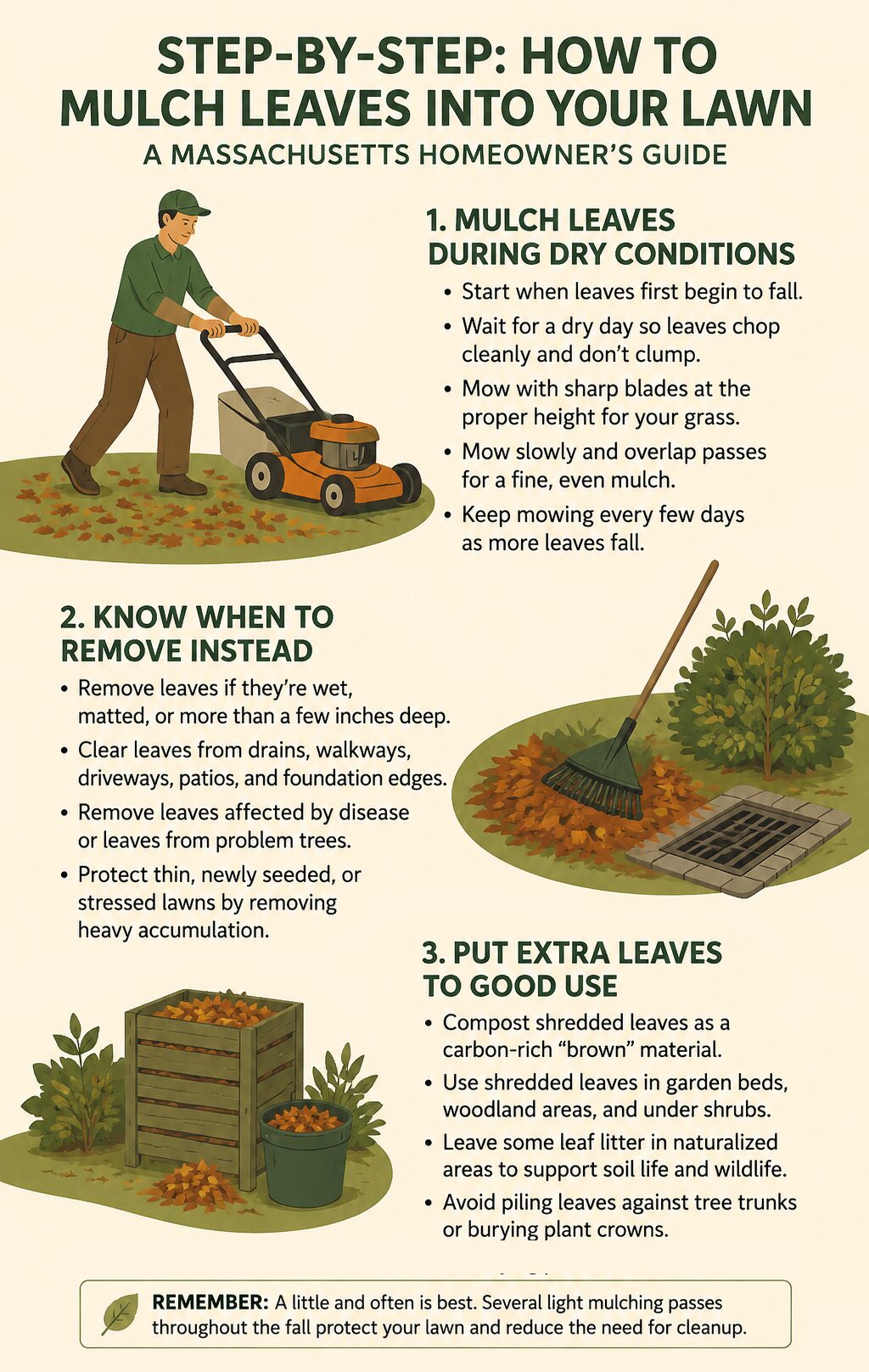
How to Mulch Leaves Properly
For many homeowners, the best approach is a series of lighter mowing visits rather than one large end-of-season effort.
- Begin before leaves become deep. Start when the first meaningful layer begins to collect.
- Choose a dry period. Dry leaves chop and distribute more evenly than wet, compressed leaves.
- Inspect the lawn first. Clear branches, stones, toys, irrigation flags, and other objects before mowing.
- Mow slowly enough for the machine to process the leaves. Heavy accumulation may require overlapping passes.
- Change direction when necessary. A second pass perpendicular to the first can reduce larger pieces and disperse rows.
- Check the finished surface. Remove excess fragments if they obscure the grass or collect in clumps.
- Keep up with continued leaf fall. Repeat before the next layer becomes thick or wet.
Blade Property Care Tip: On mature New England properties, several well-timed visits usually produce a better result than waiting until the final leaves fall. Frequent management keeps leaves lighter, drier, and easier to distribute without burying the turf.
When You Should Remove Leaves Instead
Leaf mulching is useful, but it should not become a rigid rule. There are situations where removing some or all of the leaves is the safer choice.
The Leaves Are Wet and Matted
Wet leaves tend to stick together. A mower may push them into clumps or windrows rather than cutting and distributing them evenly.
Material left in dense mats can restrict air movement and sunlight. It can also hold moisture against the turf, particularly in shaded areas where the surface dries slowly.
Allow leaves to dry when possible. If the weather remains wet and accumulation continues, removal may be more practical.
The Lawn Is Already Covered
A continuous blanket of whole leaves should not remain over turf for an extended period. UMass Extension warns that leaves left on the lawn can block sunlight, trap moisture, and contribute to thin or bare patches.
This concern is especially relevant beneath dense tree canopies, on north-facing lawns, and in enclosed properties in Newton, Brookline, Cambridge, Belmont, and other communities where buildings, fences, and mature planting can reduce light and airflow.
The Turf Is Thin, Newly Seeded, or Stressed
A strong, established lawn can generally process leaf fragments more effectively than sparse or weakened turf.
Exercise more caution when the lawn:
- Was recently seeded or overseeded
- Has significant shade-related thinning
- Experienced drought stress
- Has active disease symptoms
- Suffers from compaction or drainage problems
- Is entering winter in poor condition
Mulching leaves will not correct the underlying cause of weak turf. It may add another layer of stress if too much material remains on the surface.
The Leaves May Be Carrying a Plant Disease
Whether disease-affected leaves should be mulched, composted, or removed depends on the plant and pathogen.
Some disease-management programs recommend removing fallen material to reduce the amount of infected tissue that remains near susceptible plants. In other cases, finely chopping leaves can speed decomposition and help reduce inoculum.
Because the guidance varies, avoid applying one rule to every diseased tree or shrub. Identify the problem first and follow recommendations from a qualified horticultural professional or university extension service.
UMass Extension offers additional guidance on leaves and turf in its resource on disease management for home lawns.
Leaves Are Blocking Drainage or Creating Safety Problems
Leaves should be removed from:
- Catch basins and channel drains
- Swales and drainage paths
- Walkways, stairs, and stepping stones
- Driveways and arrival areas
- Patios and terraces
- Pool decks and equipment areas
- Window wells and foundation edges
- Street gutters and storm drains
Wet leaves on stone, brick, or wood can become slippery. Leaves blocking drainage structures can redirect water toward lawns, beds, pavement, or foundations.
On a well-maintained property, fall cleanup should address the entire drainage system, not simply the appearance of the grass.
Leaf Mulching vs. Leaf Removal
| Consideration | Leaf Mulching | Leaf Removal |
|---|---|---|
| Best use | Light to moderate dry leaf accumulation on established turf | Heavy, wet, matted, excessive, or problematic accumulation |
| Soil benefit | Returns organic material and some nutrients | Removes organic material from the lawn |
| Appearance | Clean when leaves are chopped finely and distributed evenly | Provides the most completely cleared appearance |
| Labor | Can reduce collection and hauling when performed frequently | Requires gathering, loading, and disposal or composting |
| Risk | Excess fragments can smother or mat over turf | Repeated equipment and foot traffic may compact saturated lawns |
| Best overall strategy | Use both methods selectively according to conditions and leaf volume | |
For many large or heavily wooded properties, the correct answer is not one or the other. It is a staged approach.
Early leaves may be mulched into the lawn. Later accumulation may be partly mulched and partly removed. Leaves in woodland beds may remain in selected areas, while those near entries, formal gardens, drains, and outdoor living areas are cleared.
Related Blog: Which Mulch Is Best for Your Landscape: Leaf, Bark and More
Other Productive Uses for Fallen Leaves
Leaves that cannot be absorbed by the lawn may still be useful elsewhere on the property.
Add Shredded Leaves to Compost
Dry leaves provide carbon-rich “brown” material for a compost pile. Shredding them first increases surface area and helps them break down more efficiently.
Home composting requires the right balance of dry and moist material, sufficient airflow, and appropriate moisture. Piling wet leaves by themselves often creates a compacted mass that decomposes slowly.
Use Shredded Leaves in Appropriate Garden Beds
Shredded leaves can work well in woodland gardens, beneath established shrubs, and in less formal planting areas. They help create a natural soil surface and gradually contribute organic matter.
Avoid burying plant crowns, low-growing perennials, tree root flares, or shrub stems. Whole leaves can mat over small plants and emerging bulbs, so shredding and careful placement matter.
For a broader comparison of materials used in planting beds, see our guide to leaf mulch, bark mulch, and other landscape mulches.
Retain Some Leaf Litter in Naturalized Areas
Not every part of a residential property needs the same level of cleanup.
On larger properties, selected leaf litter may remain beneath shrubs, along woodland margins, or in designated habitat areas. This approach can support soil organisms and overwintering insects while allowing lawns, entries, patios, and formal gardens to remain maintained.
The placement should be intentional. Leaves should not obstruct drainage, smother desirable groundcovers, accumulate against structures, or make the property appear neglected.
This type of selective management fits within a broader approach to sustainable landscaping, where maintenance decisions support plant health and ecological function without sacrificing the character of the property.
Common Leaf-Mulching Mistakes
Even a beneficial practice can cause problems when it is poorly timed or overdone.
Common mistakes include:
- Waiting until every leaf has fallen: Deep accumulation is harder to chop and more likely to be wet or matted.
- Mowing saturated ground: Heavy equipment can rut or compact a wet lawn.
- Leaving visible rows of fragments: Windrows indicate that the material was not distributed evenly.
- Trying to process too much at once: Excess chopped leaves can cover the turf almost as completely as whole leaves.
- Using dull mower blades: Dull blades process leaves poorly and tear the grass.
- Ignoring drainage structures: Leaves left near drains, swales, and gutters can create water-management problems.
- Assuming every part of the property should be treated the same: Lawns, perennial beds, woodland margins, patios, and foundation areas have different needs.
- Treating leaf mulch as a cure for poor soil: Compaction, nutrient imbalance, shade, irrigation problems, and poor drainage require their own solutions.
Questions to Ask Before Mulching Your Leaves
Before starting the mower, consider:
- Is the lawn established and reasonably healthy?
- Are the leaves dry enough to break apart rather than clump?
- Can I still see grass through the existing leaf layer?
- Is the ground firm enough to support mowing without rutting?
- Are any leaves showing signs of a disease that requires specific sanitation?
- Are leaves collecting in drains, low areas, or along the foundation?
- Can I repeat the process during peak leaf fall rather than waiting until the end?
- Does the property produce more leaves than the lawn can realistically absorb?
The answers may differ from one area of the property to another. A sunny front lawn may handle mulched leaves well, while a shaded side lawn requires collection. A woodland border may benefit from retained leaf litter, while a formal entry garden needs a cleaner finish.
That is why thoughtful fall property care is selective rather than uniform.
How Leaf Management Fits Into Fall Landscape Maintenance
Fall leaf work is only one part of preparing a Massachusetts property for winter.
A coordinated seasonal visit may also include:
- Final lawn mowing
- Perennial and ornamental grass care
- Selective garden-bed cleanup
- Drain and gutter clearing at the landscape level
- Removal of branches and storm debris
- Irrigation shutdown coordination
- Protection of vulnerable plants
- Late-season pruning where appropriate
- Inspection for drainage, erosion, and animal damage
- Preparation of walks, driveways, and outdoor living areas for winter
The timing of these tasks matters. Cutting back every plant too early can remove winter structure and habitat. Leaving excessive debris in formal or disease-prone areas can create other problems. Continuing to mow long after turf growth has stopped can also place unnecessary traffic on cold, wet soil.
Our landscape maintenance calendar for Boston homeowners explains how seasonal tasks fit together throughout the year.
Frequently Asked Questions About Leaf Mulching
Q: Will mulched leaves kill my lawn?
A: Finely chopped leaves applied in a manageable amount generally will not kill an established lawn. Problems occur when whole or shredded leaves form a dense layer that blocks light, airflow, and moisture movement. After mowing, the grass should remain clearly visible.
Q: Do mulched leaves cause thatch?
A: Research cited by UMass Extension found that mulching maple leaves into turf did not increase thatch. Thatch consists largely of slowly decomposing stems, roots, and other fibrous turf material, not ordinary leaf fragments that have been chopped finely.
Q: Can oak and maple leaves be mulched into a lawn?
A: Yes, both can generally be mulched when they are dry and the accumulation is manageable. Large oak leaves may require repeated passes, and a property with many mature oaks may still need substantial leaf removal late in the season.
Q: Can I mulch wet leaves?
A: It is usually better to wait for leaves to dry. Wet leaves tend to mat, clog equipment, and collect in heavy clumps. Mowing saturated soil can also create ruts and compaction.
Q: Does leaf mulching replace professional fall cleanup?
A: Not on every property. Leaf mulching can reduce the amount of material that needs to be removed, but heavily wooded properties often require additional collection, bed cleanup, drain clearing, and winter preparation. A combined approach usually produces the healthiest and cleanest result.
A More Thoughtful Approach to Fall Leaves
Mulching leaves into the lawn can be one of the simplest ways to return organic material to the soil and reduce the volume of fall debris leaving a property. It works best when leaves are dry, accumulation is moderate, the turf is healthy, and mowing occurs frequently enough to prevent a heavy layer.
It is not an all-or-nothing decision. Some leaves can support the lawn, compost, garden beds, or naturalized areas. Others should be removed because they are excessive, wet, disease-affected, obstructing drainage, or accumulating where a cleaner finish is needed.
On mature properties throughout Greater Boston, MetroWest, and Cape Cod, successful leaf management requires attention to more than the lawn. Tree canopy, shade, soil moisture, drainage, planting style, hardscape, and long-term maintenance expectations all influence the right approach.
If your property needs more coordinated seasonal care, contact the Blade team to discuss how our landscape maintenance and fine gardening services can support a healthier, more refined landscape through fall and throughout the year.