A homeowner looking for weekly mowing and a homeowner planning a pool, pergola, and new outdoor living spaces may both begin by searching for a landscaping company. The results can look surprisingly similar: attractive photographs, a list of services, and a promise to care for the property.
Yet the businesses behind those websites may offer very different expertise. Some specialize in lawn care. Others provide skilled fine gardening, install planting and stonework, or develop comprehensive plans supported by landscape architects and experienced construction teams.
Choosing a landscaping company begins with understanding those differences. The right fit depends on what your property needs, how much planning the work requires, and who will take responsibility from the first conversation through completion and ongoing care.
Key Takeaways
- Landscaping companies vary in both the range of services they offer and the depth of expertise behind them.
- Design capabilities become especially important when pools, structures, hardscape, drainage, and planting must work together.
- Evaluate relevant completed work, references, communication, insurance, and responsibility for subcontractors.
- Understand the written scope, warranty, and care arrangements before committing to a firm.
Start With What Your Property Needs
You do not need a finished plan before speaking with a landscape professional. It helps, however, to distinguish between caring for what you have, improving part of the property, and substantially changing how the landscape functions.
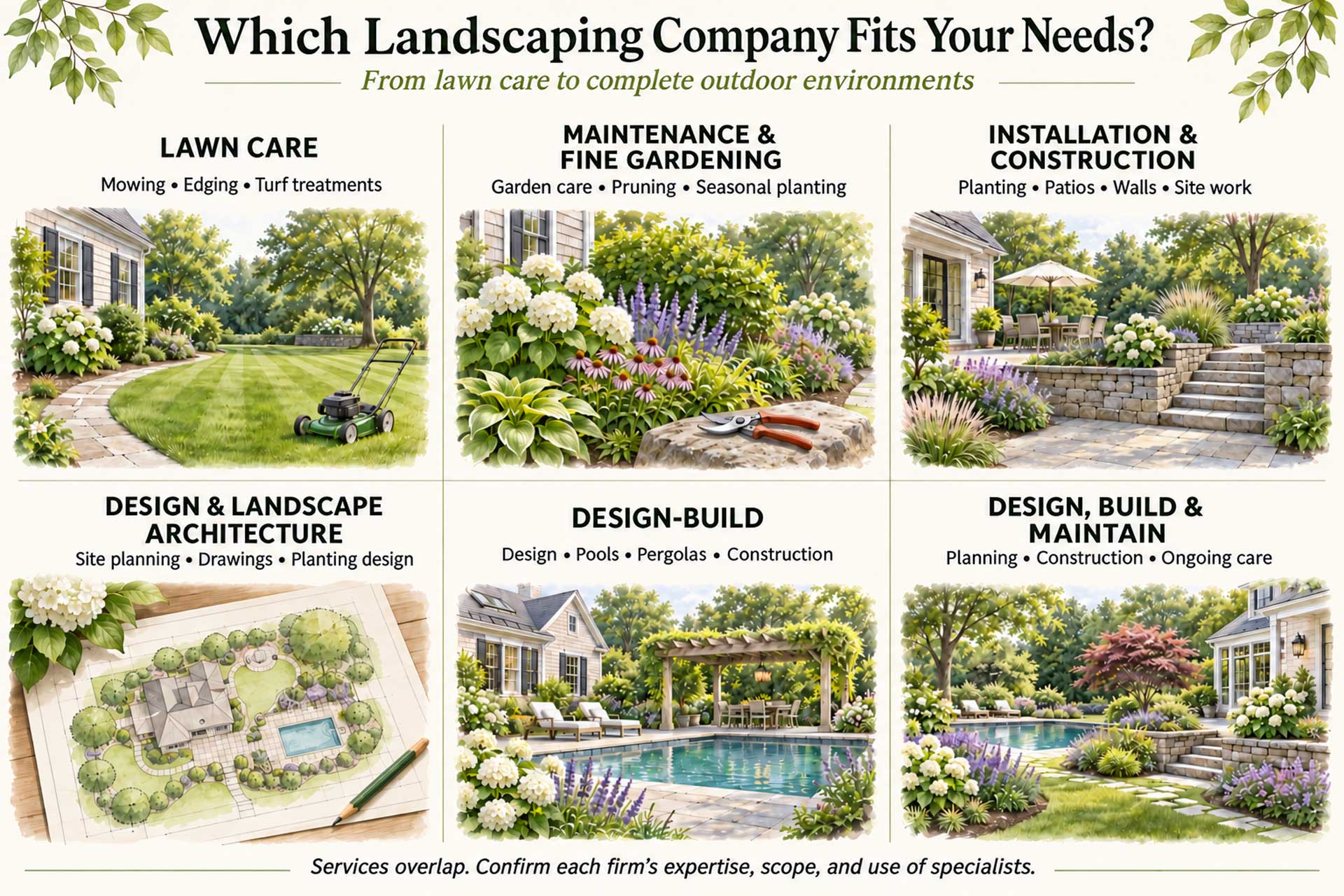
- Lawn care and routine maintenance: Mowing, edging, turf treatments, seasonal cleanups, and recurring upkeep.
- Fine gardening and landscape maintenance: Knowledgeable care of planting beds, selective pruning, seasonal displays, and attention to the development of established gardens.
- Individual design and installation projects: New planting, a patio, an entryway, retaining walls, lighting, or irrigation improvements that fit within the existing landscape.
- Major landscape design and construction: Pools, pergolas, pavilions, outdoor kitchens, terraces, substantial masonry, and projects combining several outdoor living spaces.
- Whole-property planning and phased implementation: A comprehensive design connecting the home, outdoor spaces, circulation, planting, drainage, and infrastructure, whether built together or over several years.
The boundaries are not always obvious. Replacing a small patio may be straightforward, or it may expose questions about failing steps, runoff, nearby tree roots, and access to the backyard. A pool project can affect much of the property even when the pool itself occupies a relatively modest area.
A useful first conversation should help establish the real scope. Look for a company that asks about how you use the property, what is working, what is causing difficulty, and what you may want to do later.
Understand the Different Types of Landscaping Companies
These categories overlap, and many firms work across several of them. Treat the descriptions as a starting point for questions rather than a fixed classification system.
Lawn Care Providers
Some companies focus on mowing, edging, and keeping lawn areas presentable. Others specialize in turf health, offering services such as fertilization, weed management, aeration, and overseeding. Those are different scopes, even though both may be advertised as lawn care.
A dependable provider can be an excellent fit when the property primarily needs consistent turf maintenance. Confirm whether garden beds, shrubs, irrigation checks, and seasonal work are included or handled separately.
Landscape Maintenance and Fine-Gardening Firms
Landscape maintenance can extend well beyond the lawn. It may include garden-bed care, pruning, mulching, seasonal cutbacks, and monitoring changes in the landscape.
Fine gardening generally involves closer horticultural attention: recognizing what individual plants need, pruning selectively, dividing perennials, managing seasonal displays, and maintaining the intended relationships between plants. The term is used differently by different firms, so ask what the service actually includes.
An established garden may need this level of care even when no construction is planned. A property can be consistently neat while gradually losing the plant form, balance, and seasonal character that made the original design successful.
Landscape Installation and Construction Contractors
These firms build landscape improvements. Depending on their capabilities, that may include planting, lawns, patios, walks, walls, grading, and drainage.
Some work from plans prepared by another designer or landscape architect. Others provide design assistance themselves. Ask how much planning is included and whether the company regularly completes work comparable to yours.
Construction experience also varies. A portfolio of planting installations does not establish experience with a complicated pool landscape or substantial retaining walls.
Landscape Designers and Landscape Architecture Practices
Design-focused firms develop the plan that guides the work. Their services may include site analysis, spatial planning, planting design, material selection, technical documentation, and construction observation, depending on the practice and agreement.
Landscape designers and licensed landscape architects bring overlapping but distinct qualifications. Our guide to landscape designers and landscape architects explains those differences in more detail.
With a design-only arrangement, construction is typically contracted separately. Clarify whether the design professional will help select contractors, answer questions during construction, and review how the design is being implemented.
Design-Build Firms
A design-build landscape firm combines planning and construction within a coordinated delivery process. The team developing the design can consider estimating, access, construction sequencing, and material availability as the plan takes shape.
This can be especially helpful when several parts of a project depend on one another. Pool placement, terrace elevations, retaining walls, drainage, and planting all require decisions that affect more than one trade.
The label still deserves investigation. Ask who designs the project, who builds it, and how decisions move between the office and the field. Our explanation of the landscape design-build process explores this approach further.
Integrated Design, Construction, and Maintenance Firms
Some firms extend the relationship through landscape maintenance and fine gardening after construction. Their work can encompass an initial master plan, implementation, establishment care, and ongoing stewardship.
That continuity can help preserve design intent as plants grow and the property changes. It also gives homeowners a team familiar with why particular decisions were made.
“Full service” has no consistent meaning across company websites. Confirm which services are provided, which are coordinated through specialists, and whether ongoing care is available for your property.
Specialist Providers
Arborists, pool contractors, irrigation providers, lighting specialists, and other focused businesses can bring valuable expertise. They may be hired directly for a defined need or participate in a larger project.
The important question is how their work connects to everything around it, and who manages those connections.
Look Closely at What “Design Services” Includes
Design is one of the most meaningful differences between a company that maintains or installs landscape elements and a firm equipped to plan a substantial renovation. It is also one of the least precise terms on a service list.
From a Focused Improvement to a Complete Landscape
A planting recommendation, a sketch for a new walkway, and a comprehensive property plan can all be described as design. Each can be useful, but they answer different needs.
For a focused improvement, the work might involve selecting plants suited to the site or resolving the layout of an entry garden. Comprehensive design considers the relationships across the property: how people move, where outdoor activities belong, what should be preserved, and how the landscape relates to the house.
Consider a pool with an adjoining terrace and pergola. Its success depends on more than choosing attractive individual features. The plan must account for comfortable movement, shade, privacy, equipment access, grading, drainage, utilities, and the space needed for furniture and planting.
The value lies in resolving those relationships before construction makes them difficult to change.
Understand the People and Resources Behind the Plan
Ask who will lead the design and what experience they have with comparable work. A beautiful planting portfolio and experience coordinating a major outdoor living project demonstrate different capabilities.
As complexity increases, the team may need landscape architectural expertise, surveying, civil or structural engineering, or other professional resources. A pergola or pavilion may require structural coordination; a challenging site may require more extensive grading and drainage analysis.
Clarify which professionals are on staff, which are outside consultants, and who determines the documentation and approvals needed. No single credential should be treated as a substitute for assembling the right team.
Know What You Will Receive
Ask the firm to explain its process and deliverables. Depending on the project, these might include site analysis, concept drawings, planting plans, material selections, grading information, construction details, and revisions.
A presentation rendering can help you imagine the result. Ask what additional information will guide construction, estimating, and coordination.
The Landscape Architects Technical Committee’s consumer guide, published for California homeowners, offers useful general questions about professional experience, consultants, and the services included in a design agreement.
Plan for Implementation and Future Care
A strong design process considers how the work will be built and maintained. Can equipment reach the excavation? Will a future phase require crossing a completed terrace? Will planting eventually restrict a path or obscure a view?
These questions are particularly relevant on Greater Boston properties with mature trees, older stonework, changes in grade, or limited access.
If improvements will happen over several years, the firm should be able to explain the sequence. Early decisions about utilities, access, and finished elevations can either support future work or make it more disruptive.
Match the Team to the Project’s Complexity
For a property needing regular mowing and cleanups, reliability, service consistency, and a clear maintenance scope may carry the most weight. For established gardens, look more closely at horticultural knowledge and the quality of fine-gardening work.
A defined installation may call for an experienced contractor working from a suitable plan. As more elements interact, design depth and project management become increasingly important.
For a pool and outdoor living project, ask who coordinates the pool, terraces, structures, walls, planting, utilities, and drainage. Establish who resolves conflicts between trades and who remains responsible for the overall result.
For a whole-property renovation, also consider the firm’s ability to preserve valuable existing features and organize construction around the way you live.
A full-service firm can provide continuity across these responsibilities. A separate design practice and construction team can also work well when their roles and coordination are clearly established. Evaluate the people and process behind the arrangement.
Evaluate the Company Behind the Services
Once you understand the type of firm you need, look closely at how the individual company operates.
Relevant Experience and a Proven Track Record
Ask to see work similar in scope and complexity to yours. Discuss the site conditions, challenges, and responsibilities the firm handled.
Years in business are a helpful criterion. An enduring company has a track record you can examine and time to refine its estimating, scheduling, communication, and construction processes. Consider that history alongside the experience of the people who will actually work on your property.
Reviews, Referrals, and Work You Can See
Online reviews on platforms like Houzz, Facebook and Google can often reveal patterns in communication, reliability, and follow-through. Personal recommendations add another valuable perspective, particularly when they come from homeowners whose needs resemble yours.
The Better Business Bureau can provide another perspective on a company’s history, complaints, and responses. Look beyond the rating to see whether concerns show a recurring pattern and how the company has addressed them.
Request relevant client references and ask about the experience during the work as well as the finished result. Was the scope clear? How were changes handled? Did the company respond after completion?
For a substantial project, ask whether you can visit completed work with the owner’s permission. Seeing stonework, transitions, planting, and general condition in person can reveal details that photographs miss. An older project can also show how the landscape has matured.
Insurance and Appropriate Qualifications
Request current evidence of general liability insurance and workers’ compensation coverage where applicable. For complex work, ask how coverage and professional responsibilities extend to consultants and subcontractors.
Verify relevant licenses or registrations for the professionals and trades involved, and clarify who will obtain required permits. Requirements depend on the work; a broad claim that a company is “licensed and insured” leaves important details unanswered.
The Federal Trade Commission’s contractor-selection guidance also recommends checking credentials, requesting proof of insurance, seeking trusted recommendations, and reviewing written agreements.
For work in Massachusetts requiring Home Improvement Contractor registration, the Massachusetts Contractor Hub lets homeowners check a contractor’s HIC registration and available history. Some landscaping services are exempt from HIC registration, so confirm the requirements for your particular scope of work.
Communication and Project Management
Establish who your main contact will be, how updates are provided, and who can authorize changes. For larger projects, ask who manages the daily work and coordinates design questions with the field team.
Listen to how the company explains uncertainties. Weather, site discoveries, and material availability can affect a schedule. A useful answer describes how the firm handles those conditions and keeps you informed.
Employees, Subcontractors, and Accountability
Subcontracting can bring specialized expertise to a project. Homeowners should nevertheless know which companies will participate and what each will do.
Ask the firm to identify its proposed subcontractors, explain its experience working with them, and clarify who supervises their work. Understand whether you will have one agreement or separate contracts, and who handles scheduling, corrections, and warranty questions.
Those responsibilities should remain clear if a subcontractor changes during the project.
Compare Proposals by Scope and Responsibility
A useful proposal explains what you are purchasing and what remains outside the agreement.
For maintenance, that means understanding tasks, frequency, seasonal services, and how additional work is approved. For construction, review the plans, preparation, materials, quantities, allowances, exclusions, and restoration included.
A pool proposal, for example, may cover the pool itself while leaving surrounding terraces, drainage, fencing, planting, lighting, and lawn restoration to others. A broader landscape proposal may include some or all of those elements. Comparing totals before understanding that difference can be misleading.
Also review payment terms, anticipated scheduling, and the process for approving changes. Important explanations offered during a meeting should be reflected in the written agreement.
For a closer look at what to check, our guide to comparing landscape proposals explains how to evaluate scope, specifications, allowances, and exclusions before making your decision.
Understand Warranties, Aftercare, and Ongoing Maintenance
The relationship deserves attention beyond the final installation day.
Read the Warranty Before Signing
Ask what is covered, for how long, what is excluded, and how a concern should be reported. Plant material, workmanship, equipment, and manufacturer warranties may have different terms.
Clarify who stands behind subcontracted work and whether corrective labor is included. Our guide to what a landscape warranty should cover explains these questions in more detail.
Establish the Care Arrangements
New planting needs appropriate watering and establishment care. Irrigation may need adjustment as conditions change, while gardens require ongoing attention to preserve their intended form.
Understand what the installing company provides, what belongs to you, and whether landscape maintenance and fine gardening are available afterward. If another provider will take over, ask what information will be handed off.
Company continuity matters here too. A written commitment is more useful when the business remains available to support it, making an established record one consideration in evaluating long-term service.
Questions to Bring to Your First Conversation
Use these questions to turn your research into a useful discussion:
- Have you completed work comparable to what our property needs?
- What level of design would you recommend, and who would provide it?
- Who would manage the project and communicate with us?
- Which work would your employees perform, and which subcontracting companies would participate?
- What would the proposal include, exclude, or leave for later decisions?
- Can we speak with relevant clients or see completed work?
- What insurance, warranties, and establishment care apply?
- Do you provide ongoing landscape maintenance and fine gardening?
The answers should help you understand both the company’s capabilities and what working together would feel like. A productive conversation leaves you with a clearer view of your property and the next appropriate step.
A Connected Approach to Your Property
At a Blade of Grass, we bring landscape design, construction, and ongoing property care together. Our services range from garden improvements and fine gardening to comprehensive planning and substantial outdoor living projects involving pools, pergolas, terraces, masonry, lighting, and irrigation.
Our in-house design resources and experienced construction teams allow us to consider how those elements relate before work begins. Maintenance and fine-gardening teams continue that attention as the landscape establishes and matures.
With more than three decades of experience in the Boston region, we understand the importance of connecting creative ideas with site conditions, practical execution, and long-term care. That perspective guides both a focused improvement and a complete property renovation.
If you are considering changes to your landscape or looking for more knowledgeable ongoing care, tell us about your property and what you would like it to do better. We can help clarify the scope and the services that would be appropriate.