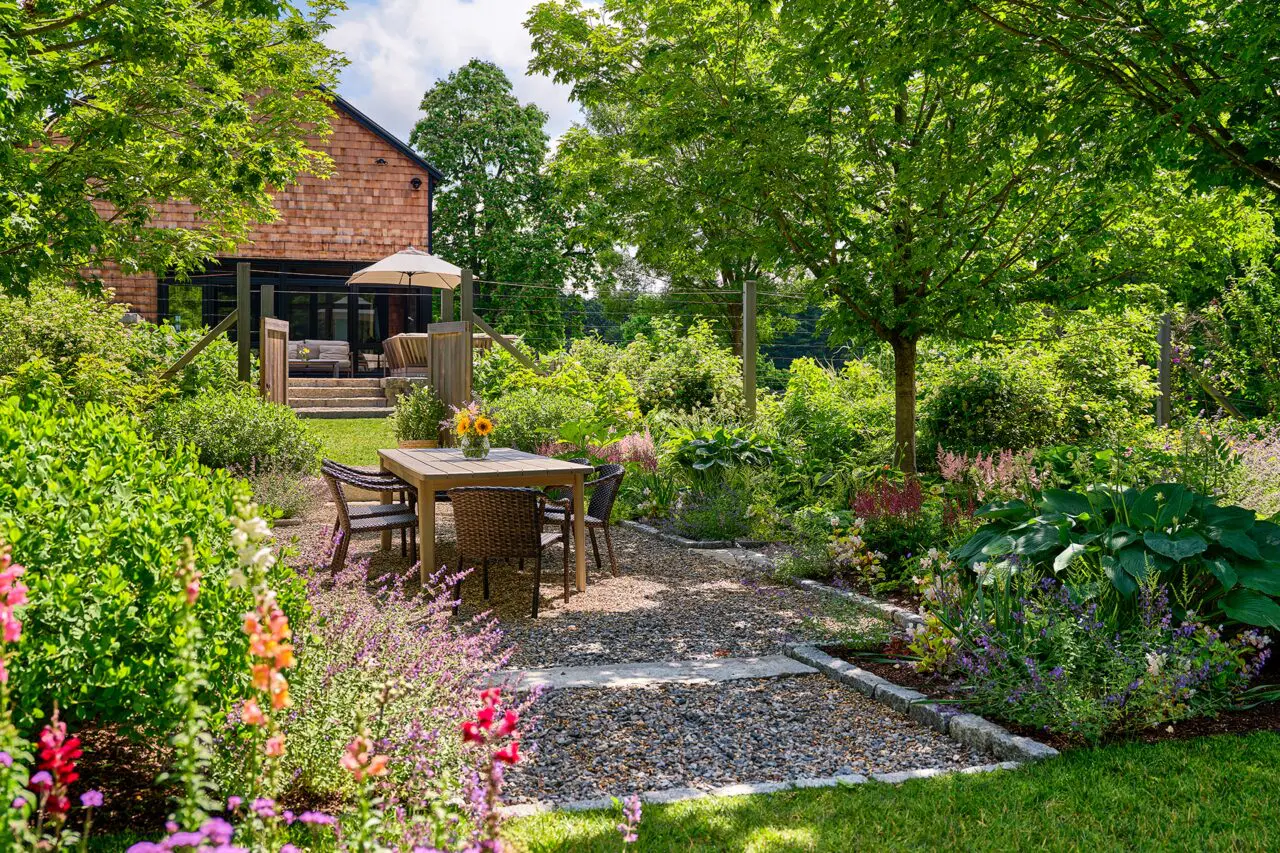
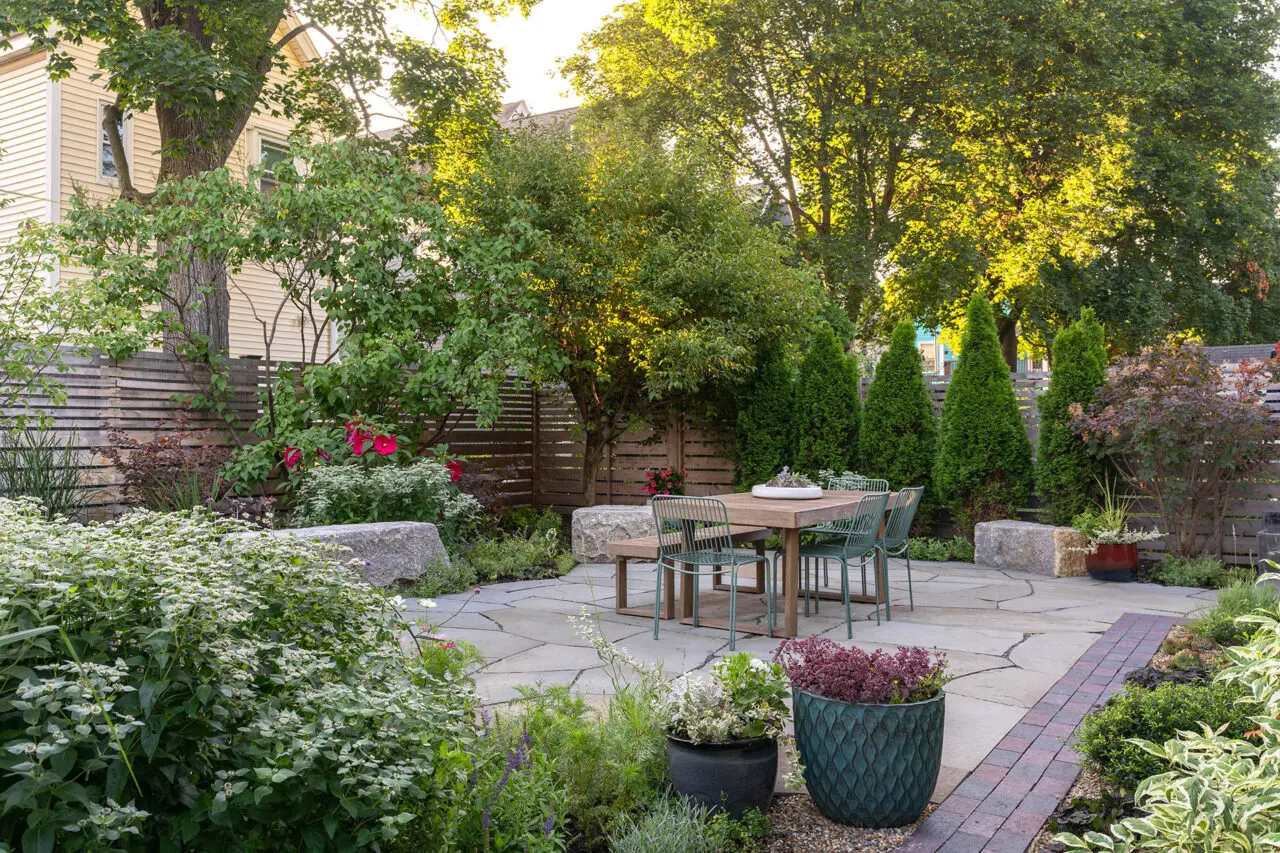
Many homeowners know their landscape is not working, but they are not always sure why.
The patio feels disconnected from the house. The front walk looks tired. Water collects in one part of the lawn. Plantings feel overgrown in some places and thin in others. A once-useful backyard no longer fits the way the family lives. The property may have good bones, but it does not feel as polished, functional, or cohesive as it should.
That is where a professional landscape assessment becomes valuable.
Before a landscape designer recommends a patio, planting plan, drainage solution, lighting system, irrigation improvement, or full-property renovation, they need to understand what is happening on the site. A strong landscape design consultation is not simply a walk around the yard. It is a careful reading of the property, including how the home sits on the land, how water moves, how people circulate, where views open or close, how plants are performing, and what long-term maintenance will realistically require.
For established properties west of Boston, across MetroWest, and along Cape Cod, this early assessment matters. Mature trees, older stonework, sloped lawns, compacted soils, shaded foundations, coastal exposure, aging irrigation, and evolving family needs can all shape the right design direction.
The National Association of Realtors and the National Association of Landscape Professionals reported that 97% of NAR members believe curb appeal is important in attracting a buyer, and that outdoor projects in their 2023 Remodeling Impact Report earned high homeowner satisfaction scores.
That does not mean every property needs a dramatic transformation. It means the right improvements should be guided by a clear understanding of the landscape as a whole.
Key Takeaways
- A landscape assessment reveals what is shaping the property before design begins.
- Designers look beyond appearance to drainage, grading, circulation, soil, planting, hardscape, lighting, and care.
- Visible problems often point to deeper site conditions.
- The right solution may be a refresh, repair, or phased master plan.
- Homeowners should prepare goals, photos, pain points, budgets, and maintenance expectations.
- The best assessment connects design, construction, and long-term property care.
- A clearer property read helps prevent costly, disconnected improvements.
Why a Landscape Assessment Comes Before Good Design
A landscape assessment is the foundation of good residential landscape design. It helps separate what homeowners notice from what is actually causing the issue.
A homeowner might say, “The backyard feels unusable.” A designer may see that the patio is too small, the grade drops awkwardly, the main door does not connect well to the outdoor space, the afternoon sun makes seating uncomfortable, and privacy is missing along one property line.
A homeowner might say, “The plants never look good.” A designer may notice compacted soil, poor drainage, too much shade, irrigation overspray, deer browsing, mature shrubs planted too close to the house, or a plant palette that no longer fits the conditions.
A good assessment asks better questions before offering answers:
- How does the property currently function?
- Where does it feel uncomfortable, unsafe, or underused?
- What conditions are causing repeated maintenance problems?
- Which features are worth preserving?
- Which improvements should happen first?
- What does the homeowner want the property to feel like in five or ten years?
This is especially important for larger properties, older homes, and landscapes that have been changed in pieces over time. Without a clear assessment, it is easy to spend money on isolated improvements that do not solve the deeper issue.
For example, replacing a wet section of lawn with new sod will not help if the root problem is poor grading. Adding privacy shrubs may not work if deer pressure, mature size, or irrigation needs are ignored. Installing a new patio may create more frustration if circulation, shade, drainage, and planting are not considered at the same time.
A professional landscape assessment helps define the right scope before the design work begins.
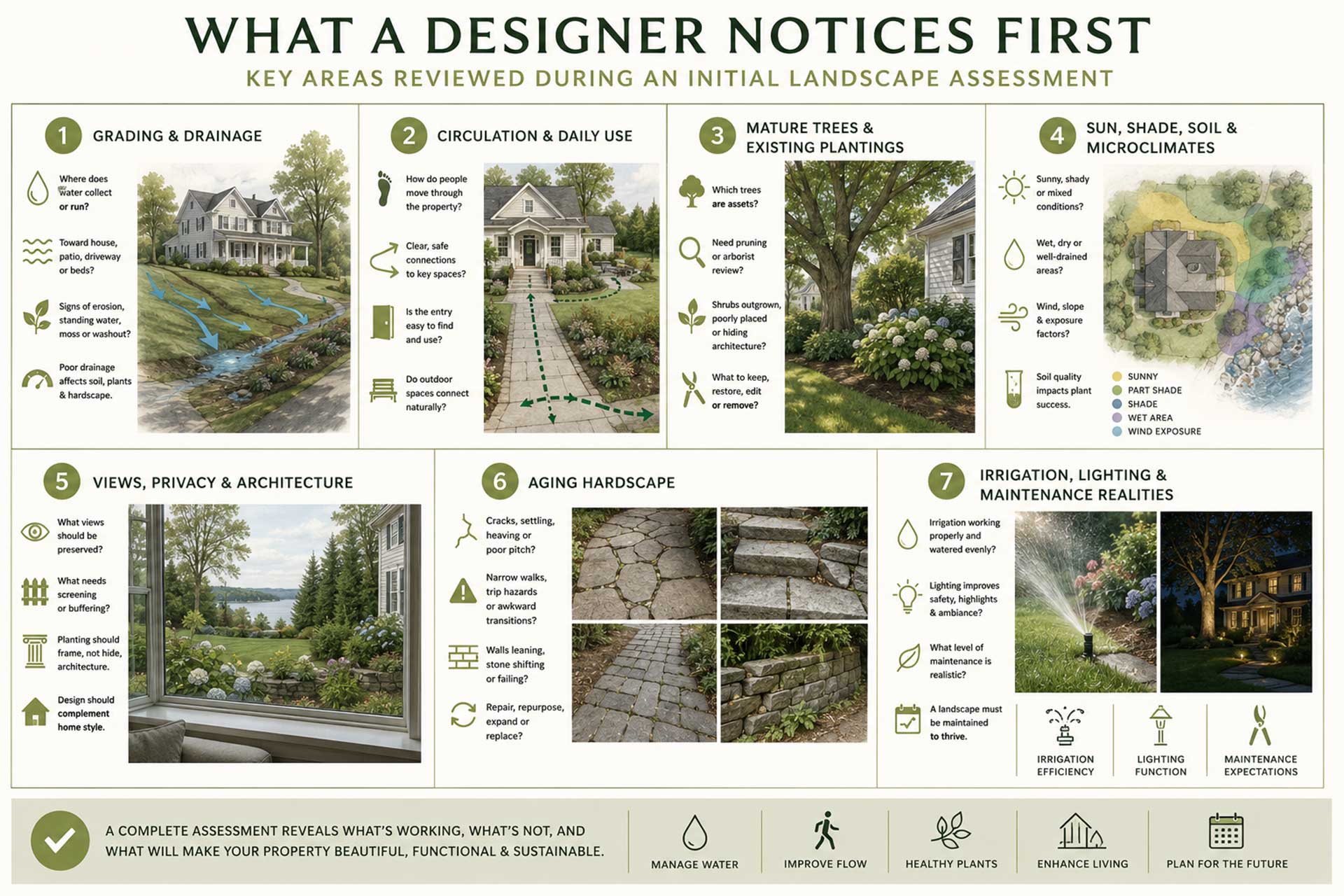
What a Designer Notices First
When a landscape designer walks a property, they are not only looking for what is attractive or unattractive. They are reading how the site works.
The strongest assessments combine creative thinking with practical observation. A designer is looking at the home, the land, the existing landscape, and the way the homeowner wants to live on the property.
1) Grading and Drainage
Water is one of the first things a designer considers. Where does it collect? Where does it move too quickly? Does water drain toward the house, across a patio, down a driveway, or into planting beds? Are there signs of erosion, moss, standing water, plant decline, or soil washout?
The U.S. Environmental Protection Agency notes that outdoor water use accounts for more than 30% of average household water use, and can be much higher in dry regions.
That statistic matters because water management is not only about drainage. It also includes irrigation, plant selection, soil health, and long-term maintenance.
For many properties in Greater Boston and MetroWest, grading and drainage issues are among the most important factors shaping the design. A beautiful planting plan cannot compensate for soil that stays too wet. A new patio will not perform well if runoff moves across it incorrectly. A lawn will continue to struggle if water sits in low areas after storms.
2) Circulation and Daily Use
Designers also look at how people move through the property.
Is the front walk easy to find? Is the driveway connected to the main entry? Are steps comfortable and safe? Does the backyard patio connect naturally to the kitchen or family room? Is there a clear route to the pool, garden, shed, guest parking, or side yard?
Circulation problems often make a property feel awkward even when individual features are attractive. A patio may be well built but rarely used because it is too far from the house. A front entry may look formal but feel inconvenient. A garden path may be charming but too narrow for daily use.
A strong landscape plan makes movement feel natural.
3) Mature Trees and Existing Plantings
Mature trees can be one of a property’s greatest assets, but they also shape what is possible. They influence shade, soil moisture, root competition, views, privacy, leaf litter, and lawn health.
A designer looks at which trees should be preserved, which may need arborist review, and how their presence affects planting and construction. Building too close to mature roots, changing grade, or adding heavy hardscape in the wrong location can damage valuable trees.
Existing shrubs and perennials also deserve careful review. Some may be healthy but poorly placed. Others may have outgrown their role. A mature hedge may provide useful privacy but need better pruning. Foundation shrubs may be hiding the architecture. Perennials may need editing rather than replacement.
A thoughtful assessment does not assume everything must go. It identifies what is worth keeping, what should be restored, and what no longer serves the property.
4) Sun, Shade, Soil, and Microclimates
The same property can contain several different growing conditions. A sunny front slope, a shaded side yard, a damp low area, a windy coastal exposure, and a dry bed under mature trees may all require different plant strategies.
UMass Extension emphasizes research-based horticultural practices for landscape management, plant health, and environmental stewardship.
In practical terms, that means a good landscape designer should not choose plants based only on appearance. They should consider soil, light, moisture, exposure, deer pressure, mature size, and how the planting will be maintained.
This is where soil testing before planting can be valuable, especially before major planting investments.
5) Views, Privacy, and Architecture
A designer also studies what should be seen and what should be screened.
Views from inside the home are especially important. A kitchen window may look directly at an unattractive fence. A family room may have a beautiful view that should be preserved. A primary bedroom may need screening from a neighboring house. A front entry may need planting that frames the architecture without hiding it.
Privacy is not only about installing a row of evergreens. It may require layered planting, fencing, walls, grade changes, tree placement, or a shift in how outdoor spaces are arranged.
The architecture of the home also matters. A Colonial, Tudor, contemporary, farmhouse, shingle-style, estate, or coastal home should not receive a generic landscape treatment. The landscape should support the home’s scale, materials, and character.
6) Aging Hardscape
Patios, walls, steps, walkways, and driveways often reveal how a property is aging.
A designer will look for cracks, settling, heaving, poor pitch, narrow widths, awkward transitions, failing walls, trip hazards, and materials that no longer fit the house. They will also consider whether existing hardscape can be reused, repaired, expanded, or should be replaced.
The right answer is not always new construction. Sometimes a front walk can be widened, a terrace can be re-edged, a wall can be repaired, or a material transition can be simplified.
For homeowners considering new stonework, patios, steps, or walls, see our guidance on choosing stone and hardscape materials for New England landscapes.
Ask an Expert: Why Is My Stone Patio Uneven After Winter, and Can It Be Repaired?
7) Irrigation, Lighting, and Maintenance Realities
A designer also considers the systems that keep a landscape performing after installation.
Is there an irrigation system? Does it work properly? Are planting beds and lawn areas on the same zones? Is there overspray on patios, walks, or the foundation? Are some areas too wet while others are dry?
Is there landscape lighting? Does it improve safety? Does it highlight the architecture and trees appropriately? Are fixtures blocked by overgrown plants? Is the lighting too bright, too sparse, or poorly aimed?
What level of property maintenance is realistic? A highly detailed perennial garden may be beautiful, but it requires a different care plan than a simple evergreen structure with ground covers and seasonal containers.
A design that ignores maintenance expectations is not truly finished.
The Difference Between Symptoms and Root Causes
One of the most valuable parts of a landscape assessment is distinguishing symptoms from root causes.
A symptom is what the homeowner sees. A root cause is what creates the problem.
Wet Lawn
A wet lawn may look like a turf problem. The homeowner may think the solution is new grass, more seed, or better lawn care.
But the root cause may be poor grading, compacted soil, a low spot, downspout discharge, irrigation overspray, shade, or subsurface drainage issues. If the cause is not addressed, the lawn will continue to struggle.
In that case, the right solution may involve drainage and grading, soil improvement, a different planting strategy, or a change in how the area is used.
Failing Plants
Failing plants can be caused by many factors: too much water, too little water, poor soil, deer browsing, salt exposure, root competition, incorrect plant selection, or improper planting depth.
Replacing plants without understanding why they failed is often a short-term fix.
A landscape designer looks for patterns. Are plants failing near a downspout? Along a driveway? Under mature trees? In full winter wind? Near irrigation heads? Those details help determine whether the solution is plant replacement, soil work, irrigation adjustment, drainage improvement, or a broader planting redesign.
Cracked Walkway
A cracked walkway may seem like a surface issue. But the cause may be freeze-thaw movement, poor base preparation, tree roots, drainage, settling, or the wrong material for the location.
If the walkway is also too narrow, poorly lit, or misaligned with the entry, simply replacing the surface may miss an opportunity to improve the arrival experience.
A strong assessment asks whether the walkway should be repaired, rebuilt, widened, rerouted, or integrated into a broader front entry design.
Overgrown Foundation Planting
Overgrown foundation planting is common on established suburban properties. Shrubs planted decades ago may now block windows, hide architectural details, crowd walkways, or create dark, heavy beds near the house.
The symptom is overgrowth. The root cause may be plants that were never sized appropriately for the location.
The solution may include selective pruning, transplanting, removal, replacement with better-scaled plants, or a full front foundation redesign.
Unusable Patio
An unusable patio may not be a patio problem. It may be too exposed to sun, too small for furniture, too far from the kitchen, too close to neighbors, poorly screened, poorly lit, or disconnected from the rest of the yard.
The right solution may involve shade, planting, seat walls, lighting, circulation changes, privacy screening, or an expanded terrace.
This is why patios and outdoor living spaces should be assessed as part of the whole property, not as isolated features.
Poor Privacy
Poor privacy is often treated as a planting problem. Homeowners may ask for a hedge, fence, or row of evergreens.
Sometimes that is appropriate. But privacy depends on sightlines, elevation, window placement, neighboring decks, property lines, and where people actually spend time outdoors.
A designer may solve privacy with layered planting, a fence, a wall, a pergola, canopy trees, grade changes, or by relocating the seating area.
How Site Conditions Shape the Design Plan
Once the assessment is complete, site conditions begin shaping the design plan.
This is where a landscape design consultation becomes more than a list of ideas. It becomes a strategy.
Planting Design
Planting design should respond to site conditions and architecture. A shaded property with mature trees may call for woodland-edge planting, ground covers, shade-tolerant shrubs, and selective lawn reduction. A sunny estate property may support larger planting masses, ornamental grasses, meadow-inspired areas, or layered privacy screening.
Planting should also account for mature size, maintenance, deer pressure, irrigation, and seasonal interest.
A good planting plan does not only ask, “What looks good?” It asks, “What will thrive here, and how will it look as it matures?”
Hardscape Design
Hardscape creates the framework for how people use the property. Patios, terraces, steps, walls, walkways, driveways, pool decks, and outdoor kitchens must fit the grade, architecture, and circulation patterns.
A designer will consider where hardscape belongs, how large it should be, what materials fit the home, and how it will drain. They will also think about construction access and whether future phases need to be planned before the first stone is set.
Learn more about our landscape construction approach.
Lighting
Lighting should be planned early, not added as an afterthought. It affects safety, evening use, curb appeal, architecture, trees, paths, steps, and outdoor entertaining.
A lighting plan should consider views from inside the home as well as views from outdoors. Poorly placed lights can create glare, while thoughtful lighting can make a property feel calm, usable, and complete.
Explore landscape lighting as part of a complete property plan.
Irrigation
Irrigation should be designed around plant needs, exposure, soil, and maintenance expectations. New plantings need more attentive watering than established landscapes, but overwatering can be just as harmful as underwatering.
Drip irrigation may be useful in planting beds, while lawn zones require different coverage. Smart controllers can help, but they still need seasonal adjustment and oversight.
Drainage
Drainage influences almost every other landscape decision. It affects lawn health, plant survival, patio performance, winter safety, soil stability, and foundation-adjacent areas.
In many cases, drainage work should happen before planting or hardscape improvements. Otherwise, new investments may be compromised by the same water problems that affected the old landscape.
Phasing
Not every property needs to be completed at once. For larger residential properties, a phased approach can be a smart way to coordinate budget, timing, permitting, construction access, and seasonal planting windows.
The key is to phase the work without losing the larger vision. A landscape master plan can help homeowners improve the property over time while avoiding rework.
Related Blog: Popular Landscape Design Projects Homeowners Request Most
When a Simple Refresh Is Enough and When a Master Plan Is Smarter
Not every landscape problem requires a full redesign. A good assessment should help homeowners understand the right level of intervention.
Sometimes a simple refresh is enough. This may include editing overgrown plantings, improving seasonal color, adding mulch, replacing tired shrubs, updating containers, adjusting lighting, or refreshing a front entry bed.
A simple refresh may be appropriate when:
- the overall layout works well
- drainage is not a major issue
- hardscape is structurally sound
- the main problem is plant age, scale, or seasonal interest
- the homeowner wants improvement without major construction
A master plan is usually smarter when the property has several connected issues.
A master plan may be appropriate when:
- the front entry, backyard, planting, drainage, lighting, and circulation all need attention
- the homeowner is planning a pool, patio, outdoor kitchen, or major addition
- there are grade changes, drainage issues, or failing hardscape
- the property will be improved in phases
- the homeowner wants a long-term vision before investing
- maintenance expectations need to be built into the design
The point of a master plan is not to make the project larger than it needs to be. It is to make sure each improvement supports the next.
Related Blog: Why the Best Properties Are Designed in Phases
What Homeowners Should Prepare Before a Consultation
A landscape design consultation is most productive when homeowners arrive with context. You do not need to have all the answers. In fact, the purpose of the consultation is often to clarify what the answers should be.
Still, a little preparation can help the designer understand the property faster.
Helpful items include:
- A property survey: This helps with boundaries, structures, setbacks, driveways, existing features, and possible planning constraints.
- A wish list: Include everything you are considering, even if you are not sure what is realistic.
- Photos: Share images of problem areas, views from inside the home, seasonal conditions, and landscapes you like.
- Pain points: Identify what bothers you most, such as privacy, drainage, unusable space, overgrowth, poor lighting, or maintenance.
- Budget range: A realistic range helps the design team recommend the right scope and phasing strategy.
- Maintenance expectations: Be honest about how much care you want the property to require.
- Long-term goals: Consider how you want to use the property in the next five to ten years.
It is also helpful to think about how you live outdoors. Do you entertain often? Do you want a quiet garden? Do children or pets use the yard? Do you need privacy from neighbors? Are you planning renovations to the house? Do you want the property to feel more formal, relaxed, natural, or contemporary?
The more clearly a designer understands your goals, the more useful the assessment will be.
Why the Best Assessment Includes Design, Construction, and Maintenance Thinking
A landscape assessment should not look only at what can be designed. It should also consider what can be built well and maintained over time.
This is where an integrated design, construction, and maintenance perspective is especially valuable.
A designer may imagine a beautiful planting plan, but the construction team must understand grading, access, drainage, walls, steps, base preparation, utilities, and sequencing. The maintenance team must understand pruning, plant health, seasonal care, irrigation adjustments, and how the landscape will mature.
The American Society of Landscape Architects describes landscape architects as professionals who lead the planning, design, and stewardship of built and natural environments.
That idea of stewardship is important for residential properties. A landscape is not finished on installation day. Plants grow. Stone settles. Lighting needs adjustment. Irrigation needs seasonal tuning. Shrubs need pruning. Trees mature. Homeowners’ needs change.
A strong assessment should account for that future.
For a Blade of Grass, the goal is not simply to make a property look better for one season. It is to create a landscape that can be built thoughtfully, cared for properly, and enjoyed for years.
Frequently Asked Questions
Q: What is a landscape assessment?
A: A landscape assessment is a professional review of a property’s existing conditions, including grading, drainage, planting, hardscape, circulation, lighting, irrigation, privacy, architecture, and maintenance needs. It helps identify what should happen before design recommendations are made.
Q: How is a landscape assessment different from a landscape design consultation?
A: A landscape design consultation often includes assessment as part of the process. The assessment focuses on understanding the property, while the consultation also discusses goals, priorities, possible solutions, budget, and next steps.
Q: When should homeowners schedule a landscape assessment?
A: Homeowners should consider an assessment when the landscape feels disconnected, drainage problems appear, plantings are failing, hardscape is aging, privacy is lacking, or several improvements are being considered at once.
Q: Does every property need a full landscape master plan?
A: No. Some properties only need a targeted refresh or specific repair. A master plan is most useful when several areas of the property are connected or when improvements will happen in phases.
Q: Can a landscape assessment help with drainage problems?
A: Yes. Drainage is one of the most important conditions to evaluate. A designer can identify visible signs of poor water movement and recommend whether grading, drainage improvements, soil work, planting changes, or hardscape adjustments should be considered.
Q: Should I know my budget before the consultation?
A: You do not need an exact number, but a realistic budget range is very helpful. It allows the design team to recommend an appropriate scope, discuss priorities, and suggest phasing if needed.
Q: What should I bring to a landscape design consultation?
A: Helpful materials include a property survey, photos, a wish list, notes about pain points, inspiration images, budget range, maintenance expectations, and any long-term plans for the home or property.
Start With a Clearer Read of Your Property
A successful landscape project starts with understanding what is already there.
Before choosing plants, stone, lighting, irrigation, or construction details, it helps to know how the property works. Where does water move? Which views matter? What is worth preserving? What is causing repeated maintenance problems? Which improvements should happen first?
For homeowners in established communities west of Boston, across MetroWest, and along Cape Cod, a thoughtful landscape assessment can turn uncertainty into a clear plan. It can reveal whether the property needs a simple refresh, targeted drainage work, improved planting, updated hardscape, better lighting, a phased master plan, or long-term maintenance support.
At a Blade of Grass, our team brings design, construction, and property care together so every recommendation is grounded in how the landscape will be built, used, and maintained.
Contact us today to schedule a landscape design consultation and start with a clearer read of your property.